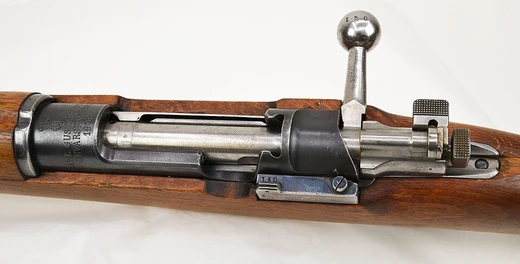
M1903 Springfield
Last updated
It was first used in combat during the Philippine-American War.[1] On 19 June 1903, the United States officially adopted the M1903 Springfield as its standard infantry rifle, and it first saw combat during the Philippine-American War.[1]
How it changed
The M1903 used a Mauser-derived bolt-action design with a charger-loaded box magazine.[2] The barrel was shortened to 24 inches, eliminating the need for separate rifle and carbine models.[3][4] The US government paid $250,000 in royalties to Mauser Werke after a patent infringement suit.[5] During World War II, Remington and Smith-Corona produced new M1903s, and the M1903A3 variant used stamped parts.[6][3]
The M1903A4 sniper variant used a Weaver 2.75x scope and served in every theater.[7] The Krag's magazine was slow to load, and it could not manage the higher chamber pressures needed for high-velocity ammunition.[2]
What the maker and period sources say
A 2020 American Rifleman article states the Springfield Armory began working on a new bolt-action rifle at the turn of the century, incorporating many Mauser features.[8] The same article notes the US government paid Mauser some $3 million for patent infringement.[8] A 2017 Shooting Illustrated article reports the M1903 was approved on June 20, 1903, weighed 8½ pounds, and had a 24-inch barrel.[9] Lyon’s study gives an overall failure rate of 4.13 per 100,000 for Springfield Armory receivers and 7.71 per 100,000 for Rock Island receivers.[10]
A 2021 Armory Life article notes the M1903A3’s effective range remained about 1,000 yards with the.30-06 cartridge.[11]
References
- Wikipedia, "M1903 Springfield" (CC BY-SA 4.0), which cites: Thompson 2013, p. 38 (original not read by us) en.wikipedia.org
- Wikipedia, "M1903 Springfield" (CC BY-SA 4.0), which cites: Campbell, "The M1903 Springfield: A Look Back", American Rifleman, 6 May 2020 (we also read that source) en.wikipedia.org
- Wikipedia, "M1903 Springfield" (CC BY-SA 4.0) en.wikipedia.org
- Wikipedia, "M1903 Springfield" (CC BY-SA 4.0), which cites: Canfield, "100 Years Of The '03 Springfield", American Rifleman, 2003, p. 42–45&78 (original not read by us) en.wikipedia.org
- Wikipedia, "M1903 Springfield" (CC BY-SA 4.0), which cites: Sheehan, "Battlefield tack driver: the model 1903 Springfield in WWI", Guns Magazine, 1 October 2006 (original not read by us) en.wikipedia.org
- Wikipedia, "M1903 Springfield" (CC BY-SA 4.0), which cites: Canfield, "Wartime Remington M1903s?", American Rifleman, 2015, p. 44 (original not read by us) en.wikipedia.org
- Wikipedia, "M1903 Springfield" (CC BY-SA 4.0), which cites: George, John (Lt. Col.), Shots Fired In Anger, NRA Press (1981), p. 392 (original not read by us) en.wikipedia.org
- Campbell, "The M1903 Springfield: A Look Back", American Rifleman, 6 May 2020. facts only, no text reused. americanrifleman.org
- Hacker, "The History of the 1903 Springfield Rifle", Shooting Illustrated, 6 April 2017. facts only, no text reused. shootingillustrated.com
- Lyon, Joseph: Some Observations On The Failure Of U.S. Model 1903 Rifle Receivers. facts only, no text reused. m1903.com
- Laemlein, "A Second-Generation Springfield — The M1903A3", The Armory Life, 30 November 2021. facts only, no text reused. thearmorylife.com
Each numbered sentence above was checked against the source it cites before publication. Sentences citing Wikipedia adapt text from the English Wikipedia article M1903 Springfield (contributors), used under CC BY-SA 4.0; this entry is available under the same licence. Other sources were used for facts only; no text or images are copied from them.
More in Bolt-Action Rifles
Sources
Compiled from Wikipedia and the sources listed below. Text from Wikipedia is available under CC BY-SA 4.0; this entry is adapted from it.
- Wikipedia: M1903 Springfield (CC BY-SA 4.0).
- Word definitions: the Codexery glossary, each quoted from its Wikipedia article.
Spotted an error? Know more?
Reader corrections go straight into our review queue. Suggest an edit · How this site is sourced