
Frank Bresee
Radio actor, historian, and creator of the board game Pass-Out.

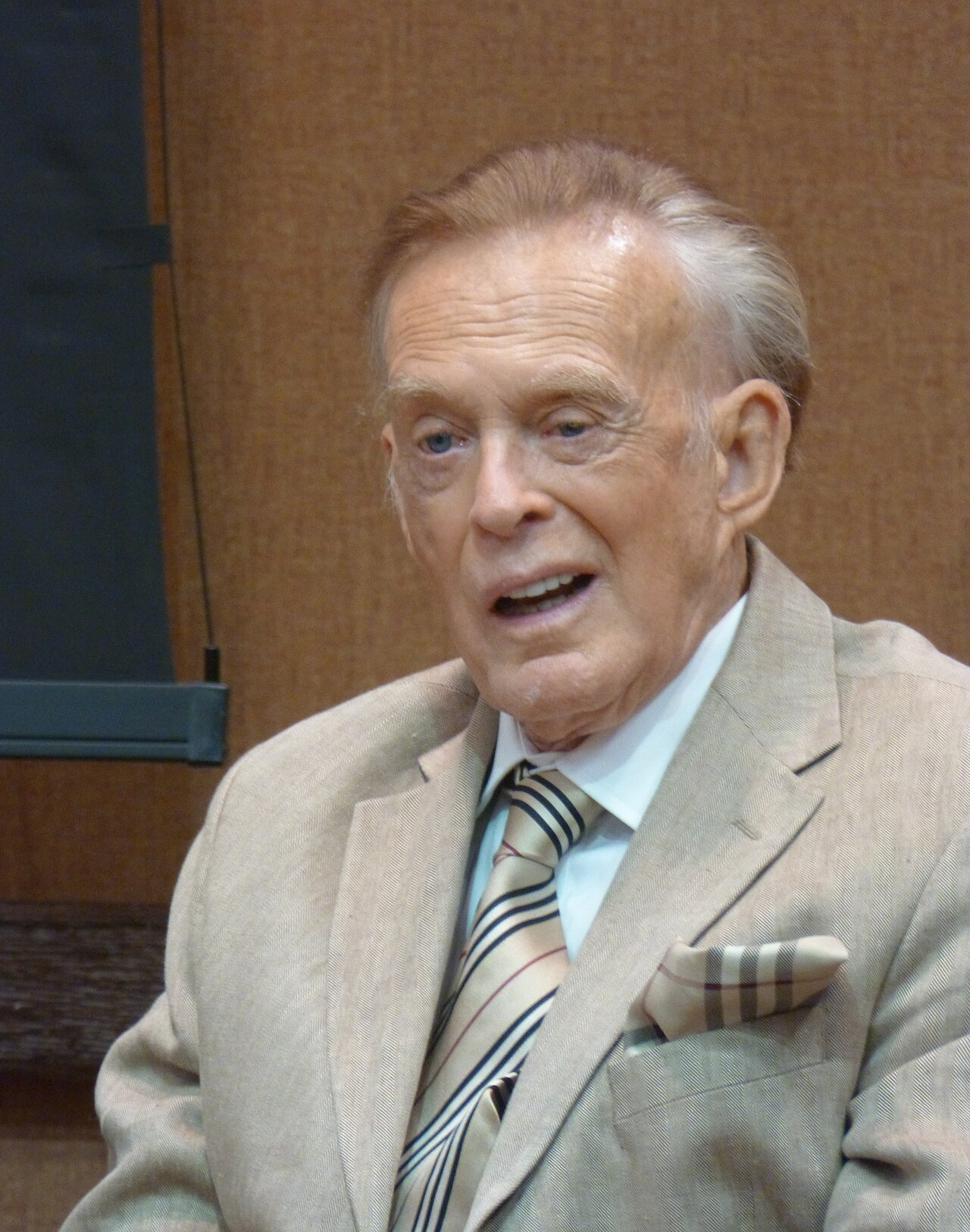
Gazebo · CC BY-SA 3.0
Frank Bresee (August 20, 1929 – June 5, 2018) worked as a radio actor, a radio historian, and a designer of board games. He is remembered for two main achievements: hosting the program *Golden Days Of Radio* and creating the board game *Pass-Out*.
Bresee was born in Los Angeles. When he was ten, a school trip to the KFAC studios sparked his ambition to work in radio. In 1942, he stepped in as "Little Beaver" on *Red Ryder* while the regular actor was away filming, and that same year he played Alvin on *The Hopalong Cassidy Show*, a program that featured Arthur Q. Bryan and Mel Blanc.
He attended hundreds of live radio broadcasts and collected scripts, transcription discs, and other memorabilia; his archive of 3,900 tape reels now resides at the Thousand Oaks Library in Southern California. In August 1949, he launched *Golden Days Of Radio* on CBS affiliate KNX, playing old transcription discs. He also frequently substituted for late-night DJ Johnny Grant. In 1950, he began working as an assistant on Bob Hope’s NBC radio show. Later, he hosted programs on Bill Bragg’s internet station *Yesterday USA*.
His most lasting cultural impact, however, is *Pass-Out*, a board game first sold in 1962. A 2016 article described it as “essentially Monopoly with booze.” The game grew very popular in the late 1960s and 1970s and is still sold in many countries, though its U.S. retail presence is now mostly on Amazon. Bresee created over a dozen other adult-oriented games, but none matched *Pass-Out*’s success. In that same 2016 story, his wife Bobbie—a former Playboy Bunny—said the game “bought this house, it bought a house in Hancock Park, two Rolls-Royces, dozens of trips to Europe and all my opera dresses.”
Bresee died on June 5, 2018, at age 88.
Quick Facts
- Birth Date
- 1929-08-20
- Birth Place
- Los Angeles, California
- Death Date
- 2018-06-05
- Occupation
- Radio actor and historian, board game designer
Facts from the source article.
Lore & Background
Frank Bresee was born August 20, 1929, in Los Angeles. At age 10, a school field trip to the studios of classical music station KFAC inspired him to pursue radio. In 1942, he began appearing as 'Little Beaver' on the Red Ryder radio program when the regular actor, Tommy Cook, was away working on motion pictures. That same year, he played Alvin on The Hopalong Cassidy Show, which also starred Arthur Q. Bryan and Mel Blanc. Bresee attended hundreds of radio broadcasts and collected scripts, transcription discs, and other memorabilia; his tape archives of 3,900 reels are held at the Thousand Oaks Library in Southern California. In August 1949, he launched 'Golden Days Of Radio' at CBS' Los Angeles affiliate station KNX, playing transcription discs of old programs. The program later aired on the Armed Forces Radio Network from 1967 to 1995. He also often filled in for late-night disc jockey and 'Honorary Mayor Of Hollywood' Johnny Grant, and in 1950 began working as an assistant on Bob Hope's weekly NBC radio show. Bresee also hosted programs on the 'Yesterday USA' internet radio station run by Bill Bragg, the former voice of State Fair of Texas mascot Big Tex.
Reader's Guide
Frank Bresee's significance lies in his dual legacy as a radio historian and a board game designer. His program 'Golden Days Of Radio', which began in 1949 and aired on the Armed Forces Radio Network for nearly three decades, preserved and shared classic radio broadcasts with a wide audience. His personal archive of 3,900 reels of tape, now held at the Thousand Oaks Library, represents a substantial resource for radio history. However, his most lasting cultural impact came from the board game Pass-Out, first sold in 1962. Described in a 2016 story as 'essentially Monopoly with booze', the game became very popular in the late 1960s and 1970s and is still sold today in many countries, though its U.S. retail presence is now mainly limited to Amazon. While Bresee created more than a dozen other adult-oriented board games, Pass-Out was by far the most successful. His wife Bobbie, a former Playboy Bunny, noted in that same 2016 story that the game 'bought this house [in Hollywood], it bought a house in Hancock Park, two Rolls-Royces, dozens of trips to Europe and all my opera dresses.' Bresee died June 5, 2018, at age 88.
Did You Know?
- Bresee began appearing as 'Little Beaver' on the Red Ryder radio program in 1942 when the regular actor was away working on motion pictures.
- He hosted 'Golden Days Of Radio' on the Armed Forces Radio Network from 1967 to 1995.
- The board game Pass-Out was first sold in 1962 and is still sold today in many countries.
A Creative Life in Three Dimensions
Frank Bresee (1929–2018) carved out a remarkably varied creative life in America, working across three distinct fields: radio acting, radio history, and board game design. Rather than confining himself to a single discipline, he moved fluidly between performance, scholarship, and design, suggesting a mind that found expression in multiple media. Born in 1929, he entered the world at a time when radio was still a dominant storytelling medium, and he spent his professional life both participating in that tradition and documenting it. His work as an actor placed him on the other side of the microphone from the audience, while his historical work positioned him as a keeper of the medium's legacy. The addition of board game design to his résumé reveals a further creative impulse toward structured play and interactive entertainment. Across all three roles, Bresee demonstrated a commitment to storytelling and audience engagement, whether through voice, written scholarship, or the tactile mechanics of a tabletop game. His nearly nine decades of life gave him ample time to develop and refine each of these crafts.
Voice and Performance in the Radio Tradition
As an American radio actor, Frank Bresee dedicated a portion of his career to the art of performing for an audio-only audience. Radio acting demands a particular set of skills: the ability to convey emotion, character, and narrative entirely through the human voice, without the aid of visual cues, set design, or physical gesture. Bresee's work in this medium placed him within the broader American tradition of radio drama and spoken storytelling, a tradition that shaped how millions of listeners experienced narrative before television became the dominant home entertainment form. His decision to act in radio rather than pursue other performance avenues suggests a particular affinity for the intimacy and imagination that the medium requires of both performer and listener. As a radio actor, he was a storyteller whose primary instrument was his voice and whose stage was the listener's mind. His contributions to this craft, made over the course of his working life in the twentieth and early twenty-first centuries, added to the rich tapestry of American radio performance.
Documenting the Airwaves: The Radio Historian
Beyond his work as a performer, Frank Bresee also devoted himself to the study and documentation of radio as a historical medium. As a radio historian, he turned his attention to the past of the very industry in which he had performed, seeking to preserve, analyze, and share the story of how radio shaped American culture. This dual role—actor and historian—gave him a unique vantage point: he understood radio not only from the inside, as a practitioner who had stood before a microphone, but also from the outside, as a scholar examining the medium's development, its key figures, and its cultural impact. His historical work contributed to the broader effort of ensuring that the stories told over the airwaves, and the people who told them, would not be lost to time. In an era when newer media rapidly displaced older ones, Bresee's work as a radio historian served as a form of cultural preservation, anchoring the legacy of a medium that had once been the primary window through which Americans experienced shared narrative and entertainment.
Beyond the Microphone: The Board Game Designer
Perhaps the most unexpected facet of Frank Bresee's creative output was his work as a board game designer. This role required a different kind of thinking than acting or historical writing: it demanded an understanding of rules, player interaction, strategy, and the satisfaction of structured play. As a board game designer, Bresee created systems that invited participants to engage with one another in a shared physical space, crafting experiences that balanced challenge, chance, and cooperation. This creative pursuit complemented his other work in an interesting way—where radio acting was a one-to-many performance and historical writing was a solitary scholarly endeavor, board game design was inherently interactive and social, built around the experience of multiple players navigating a shared set of rules. For an American creative who had spent much of his life working with audio and text, the tactile, spatial, and strategic dimensions of tabletop game design offered a refreshing change of medium. It speaks to a versatile mind that found storytelling and engagement possible in virtually any format, from the spoken word to the arranged pieces on a game board.
Gallery
Frequently Asked Questions
Who is Frank Bresee?
Frank Bresee was a Los Angeles–born figure who worked across three fields: performing as a radio actor, chronicling radio history, and designing board games. He is best remembered for hosting the program *Golden Days of Radio* and for inventing the tabletop game *Pass-Out*.
What board game did Frank Bresee design?
Bresee created *Pass-Out*, a board game that became his signature contribution to the hobby. It is the title most often associated with his name in the board-game community.
How did Frank Bresee first get into radio?
A school field trip to the KFAC studios when he was ten ignited his desire to work in broadcasting. By 1942, at just thirteen, he had already filled in as "Little Beaver" on *Red Ryder* and voiced Alvin on *The Hopalong Cassidy Show* alongside Arthur Q. Bryan and Mel Blanc.
What was *Golden Days of Radio*?
It was a program that Bresee hosted, in which he revisited and celebrated classic radio dramas and comedy shows from the medium's golden era. The show became one of his two most recognized achievements alongside his board-game work.
When did Frank Bresee die?
Frank Bresee passed away on June 5, 2018, at the age of 88. His legacy endures through both his radio-historical programming and the board game *Pass-Out*.
More in Board game designers 1-24
Spotted an error? Know more?
Reader corrections go straight into our review queue. Suggest an edit · How this site is sourced