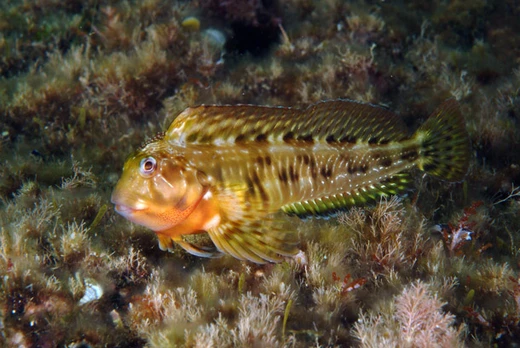
Opistognathidae
Jawfishes are burrow-dwelling mouthbrooders with large heads and eyes.

Jawfishes, known scientifically as Opistognathidae, belong to the order Blenniiformes and include roughly 80 species. They live in warmer waters of the Atlantic, Pacific, and Indian Oceans, ranging from shallow areas down to a few hundred meters deep. Their taxonomy is complicated, with several species still undescribed.
These fish resemble blennies in appearance. Most are small, elongated creatures that grow up to 10 cm (3.9 in), though a few, like the giant jawfish (*Opistognathus rhomaleus*), can reach about 0.5 m (1 ft 8 in). They have large heads, mouths, and eyes relative to their bodies. A single, long dorsal fin with 9 to 12 spines runs along their back, and their caudal fin may be rounded or pointed.
Jawfishes are known for digging burrows in sandy seabeds. They fill their mouths with sand and spit it elsewhere, slowly carving out a tunnel. From the safety of these burrows, they hover and feed on plankton or small organisms, darting back inside at any hint of danger. They defend the territory around their homes.
Except for the blue-spotted jawfish (*Opistognathus rosenblatti*), all jawfishes are mouthbrooders: they hold their eggs in their mouths until they hatch, shielding the fry from predators. The gestation period varies by species; for example, the gold-specs jawfish (*Opistognathus randalli*) typically keeps its clutch for 8 to 10 days before hatching.
Quick Facts
- Taxon
- Opistognathidae
Facts from the source article.
Lore & Background
Jawfishes are physically similar to blennies, with an elongated body plan and a single, long dorsal fin bearing 9–12 spines. Their heads, mouths, and eyes are large relative to the rest of their bodies, and their caudal fin may be rounded or pointed. Most species are small, up to 10 cm, but the giant jawfish (O. rhomaleus) reaches about 0.5 m. The species-level taxonomy is complex, and the family includes several undescribed species.
These fish typically reside in burrows they construct in sandy substrate by stuffing their mouths with sand and spitting it out elsewhere, slowly creating a tunnel. They hover near the burrow entrance, feeding on plankton or other small organisms, and dart back inside at the first sign of danger. They are territorial around their burrows.
With the exception of the blue-spotted jawfish (O. rosenblatti), jawfishes are mouthbrooders: eggs hatch in the parent's mouth, protecting the fry from predators. Gestation varies by species; for example, the gold-specs jawfish (Opistognathus randalli) typically keeps its clutch for 8–10 days before hatching.
Reader's Guide
Opistognathidae, the jawfishes, are a family within the order Blenniiformes comprising about 80 species found in warmer parts of the Atlantic, Pacific, and Indian Oceans, from shallows to depths of a few hundred meters. Their most distinctive traits are their burrow-building behavior—using their mouths to excavate sand tunnels—and their mouthbrooding reproduction, where eggs hatch in the parent's mouth, a strategy shared by all species except the blue-spotted jawfish (O. rosenblatti). The family's physical similarity to blennies, combined with their large heads, mouths, and eyes, sets them apart. The species-level taxonomy remains complex, with several undescribed species, indicating ongoing discovery. Their territorial nature and reliance on burrows for protection from predators highlight their ecological niche as hover-feeders on plankton. The inclusion of four genera—Anoploptacus, Lonchopisthus, Opistognathus, and Stalix—reflects the family's diversity. The giant jawfish (O. rhomaleus) exemplifies size variation within the group, reaching about 0.5 m, while most species are under 10 cm. The gold-specs jawfish (Opistognathus randalli) provides a specific example of gestation duration, holding eggs for 8–10 days.
Did You Know?
- Most jawfish species are mouthbrooders, except the blue-spotted jawfish (O. rosenblatti).
- The gold-specs jawfish (Opistognathus randalli) keeps its eggs for 8–10 days before hatching.
More in Blennies, Part 2 1-24
Spotted an error? Know more?
Reader corrections go straight into our review queue. Suggest an edit · How this site is sourced