Frequently Asked Questions
The most-asked questions about black holes.
What is a black hole in the most basic sense?
A black hole is a region of spacetime where gravity is so intense that nothing—not even light—can escape once it crosses a boundary called the event horizon. They are not physical objects with a solid surface but rather extreme warps in the geometry of space and time.
Who are the key figures behind black hole theory?
Karl Schwarzschild produced the first exact mathematical description of a non-rotating black hole in 1916, while Roger Penrose later proved that singularities are a generic feature of collapsing matter. Stephen Hawking's work on quantum radiation from black holes and the information paradox reshaped the field in the 1970s.
Where should a complete beginner start learning about black holes?
Begin with the intuitive idea of an event horizon and gravitational time dilation, then work up to the Schwarzschild metric as the simplest exact solution of general relativity. From there, branching into rotating (Kerr) black holes, accretion disks, and Hawking radiation gives a natural progression.
What exactly is the event horizon?
It is the spherical boundary surrounding a black hole beyond which all future-directed paths in spacetime lead inward, making escape impossible. It is not a material surface you could touch; it is a causal limit defined by the geometry of spacetime itself.
How do black holes actually form?
The most common route is the gravitational collapse of a massive star's core once nuclear fusion can no longer counteract gravity, typically requiring a progenitor above roughly twenty solar masses. Supermassive black holes at galactic centers are thought to have grown over billions of years by accreting gas and merging with other black holes.
What is Hawking radiation and why does it matter?
Hawking radiation is the predicted thermal glow emitted by a black hole due to quantum field effects near the event horizon, implying the hole slowly loses mass and eventually evaporates. The timescale for a stellar-mass black hole is vastly longer than the current age of the universe, so the effect is negligible in practice.
What does the no-hair theorem say?
It states that any stationary black hole described by general relativity is completely characterized by just three externally measurable quantities: its mass, electric charge, and angular momentum. All other details about the matter that formed it are, in principle, inaccessible to an outside observer.
When was the first image of a black hole released?
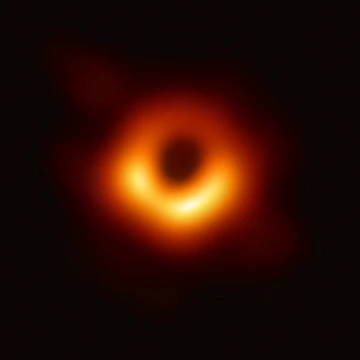
In April 2019, the Event Horizon Telescope collaboration published the first resolved image of the shadow cast by the supermassive black hole in galaxy M87, roughly 55 million light-years from Earth. A follow-up image of Sagittarius A*, the black hole at the center of the Milky Way, was released in May 2022.
What is the black hole information paradox?
It is the tension between quantum mechanics, which demands that information about a physical system is never truly destroyed, and the semiclassical prediction that matter falling into a black hole vanishes behind the horizon and is lost when the hole evaporates. Resolving it is considered a central open problem in quantum gravity.
How large can black holes get?
Stellar-mass black holes typically span a few to a few hundred solar masses, while the supermassive ones anchoring galactic centers range from millions to tens of billions of solar masses. The record holder, TON 618, is estimated at around 66 billion solar masses, making its event horizon roughly 400 times the diameter of the Sun.