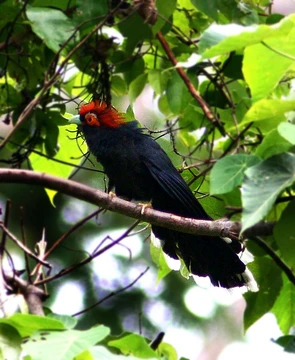
Fire-throated flowerpecker
A Philippine flowerpecker formerly treated as a subspecies of the fire-breasted flowerpecker.
Last updated
The fire-throated flowerpecker, known scientifically as Dicaeum luzoniense, belongs to the flowerpecker family. This bird lives in the Philippines, but not on Mindoro, the Palawan group, or the Sulu Archipelago. Experts once considered it a subspecies of the fire-breasted flowerpecker.
Scientific classification
- KingdomAnimalia
- PhylumChordata
- ClassAves
- OrderPasseriformes
- FamilyDicaeidae
- GenusDicaeum
- SpeciesDicaeum luzoniense
Named by Ogilvie-Grant, 1894
Sources: Wikipedia taxobox: Fire-throated flowerpecker (CC BY-SA 4.0)
Conservation status
Least Concern (LC)
- LC▲ this species
- NT
- VU
- EN
- CR
- EW
- EX
Source: IUCN Red List assessment · GBIF copy of the Red List category
Where the fire-throated flowerpecker has been recorded
Each dot is a place where the species has been observed and reported (1,128 records, half-degree grid) — not a modelled range. 31 inland records left out (institution coordinates).
Map: drawn by Codexery. Data: GBIF occurrence search (records CC0 / CC BY) · Natural Earth basemap (public domain) · place coordinates: Wikipedia (CC BY-SA 4.0)
Quick Facts
- Genus
- Dicaeum
- Species
- luzoniense
Facts from the source article.
Description and taxonomy
The fire-throated flowerpecker was formally described in 1894 by Scottish ornithologist William Robert Ogilvie-Grant, based on specimens collected by John Whitehead in the mountains of northern Luzon. Ogilvie-Grant gave it the binomial name Dicaeum luzoniense. It was formerly considered a subspecies within the fire-breasted flowerpecker (Dicaeum ignipectus) species complex, which also includes the Cambodian flowerpecker and Sumatran flowerpecker.
It differs from that complex by having less extensive red, mostly confined to the throat (hence the name fire-throated), a slightly larger size, and a slower-paced, lower song. Three subspecies are recognized: D. l. luzoniense from montane Luzon; D. l. apo from the Western Visayas and Mindanao, which has glossier head and neck sides, brighter vent and undertail, and darker abdomen sides; and D. l. bonga from Samar, which is smaller with a darker head.
The Samar subspecies was known only from its holotype collected in 1896 at 100 meters above sea level, leading to speculation that the specimen was mislabeled, but it was photographed for the first time in 2025.
Habitat and conservation status
This bird lives in tropical moist mountain forests at elevations of 1,000 meters or higher. However, the Samar subspecies bonga was found below 100 meters in 1896 and at 200 meters in 2025, both times in lowland forest.
The IUCN considers it Least Concern, even though it is not common anywhere. Mountain forests are cleared less often than lowland ones, but deforestation from farming, land conversion, and mining continues across the Philippines. The species can be found in places like Mount Banahaw, Mount Kitanglad, Mount Apo, Mount Pulag, Samar Island Natural Park, and Northern Sierra Madre Natural Park, but protection there is weak and trees keep being cut.
Did You Know?
- The fire-throated flowerpecker typically occurs singly or in pairs and joins mixed-species flocks.
- Its diet is presumed to include small fruits, insects, and nectar, especially from mistletoes.
More in Birds of the Philippines
Test yourself
Three questions drawn from this entry’s sources. Pick an answer to check it.
Answers checked against the source article
Sources
Compiled from Wikipedia and the sources listed below. Text from Wikipedia is available under CC BY-SA 4.0; this entry is adapted from it.
- Wikipedia: Fire-throated flowerpecker (CC BY-SA 4.0).
- Conservation status: IUCN Red List assessment.
- Occurrence records: GBIF (CC0 / CC BY). Basemap: Natural Earth (public domain).
- Word definitions: the , each quoted from its Wikipedia article.
Spotted an error? Know more?
Reader corrections go straight into our review queue. Suggest an edit · How this site is sourced