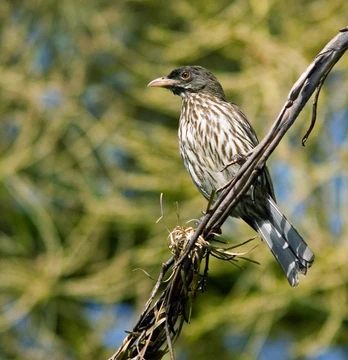
Clapper rail
A secretive saltmarsh rail of the Atlantic and Caribbean coasts.
Last updated
The clapper rail (Rallus crepitans) is a sizable brown bird living in Atlantic coastal wetlands from the eastern United States to eastern Mexico and some Caribbean islands. Its classification is unclear and still under review, as it was once grouped with the mangrove rail as the same species.
Scientific classification
- KingdomAnimalia
- PhylumChordata
- ClassAves
- OrderGruiformes
- FamilyRallidae
- GenusRallus
- SpeciesRallus crepitans
Named by JF Gmelin, 1789
Close relatives
Other species of Rallus with a Codexery entry.
- King rail Rallus elegans
Sources: Wikipedia taxobox: Clapper rail (CC BY-SA 4.0)
Conservation status
Least Concern (LC)
- LC▲ this species
- NT
- VU
- EN
- CR
- EW
- EX
Source: IUCN Red List assessment · GBIF copy of the Red List category
How big is it?
Largest length in the source, 0.41 m, next to a 1.8 m person.
Diagram: drawn by Codexery, schematic shapes to scale (not a likeness). Length: Wikipedia: Clapper rail
Where the clapper rail has been recorded
Each dot is a place where the species has been observed and reported (346,078 records, half-degree grid) — not a modelled range. 109 inland records left out (institution coordinates).
Map: drawn by Codexery. Data: GBIF occurrence search (records CC0 / CC BY) · Natural Earth basemap (public domain) · place coordinates: Wikipedia (CC BY-SA 4.0)
Taxonomy
The clapper rail was formally described in 1789 by German naturalist Johann Friedrich Gmelin in his revised edition of Carl Linnaeus's Systema Naturae. Gmelin placed it in the genus Rallus, which Linnaeus had erected in 1758, and coined the binomial name Rallus crepitans. The specific epithet crepitans is Latin for 'breaking wind' or 'resounding'.
Gmelin based his description on those by Thomas Pennant and John Latham, with the type locality being Long Island, New York. The clapper rail was formerly treated as a subspecies of the mangrove rail (Rallus longirostris), but a molecular phylogenetic study published in 2013 led to its recognition as a separate species. Eight subspecies are recognised: R. c. crepitans, R. c. waynei, R. c. saturatus, R. c. scottii, R. c. insularum, R. c. coryi, R. c. caribaeus, and R. c. pallidus.
Behaviour
Clapper rails feed on crustaceans, aquatic insects, and small fish, foraging by walking and sometimes probing with their long bills in shallow water or mud. The nest is a large platform of dry grasses placed on the ground in dense vegetation.
Clutch size ranges from four to sixteen eggs, averaging nine; the eggs are creamy white with irregular blotches of reddish-brown, grey, or lilac. Both parents incubate the eggs for 20 days, with the male incubating at night. Young are brooded for several days, become independent at six weeks, and can fly at ten weeks.
Did You Know?
- The clapper rail is a chicken-sized bird that rarely flies.
- Its bill curves slightly downward and is orange yellow at the base in males, duller in females.
- Females show weak philopatry, while males show a lack of philopatry.
More in Birds of the Dominican Republic
Test yourself
Three questions drawn from this entry’s sources. Pick an answer to check it.
Answers checked against the source article
Sources
Compiled from Wikipedia and the sources listed below. Text from Wikipedia is available under CC BY-SA 4.0; this entry is adapted from it.
- Wikipedia: Clapper rail (CC BY-SA 4.0).
- Conservation status: IUCN Red List assessment.
- Occurrence records: GBIF (CC0 / CC BY). Basemap: Natural Earth (public domain).
- Word definitions: the , each quoted from its Wikipedia article.
Spotted an error? Know more?
Reader corrections go straight into our review queue. Suggest an edit · How this site is sourced