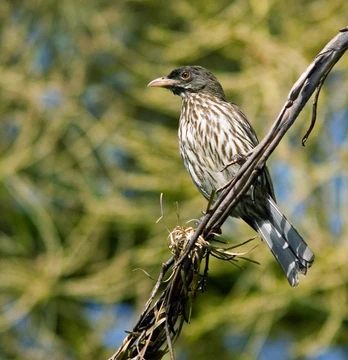
Antillean palm swift
A small swift found on Caribbean islands, nesting on palm fronds.
Last updated
The Antillean palm swift (Tachornis phoenicobia) belongs to the swift family Apodidae and the subfamily Apodinae. It inhabits the Caribbean islands of Cuba, Jamaica, and Hispaniola, which includes the Dominican Republic and Haiti.
Scientific classification
- KingdomAnimalia
- PhylumChordata
- ClassAves
- OrderApodiformes
- FamilyApodidae
- GenusTachornis
- SpeciesTachornis phoenicobia
Named by Gosse, 1847
Sources: Wikipedia taxobox: Antillean palm swift (CC BY-SA 4.0)
Conservation status
Least Concern (LC)
- LC▲ this species
- NT
- VU
- EN
- CR
- EW
- EX
Source: IUCN Red List assessment · GBIF copy of the Red List category
How big is it?
Largest length in the source, 0.11 m, next to a 1.8 m person.
Diagram: drawn by Codexery, schematic shapes to scale (not a likeness). Length: Wikipedia: Antillean palm swift
Where the antillean palm swift has been recorded
Each dot is a place where the species has been observed and reported (42,362 records, half-degree grid) — not a modelled range. 50 inland records left out (institution coordinates).
Map: drawn by Codexery. Data: GBIF occurrence search (records CC0 / CC BY) · Natural Earth basemap (public domain) · place coordinates: Wikipedia (CC BY-SA 4.0)
Description
This swift measures 9 to 11 cm in length and weighs roughly 9 to 11 g, with long narrow wings and a medium-length forked tail. Both sexes look alike. The nominate subspecies has a dark sooty brown crown and nape, a sooty black to black back, and white sides on the rump.
Its underparts are mostly dull white, with dark sooty brown flanks, a narrow breast band, and undertail coverts. Immatures have duller white underparts and paler sooty brown flanks and undertail coverts. The subspecies T. p. iradii is somewhat larger, with a more deeply forked tail, a more sooty back, and paler flanks.
Distribution and habitat
The Antillean palm swift’s nominate subspecies lives on Jamaica, Hispaniola, and a few small islands near Hispaniola. The subspecies T. p. iradii occupies mainland Cuba and Isla de la Juventud.
Vagrants have turned up in Florida, with sightings from Puerto Rico, the Cayman Islands, Inagua in the Bahamas, and the Turks and Caicos Islands. This bird favors dry grassy areas with palms, scrub, forest, and suburban or urban spaces. It reaches elevations up to 1,700 meters on Hispaniola and 1,200 meters on Jamaica.
Behavior
Resident year-round, the Antillean palm swift feeds on insects caught in flight, usually low over vegetation in small flocks, sometimes alongside swallows. Its breeding season on Cuba runs from May to July, and on Hispaniola from March to May.
It builds a hanging pouch nest of plant fibers and feathers glued with saliva, attached to a dead drooping palm frond, nesting in small colonies. Both parents incubate the two to five eggs and care for the young. Its flight call is a weak, twittering tooee-tooee.
Did You Know?
- The IUCN has assessed the Antillean palm swift as being of Least Concern.
- Planting of decorative palms provides nest sites for these birds.
More in Birds of the Dominican Republic
Test yourself
Three questions drawn from this entry’s sources. Pick an answer to check it.
Answers checked against the source article
Sources
Compiled from Wikipedia and the sources listed below. Text from Wikipedia is available under CC BY-SA 4.0; this entry is adapted from it.
- Wikipedia: Antillean palm swift (CC BY-SA 4.0).
- Conservation status: IUCN Red List assessment.
- Occurrence records: GBIF (CC0 / CC BY). Basemap: Natural Earth (public domain).
- Word definitions: the , each quoted from its Wikipedia article.
Spotted an error? Know more?
Reader corrections go straight into our review queue. Suggest an edit · How this site is sourced