Atlantic yellow-nosed albatross
A small mollymawk with a yellow bill and endangered Atlantic range.
Last updated
The Atlantic yellow-nosed albatross (Thalassarche chlororhynchos) is a large seabird belonging to the albatross family Diomedeidae. This small mollymawk was formerly grouped with the Indian yellow-nosed albatross under the name yellow-nosed albatross, and some authorities, including the Clements checklist and the South American Classification Committee, still treat them as the same species, pending a formal proposal. German naturalist Johann Friedrich Gmelin first formally described this species in 1789 in his expanded edition of Linnaeus’s Systema Naturae, placing it in the genus Diomedea with the binomial Diomedea chlororhynchos.
Gmelin based his description on the “yellow-nosed albatross” that English ornithologist John Latham had described and illustrated in 1785 from a specimen collected off the Cape of Good Hope. Today, it is one of nine species in the genus Thalassarche, introduced by Ludwig Reichenbach in 1853. The genus name comes from Ancient Greek thalassa (“sea”) and arkhē (“power” or “command”). The specific name chlororhynchos combines khlōros (“yellow”) and rhunkhos (“bill”).
Description
The species is monotypic, with no recognized subspecies. This albatross averages 81 cm (32 in) in length. It is a typical black-and-white mollymawk with a grey head, a large eye patch, and a white nape and hindneck. Its bill is black with a yellow culminicorn and a pink tip.
The saddle, tail, and upperwing are blackish grey, while the underparts are mostly white. The underwing and primaries have a narrow black margin. Juveniles resemble adults but have a white head and a black bill. It differs from the Indian yellow-nosed albatross by its darker head.
Among other mollymawks, it stands out for its smaller size (especially narrow wings) and the thin black edging on the underwing. The grey-headed albatross has a similar grey head but more extensive, less defined black underwing markings.
Distribution
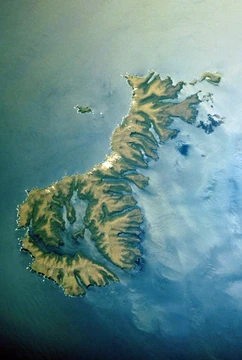
Salvin’s albatross also has a grey head but broader wings, a pale bill, and even narrower black underwing borders. Atlantic yellow-nosed albatrosses breed on mid-Atlantic islands, including Tristan da Cunha (Inaccessible Island, Middle Island, Nightingale Island, Stoltenhoff Island) and Gough Island. At sea, they range across the South Atlantic from South America to Africa, between 15°S and 45°S.
Scientific classification
- KingdomAnimalia
- PhylumChordata
- ClassAves
- OrderProcellariiformes
- FamilyDiomedeidae
- GenusThalassarche
- SpeciesThalassarche chlororhynchos
Named by (Gmelin, JF, 1789)
Close relatives
Other species of Thalassarche with a Codexery entry.
- Grey-headed albatross Thalassarche chrysostoma
- Indian yellow-nosed albatross Thalassarche carteri
- Black-browed albatross Thalassarche melanophris
- Thalassarche cauta
Sources: Wikipedia taxobox: Atlantic yellow-nosed albatross (CC BY-SA 4.0) · order, family and genus agree with WoRMS AphiaID 159069 (CC BY 4.0)
Conservation status
Endangered (EN)
- LC
- NT
- VU
- EN▲ this species
- CR
- EW
- EX
Source: IUCN Red List assessment · GBIF copy of the Red List category
How big is it?
Largest length in the source, 0.81 m, next to a 1.8 m person.
Diagram: drawn by Codexery, schematic shapes to scale (not a likeness). Length: Wikipedia: Atlantic yellow-nosed albatross
Where the atlantic yellow-nosed albatross has been recorded
Each dot is a place where the species has been observed and reported (9,329 records, half-degree grid) — not a modelled range. 10 inland records left out (institution coordinates). 12 isolated far-off records not drawn.
Map: drawn by Codexery. Data: GBIF occurrence search (records CC0 / CC BY) · Natural Earth basemap (public domain) · place coordinates: Wikipedia (CC BY-SA 4.0)
More in Birds of subantarctic islands
Test yourself
Three questions drawn from this entry’s sources. Pick an answer to check it.
Answers checked against the source article
Sources
Compiled from Wikipedia and the sources listed below. Text from Wikipedia is available under CC BY-SA 4.0; this entry is adapted from it.
- Wikipedia: Atlantic yellow-nosed albatross (CC BY-SA 4.0).
- Classification: the source article's taxobox; order, family and genus checked against WoRMS, the World Register of Marine Species (CC BY 4.0).
- Conservation status: IUCN Red List assessment.
- Occurrence records: GBIF (CC0 / CC BY). Basemap: Natural Earth (public domain).
- Word definitions: the , each quoted from its Wikipedia article.
Spotted an error? Know more?
Reader corrections go straight into our review queue. Suggest an edit · How this site is sourced