Western Orphean warbler
A large warbler with a dark head and white throat.
Last updated
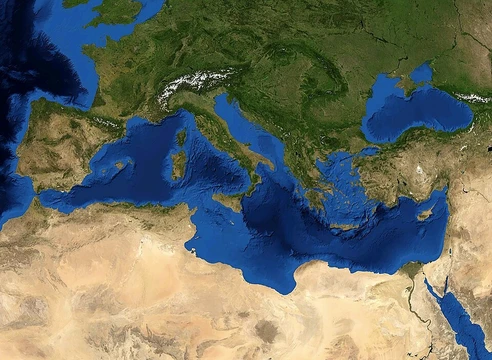
The western Orphean warbler (Curruca hortensis) is an Old World warbler that summers around the Mediterranean, through western Europe and into northwest Africa. It migrates to winter in Sub-Saharan Africa and is a rare vagrant to northern and north-western Europe.
Scientific classification
- KingdomAnimalia
- PhylumChordata
- ClassAves
- OrderPasseriformes
- FamilySylviidae
- GenusCurruca
- SpeciesCurruca hortensis
Named by (Gmelin, 1789)
Close relatives
Other species of Curruca with a Codexery entry.
- Sardinian warbler Curruca melanocephala
- Spectacled warbler Curruca conspicillata
- Western subalpine warbler Curruca iberiae
- Barred warbler Curruca nisoria
Sources: Wikipedia taxobox: Western Orphean warbler (CC BY-SA 4.0)
Conservation status
Least Concern (LC)
- LC▲ this species
- NT
- VU
- EN
- CR
- EW
- EX
Source: IUCN Red List assessment · GBIF copy of the Red List category
How big is it?
Largest length in the source, 0.16 m, next to a 1.8 m person.
Diagram: drawn by Codexery, schematic shapes to scale (not a likeness). Length: Wikipedia: Western Orphean warbler
Where the western orphean warbler has been recorded
Each dot is a place where the species has been observed and reported (30,872 records, half-degree grid) — not a modelled range. 216 inland records left out (institution coordinates).
Map: drawn by Codexery. Data: GBIF occurrence search (records CC0 / CC BY) · Natural Earth basemap (public domain) · place coordinates: Wikipedia (CC BY-SA 4.0)
Taxonomy and etymology
The western Orphean warbler gets its English name from the legendary musician Orpheus, and its scientific name hortensis means "of a garden" in Latin. While two subspecies are widely recognized, they are now typically treated as separate species.
This bird is closely related to the Arabian warbler, as well as the brown and Yemen warblers, which are sometimes grouped under Parisoma. Together with the lesser whitethroat group, they form a distinct clade of typical warblers. These species all have prominent white throats, lack rufous wing patches, and usually feature dark sides to the head.
Description
At 15–16 cm in length, it is somewhat larger than a blackcap and one of the largest typical warblers. Adult males have a plain grey back, whitish underparts, a long pointed bill, black legs, a dark grey head, black eye mask, white throat, and white iris. Females and immatures have a paler head, buff underparts, a brownish-tinged grey back, and a dark iris in young birds. The song is a series of warbling liroo-liroo and scolding notes.
More in Birds of Southern Europe
Sources
Compiled from Wikipedia and the sources listed below. Text from Wikipedia is available under CC BY-SA 4.0; this entry is adapted from it.
- Wikipedia: Western Orphean warbler (CC BY-SA 4.0).
- Conservation status: IUCN Red List assessment.
- Occurrence records: GBIF (CC0 / CC BY). Basemap: Natural Earth (public domain).
- Word definitions: the , each quoted from its Wikipedia article.
Spotted an error? Know more?
Reader corrections go straight into our review queue. Suggest an edit · How this site is sourced