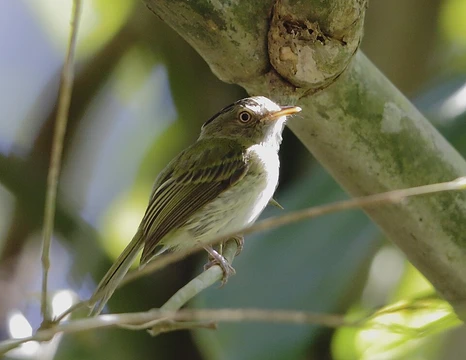
Cattle tyrant
A terrestrial tyrant flycatcher that often follows large mammals.
The cattle tyrant, known as suiriri-cavaleiro in Brazil, is a bird from the tyrant flycatcher family. It is the sole species in the genus Machetornis. Its exact evolutionary links within the family remain unclear, though it looks similar to Tyrannus flycatchers, likely due to convergent evolution.
Quick Facts
- Genus
- Machetornis
- Species
- rixosa
Facts from the source article.
Did You Know?
- The cattle tyrant's plumage is mostly olive-brown above and yellow below, with a grey head and thin dark eyestripe.
- The nominate subspecies has a whitish throat, while the other two subspecies have a yellower throat and less grey on the head.
- The thin bill and legs are black.
Subspecies and distribution
The genus name Machetornis, given by George Robert Gray, derives from Ancient Greek for fighter and bird, referencing its pugnacious behaviour and habit of taking over nests of other species. The specific name rixosa comes from Latin meaning quarrelsome. The species has a disjunct distribution with three accepted subspecies. The nominate M. r. rixosa occurs in eastern South America from northern Argentina and Bolivia to northeastern Brazil.
M. r. flavigularis ranges from southern Central America through Panama to western Colombia and western Venezuela. M. r. obscurodorsalis is found from eastern Ecuador through central Colombia to eastern Venezuela. The two northern subspecies are not very distinct and may be better merged under M. r. flavigularis. The species inhabits drier open and semi-open habitats such as savannah, pastureland, and gardens, avoiding forests. Deforestation has allowed it to colonize areas like northeast Ecuador.
Behaviour
Cattle tyrants feed on insects, mostly taken from the ground. They may follow cattle or other large animals, catching prey flushed by their movement, or hitch rides on these animals to snatch flushed insects with a quick sally-flight. Occasionally they hawk for insects from a high perch. They sometimes take ticks off mammals, and will hunt horseflies attempting to land on capybaras. They build bulky nests or steal nests of rufous-fronted thornbirds. Three to four eggs are laid and incubated for 14 days, with chicks fledging after 15 days.
More in Birds of South America
Spotted an error? Know more?
Reader corrections go straight into our review queue. Suggest an edit · How this site is sourced