Azure (color)
A sky-blue hue between cyan and blue on the color wheel.
Last updated
Azure is a color between cyan and blue on the color wheel, often described as the color of a clear sky. On the RGB color wheel, azure (hexadecimal #0080FF) is defined as the hue at 210 degrees, halfway between blue and cyan. In the RGB color model, it is created by adding 50% green light to 100% blue light.
Quick Facts
- Rgb hue angle
- 210 degrees
- First english user
- Geoffrey Chaucer
- Work containing first use
- Troilus and Criseyde
Facts from the source article.
Etymology and history
The name azure derives from the vivid-blue gemstone lapis lazuli, a metamorphic rock. Lapis is Latin for 'stone,' and lāzulī is the genitive of Medieval Latin lāzulum, from Arabic لازورد (lāzaward), itself from Persian لاژورد (lāžaward), the name of the stone and a place where it was mined. The stone's name came to denote its color. French azur, Italian azzurro, Polish lazur, Romanian azur and azuriu, Portuguese and Spanish azul, Hungarian azúr, and Catalan atzur all originate from lapis lazuli.
The loss of the initial l in Romance languages may result from rebracketing, as speakers may have perceived the sound as the initial phoneme of the definite article. English adopted the word from French; the first recorded English use as a color name was in 1374, in Geoffrey Chaucer's Troilus and Criseyde, referring to 'a broche, gold and asure.' Some languages, such as Italian, treat azure as a basic color distinct from blue, and some sources define blue as a darker shade of azure.
Azure also describes the color of the mineral azurite, both naturally and as a pigment. Coarse grinding preserved azurite's deep color, while fine grinding produced a lighter, washed-out hue.
The pigment was traditionally considered unstable in oil paints and was sometimes isolated from other colors. The term spread through heraldry, where 'azure' represents a blue tincture, depicted in engravings as parallel horizontal lines or abbreviated az. or b. In practice, azure has been represented by many shades of blue; later heraldic practice sometimes specifies a lighter blue called bleu celeste.
Distinction among indigo, azure, and cyan
On the RGB color wheel, indigo colors have hue codes between 255 and 225 degrees, azure colors between 195 and 225 degrees, and cyan colors between 165 and 195 degrees. Another description is that cyan mixes blue and green light, azure mixes blue and cyan light, and indigo mixes blue and violet light. The very pale X11 web color azure (RGB 240, 255, 255) has a hue of 180 degrees, making it a tone of cyan, though it follows the artistic meaning of azure as sky blue.
In culture
Côte d'Azur ('Azure Coast') is a name for the French Riviera on France's southeastern Mediterranean coast. In Chinese mythology, the Azure Dragon is one of the Four Symbols of the Chinese constellations, representing the east and spring; it is known as Seiryū in Japan and Cheongryong in Korea. Savoy azure (azzurro Savoia) is a traditional national color of Italy, taken from the House of Savoy, and is worn by the Italy national football team, nicknamed gli Azzurri, and by the Italian state police.
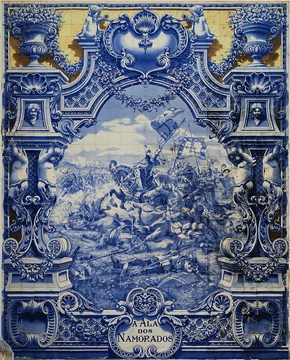
Portuguese and Spanish tilework called azulejo shares the same etymology due to the use of blue (azul). In modern Hebrew, the azure color is called Tekhelet; Tekhelet and white are sacred colors for the Jewish people, appear in the flag of Israel, and are the national colors of Israel. In the Soulcalibur video game series, the character Nightmare is called the 'Azure Knight' because of his azure armor.
More in Bird Colours
Sources
Compiled from Wikipedia and the sources listed below. Text from Wikipedia is available under CC BY-SA 4.0; this entry is adapted from it.
- Wikipedia: Azure (color) (CC BY-SA 4.0).
Spotted an error? Know more?
Reader corrections go straight into our review queue. Suggest an edit · How this site is sourced