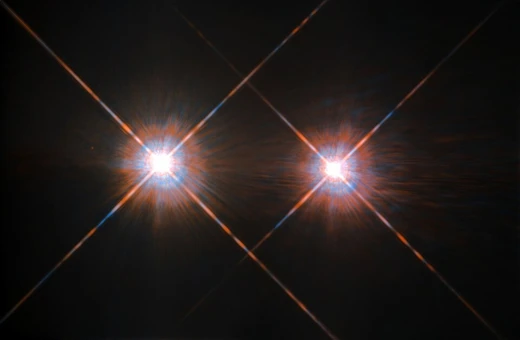
Semidetached binary
Last updated
This configuration is distinct from detached binaries, where neither star fills its Roche lobe.[1][2] Low-mass X-ray binaries are examples of semidetached systems, with gas from a donor star overflowing the Roche lobe.[3]
Quick Facts
- Example system
- Cygnus X-1 (a well-known black hole binary)
Facts from the source article.
Key facts and history
Double stars have been observed since the invention of the telescope, with early examples including Mizar and Acrux.[4] Giovanni Battista Riccioli observed Mizar as double in 1650, and Father Fontenay discovered Acrux as double in 1685.[4] In 1767, John Michell used statistics to show that many star pairs are not random alignments, providing the first evidence for binary stars.[5] William Herschel began observing double stars in 1779, hoping to measure parallax, but by 1803 he concluded they were orbiting each other.[6]
Herschel first used the term "binary" for such systems in 1802.[7] Binary stars are classified by observation method: visual, spectroscopic, photometric (eclipsing), or astrometric.[8] The high-mass X-ray binary Cygnus X-1 is believed to contain a black hole, with the unseen companion's mass estimated at about nine solar masses.[9][10] Félix Savary calculated the first orbital path for a binary star, Xi Ursae Majoris, in 1827.[6]
When a binary system includes a compact object like a white dwarf, neutron star, or black hole, gas from the donor star can be pulled onto that compact object through Roche lobe overflow.[11][3]
What the cited sources add
This handbook provides the orbital elements and calculation methods used for binary star positions, such as for alpha Centauri AB.[12][13] The Applegate mechanism, described in a 1992 Astrophysical Journal paper, explains long-term orbital period variations in certain eclipsing binaries through magnetic torque changing a star's oblateness.[14] The Open Library record for ISBN 0387911251 lists "Astronomy, a Handbook" as published by Sky in 1975.[15] A 2006 paper in the Proceedings of the International Astronomical Union reports that eclipsing binaries provide a direct method for measuring galaxy distances with an improved accuracy of 5%.[16]
References
- Wikipedia, "Binary star" (CC BY-SA 4.0), which cites: Nguyen, "Roche model", San Diego State University (original not read by us) en.wikipedia.org
- Wikipedia, "Binary star" (CC BY-SA 4.0), which cites: Voss, "Galactic distribution of merging neutron stars and black holes", Monthly Notices of the Royal Astronomical Society, 2003, p. 1169–1184 (original not read by us) en.wikipedia.org
- Wikipedia, "Binary star" (CC BY-SA 4.0), which cites: Israel, "A Systematic Search of New X-ray Pulsators in ROSAT Fields", October 1996 (original not read by us) en.wikipedia.org
- Wikipedia, "Binary star" (CC BY-SA 4.0), which cites: The Binary Stars, Robert Grant Aitken, New York: Dover, 1964, p. 1.; Vol. 1, part 1, p. 422, Almagestum Novum , Giovanni Battista Riccioli, Bononiae: Ex typographia haeredis Victorij Benatij, 1651.; A New View of Mizar , Leos Ondra, accessed on line May 26, 2007.; The Binary Stars, Robert Grant Aitken, New York: Dover, 1964, p. 1. (original not read by us) en.wikipedia.org
- Wikipedia, "Binary star" (CC BY-SA 4.0), which cites: This Month in Physics History, November 27, 1783: John Michell anticipates black holes, APS News, November 2009 (Volume 18, Number 10), www.aps.org (original not read by us) en.wikipedia.org
- Wikipedia, "Binary star" (CC BY-SA 4.0), which cites: Aitken, "The Binary Stars", McGraw-Hill Book Company, Inc., 1935, p. 4–9; Heintz, "Double Stars", D. Reidel Publishing Company, 1978, p. 4; Herschel, "Account of the Changes That Have Happened, during the Last Twenty-Five Years, in the Relative Situation of Double-Stars; with an Investigation of the Cause to Which They Are Owing", Philosophical Transactions ; p. 291, French astronomers, visual double stars and the double stars working group of the Société Astronomique de France, E. Soulié, The Third Pacific Rim Confe (original not read by u en.wikipedia.org
- Wikipedia, "Binary star" (CC BY-SA 4.0), which cites: The Binary Stars, Robert Grant Aitken, New York: Dover, 1964, p. ix.; Herschel, "Catalogue of 500 New Nebulae, Nebulous Stars, Planetary Nebulae, and Clusters of Stars; With Remarks on the Construction of the Heavens", Philosophical Transactions of the Royal Society of London, 1802, p. 477 (original not read by us) en.wikipedia.org
- Wikipedia, "Binary star" (CC BY-SA 4.0), which cites: Heintz, "Double Stars", D. Reidel Publishing Company, 1978, p. 1–2; "Binary Stars", Cornell University (original not read by us) en.wikipedia.org
- Wikipedia, "Binary star" (CC BY-SA 4.0), which cites: Iorio, "On the orbital and physical parameters of the HDE 226868 / Cygnus X-1 binary system", Astrophysics and Space Science, 2008, p. 335–340 (original not read by us) en.wikipedia.org
- Wikipedia, "Binary star" (CC BY-SA 4.0), which cites: "Black Holes", NASA (original not read by us) en.wikipedia.org
- Wikipedia, "Binary star" (CC BY-SA 4.0), which cites: Smith, Robert Connon, "Cataclysmic Variables", Contemporary Physics, November 2006, p. 363–386 (original not read by us) en.wikipedia.org
- Wikipedia, "Binary star" (CC BY-SA 4.0), which cites: Roth, "Astronomy: a Handbook", Sky Publishing Company, 1975, p. 484–485; Sixth Catalog of Orbits of Visual Binary Stars , William I. Hartkopf and Brian D. Mason, United States Naval Observatory, accessed on line August 20, 2008. (we also read that source) en.wikipedia.org
- Wikipedia, "Binary star" (CC BY-SA 4.0), which cites: Roth, "Astronomy: a Handbook", Sky Publishing Company, 1975, p. 484–485 (we also read that source) en.wikipedia.org
- Wikipedia, "Binary star" (CC BY-SA 4.0), which cites: Applegate, "A mechanism for orbital period modulation in close binaries", Astrophysical Journal, Part 1, 1992, p. 621–629 (original not read by us) en.wikipedia.org
- Open Library record, ISBN 0387911251 ("Astronomy, a Handbook"). CC0 (metadata); book content not read. openlibrary.org
- Wikipedia, "Binary star" (CC BY-SA 4.0), which cites: Bonanos, Alceste Z., "Eclipsing binaries: Tools for calibrating the extragalactic distance scale", Proceedings of the International Astronomical Union, 2006, p. 79–87 (original not read by us) en.wikipedia.org
Each numbered sentence above was checked against the source it cites before publication. Sentences citing Wikipedia adapt text from the English Wikipedia article Binary star (contributors), used under CC BY-SA 4.0; this entry is available under the same licence. Other sources were used for facts only; no text or images are copied from them.
More in Binary and Multiple Stars
Sources
Compiled from Wikipedia and the sources listed below. Text from Wikipedia is available under CC BY-SA 4.0; this entry is adapted from it.
- Wikipedia: Binary star (CC BY-SA 4.0).
Spotted an error? Know more?
Reader corrections go straight into our review queue. Suggest an edit · How this site is sourced