81 Cancri
A multiple system with a close binary and a brown dwarf binary.
Last updated
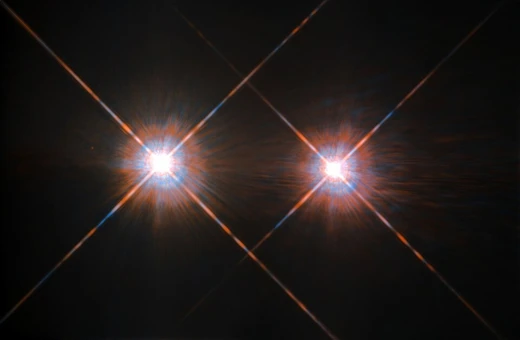
81 Cancri, also designated Pi¹ Cancri, is a stellar system located in the constellation Cancer. Its primary component is a close binary pair, while a widely separated binary brown dwarf orbits them. The system’s main star has an apparent visual magnitude of 6.49, making it just barely visible without a telescope. Because it lies near the ecliptic, the star can be occulted by the Moon.
Parallax measurements place the system about 66 light-years from the Sun. It moves across the sky at a high proper motion and is receding from Earth at a line-of-sight velocity of 49.8 km/s.
The close binary was first identified as a visual pair by W. S. Finsen in 1959. The two stars orbit each other every 988.058 days on an eccentric path (eccentricity 0.433). The primary is a G-type main-sequence star (class G8V) with 89% of the Sun’s mass and 82% of its radius. It shines with roughly the same luminosity as the Sun and has an effective temperature of 5,430 K. The secondary is a K-type main-sequence star (class K1V), slightly less massive than the primary and a few hundred kelvin cooler.
A brown dwarf companion was detected in 2001. The object 2MASSW J0912145+145940 (2M0912+14) was found to share the system’s proper motion, confirming it as a member. Designated 81 Cancri C, it has a spectral type of L8, near the boundary between L and T dwarfs. It lies about 43 arcseconds from the primary pair, corresponding to a minimum physical separation of roughly 880 AU at the system’s distance of 20.4 parsecs.
This brown dwarf appeared about half a magnitude brighter in the JHK bands than expected for its spectral type and distance. The system showed no signs of being unusually young, suggesting that component C might itself be an unresolved binary. In 2006, follow-up observations revealed it to be slightly oblong, confirming two brown dwarfs of similar spectral type. These two components, C and D, are separated by about 11 AU, and their mutual orbit is estimated to take on the order of 150 years due to their low masses.
Quick Facts
- Bayer designation
- Pi1 Cancri
- Apparent visual magnitude
- 6.49
- Distance from sun
- 66 ly
- Orbital period (ab)
- 988.058 days
- Orbital eccentricity (ab)
- 0.433
Facts from the source article.
More in Binary and Multiple Stars
Sources
Compiled from Wikipedia and the sources listed below. Text from Wikipedia is available under CC BY-SA 4.0; this entry is adapted from it.
- Wikipedia: 81 Cancri (CC BY-SA 4.0).
Spotted an error? Know more?
Reader corrections go straight into our review queue. Suggest an edit · How this site is sourced