Liger
Largest extant felid, a lion-tiger hybrid.

Asm sultan · CC0
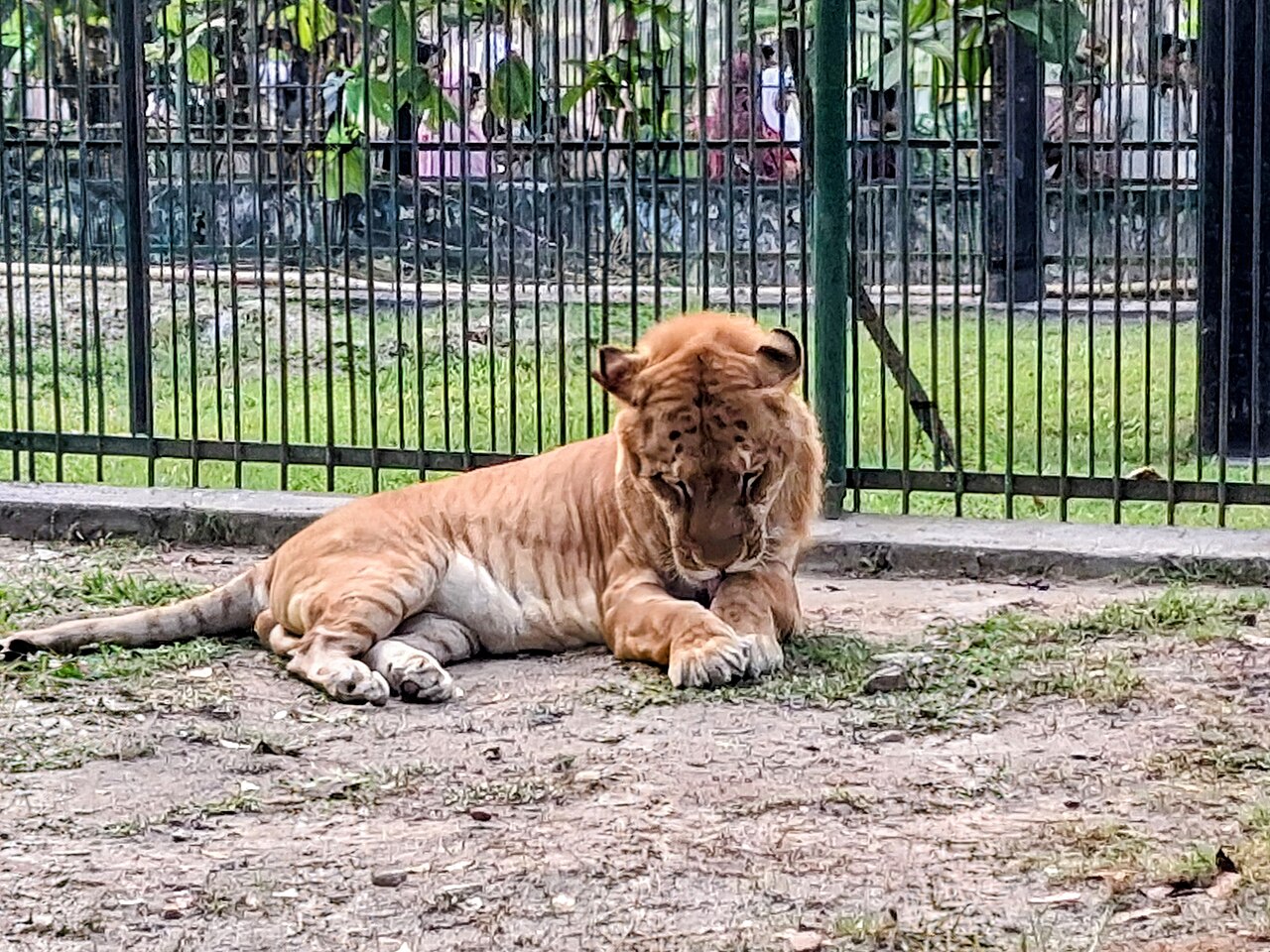
The liger is the hybrid resulting from a male lion mating with a female tiger. It differs from the tigon, which comes from a male tiger and a lioness, and holds the record as the biggest living cat species. Ligers combine traits from both parents: they are strong swimmers, like tigers, and highly social, like lions. A key distinction is that ligers usually outgrow both parent species, whereas tigons do not.
The earliest known records of lion-tiger hybrids go back to early 19th-century India. In 1798, Étienne Geoffroy Saint-Hilaire produced a color plate showing the offspring of a lion and a tiger. The term "liger," blending "lion" and "tiger," emerged by the 1930s; a female liger is called a "ligress," following the pattern of "tigress." In 1825, G. B. Whittaker engraved liger cubs born the previous year, and a 19th-century naïve painting depicts those parents, their three cubs, and their trainer. Two liger cubs born in 1837 were presented to King William IV and later to Queen Victoria. In 1897, Carl Hagenbeck bred ligers at his Tierpark in Hamburg, and he sent photographs and details to zoologist James Cossar Ewart in 1900 and 1901. A. H. Bryden, writing in *Animal Life and the World of Nature* (1902–1903), described one of Hagenbeck’s hybrids born on May 11, 1897, as measuring 10 feet 2 inches from nose to tail, standing just under 4 feet at the shoulder, and weighing 467 pounds—exceeding a large lion’s typical 400 pounds. This animal had faint stripes and mottling, a lion-like head and tail, no mane, and was described as huge and powerful. In 1935, four ligers from two litters were raised in Bloemfontein, South Africa; three survived until 1953, with a male weighing 750 pounds and standing 18 inches taller at the shoulder than a full-grown male lion. In 1948, *LIFE* magazine featured "Shasta," a liger born at Salt Lake City’s Hogle Zoo after its parents were allowed to cohabitate. The two-pound cub was neglected by its mother but hand-raised by the zoo superintendent. Although ligers are now more common than tigons, Gerald Iles noted in *At Home in the Zoo* (1961) that he had never seen one, suggesting they were then rarer.
In appearance, the liger has a tawny background with faint tiger-like stripes, and may also show rosettes inherited from the lion parent. Markings can be black, dark brown, or sandy, and the background color varies from tawny to golden. Like tigers, the underparts are pale due to countershading. The exact pattern depends on the subspecies of the parents and how their genes combine. White tigers crossed with lions produce pale golden ligers; theoretically, white lions and white tigers could yield white or stripeless ligers. No black ligers exist, as true melanistic lions have never been confirmed and melanistic tigers are extremely rare. Blue or gray ligers are highly unlikely since Maltese tigers are probably extinct. White ligers are very rare; the first known ones were born in December 2013 at Myrtle Beach Safari, from a white male lion and a white female tiger.
Ligers are often considered the world’s largest cats. Males can reach 3 to 3.6 meters (9.8 to 11.8 feet) in total length and weigh up to 500 kilograms (1,100 pounds), surpassing both large lions and tigers in weight and matching them in length. Their large size may be linked to imprinted genes—genes that are expressed only when inherited from one parent. In some hybrid crosses, maternally inherited genes can cause oversized growth, while paternally inherited genes normally counteract this in purebred offspring. Other big cat hybrids, like the litigon (a male lion crossed with a female tigon), can reach similar sizes; one male named Cubanacan at the Alipore Zoo in India weighed 363 kilograms.
- type
- Hybrid big cat
- parents
- Male lion (Panthera leo) and female tiger (Panthera tigris)
- typical_lifespan
- 13 to 18 years, occasionally into 20s
- fertility
- Male ligers are sterile; female ligers are often fertile
Lore & Background
The history of lion–tiger hybrids dates to at least the early 19th century in India. The name 'liger', a portmanteau of lion and tiger, was coined by the 1930s. B. Ligers are about the same size as the prehistoric Smilodon populator and American lion.
Reader's Guide
The liger represents a notable example of interspecific hybridization within the genus Panthera, combining traits from both lions and tigers. Its existence has been documented since at least the early 19th century, with early records from India and later from European zoos. The liger's significance lies in its status as the largest known extant felid, often exceeding both parent species in size, which has drawn scientific interest regarding the role of imprinted genes in hybrid growth. Despite their size, male ligers are sterile in accordance with Haldane's rule, while females are often fertile, allowing for further hybrid breeding. Ligers have been exhibited to royalty and featured in popular media, such as LIFE magazine and the Guinness Book of World Records. However, they also face health challenges, including a higher rate of injury and neurological disorder, as well as organ failure, cancer, and arthritis. The liger's legacy is one of both fascination and caution, highlighting the complexities and ethical considerations of hybrid animal breeding.
Did You Know?
- The name 'liger' is a portmanteau of lion and tiger, coined by the 1930s.
- Female ligers are often fertile, while male ligers are sterile, in accordance with Haldane's rule.
Origins & the Early Record
B. Whittaker rendered a set of cubs born the previous year, and a naïve-style 19th-century painting later depicted those same three offspring alongside their parents and a trainer. H.
Coat, Colour & Genetic Expression
The liger's coat is a visual negotiation between its two parent species. Over a tawny, sandy, or golden lionesque base, faint tiger-like stripes appear, sometimes accompanied by rosettes inherited from the lion parent—markings that lion cubs carry and that some adults retain in subtle form. The stripes themselves may be black, dark brown, or sandy, and the underparts tend to be pale, an example of countershading shared with tigers. The exact pattern and hue depend on which subspecies the parents belonged to and how their genes interact in the offspring. White tigers crossed with lions have produced pale-golden ligers, and in theory a white-lion–white-tiger pairing could yield white, very pale, or even stripeless offspring. True black ligers, however, do not exist: no substantiated reports of black lions have ever surfaced, and the handful of melanistic tigers on record are usually cases of pseudo-melanism or abundism rather than genuine melanism. Because blue or Maltese tigers are thought to be extinct, gray or blue ligers are exceedingly improbable.
Gigantism & the Growth Question
Ligers are widely regarded as the largest of all extant felids, and the measurements support that claim. One explanation points to imprinted genes—genes whose expression depends on whether they are inherited from the mother or the father. In certain dog-breed crosses, maternally inherited growth genes are normally counteracted by paternal genes; in the liger, that counterbalance may be disrupted, allowing the animal to outgrow both parent species. This directional size advantage is unique to the lion-sire cross: the opposite hybrid, the tigon, does not typically exceed its parents in size. A common misconception holds that ligers grow continuously due to hormonal problems, but evidence suggests they simply have a longer growth period and reach full adult size later than other big cats. No further increase in shoulder height or body length has been observed in ligers past six years of age.
Temperament, Rarity & Early Encounters
Beyond their striking size, ligers display a blend of parental temperaments that sets them apart among big cats. They share the tiger's fondness for water, readily taking to swimming, while also exhibiting the sociable, group-oriented behaviour characteristic of lions. This combination distinguishes them from both parent species and from the tigon, the hybrid produced by the reverse cross of a male tiger with a lioness. Although ligers are more commonly encountered in zoos and private collections today than tigons, their historical rarity was considerable. The two-pound cub was largely neglected by its tigress mother, and the zoo's superintendent took it home to raise by hand before returning it to a cage positioned across from its parents' separate enclosures. These early accounts underscore how unusual and logistically challenging liger production was, even in well-established institutions.
Common Misconceptions (Editorial)
Some people think ligers are a naturally occurring species in the wild, but they are exclusively a human-bred hybrid. Others mistakenly believe male ligers can reproduce, but only female ligers are often fertile; male ligers are sterile. It is also commonly assumed that ligers are the same size as a typical lion or tiger, whereas they actually grow larger than either parent species—comparable in size to the prehistoric *Smilodon populator* and American lion.
Why It Matters (Editorial)
The liger endures as a subject of fascination because it represents both the awe and the ethical complexity of human intervention in nature. Its immense size, social lion-like behavior, and tiger-like swimming ability make it a living puzzle that challenges our understanding of genetics and hybrid vigor. At the same time, the liger’s existence and sterility in males highlight the biological limits and consequences of crossbreeding two distinct species.
Gallery




Frequently Asked Questions
What exactly is a liger?
A liger is the hybrid cat born from the pairing of a male lion with a female tiger. It holds the distinction of being the largest living member of the feline family, outgrowing both parent species.
What's the difference between a liger and a tigon?
The key distinction lies in which parent is male: a liger has a lion father and a tiger mother, while a tigon has a tiger father and a lion mother. Ligers consistently grow larger than either parent, a trait tigons do not share.
Can ligers have their own offspring?
Male ligers are sterile and unable to sire young, but female ligers are frequently fertile. This asymmetry means the hybrid line can continue only through the daughters.
How long do ligers live and what are their temperaments like?
Most ligers live between 13 and 18 years, though a few have reached their twenties. Behaviorally, they blend their tiger parent's affinity for swimming with the outgoing, social nature typical of lions.
More in Big Cats 1-22
Spotted an error? Know more?
This is a living reference — every entry is fact-audited, and reader corrections feed straight into our audit queue. Suggest an edit · See this site's audit record