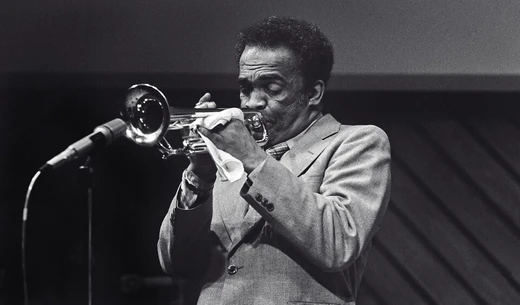
Kenny Dorham
Bebop trumpeter known for his pure tone and underrated status.
Last updated

via Wikipedia: Kenny Dorham · see source
McKinley Howard "Kenny" Dorham (August 30, 1924 – December 5, 1972) was an American jazz trumpeter, composer, and occasional singer. Critics and fellow musicians frequently praise his talent, but he never received the kind of attention or public recognition from the jazz establishment that many of his peers did. Writer Gary Giddins said that Dorham's name has become "virtually synonymous with 'underrated'." He composed the bossa nova jazz standard "Blue Bossa," which was first recorded by his associate Joe Henderson.
Career
Kenny Dorham was a busy bebop trumpeter who got his start in the big bands of Lionel Hampton, Billy Eckstine, Dizzy Gillespie, and Mercer Ellington, and later played in Charlie Parker’s quintet, joining in December 1948. He was an original member of the cooperative group the Jazz Messengers. As a sideman, he recorded with Thelonious Monk and Sonny Rollins, and after Clifford Brown died in 1956, Dorham took his place in the Max Roach Quintet. He also led his own groups, like the Jazz Prophets, which he formed shortly after Art Blakey took over the Jazz Messengers name.
That group featured a young Bobby Timmons on piano, Sam Jones on bass, J. R. Monterose on tenor sax, and guest guitarist Kenny Burrell; they recorded a live Blue Note album, ‘Round About Midnight at the Cafe Bohemia, in 1956. In 1956, Dorham shared a bill with Miles Davis. According to Davis’s biography, after the show, Jackie McLean told Davis that Dorham was playing so beautifully that Davis sounded like an imitation of himself. In 1963, Dorham added 26-year-old tenor saxophonist Joe Henderson to his band, and they later recorded the album Una Mas.
Their friendship led to more albums, including Henderson’s Page One, Our Thing, and In ‘n Out. Throughout the 1960s, Dorham recorded frequently for Blue Note and Prestige, both as a leader and as a sideman for Henderson, Jackie McLean, Cedar Walton, Andrew Hill, Milt Jackson, and others. Dorham’s later quartet included Tommy Flanagan on piano, Paul Chambers on bass, and Art Taylor on drums. Their debut recording was Quiet Kenny for Prestige’s New Jazz label, an album made up mostly of ballads.
Other work
An earlier quartet, co-led with alto saxophonist Ernie Henry, released 2 Horns / 2 Rhythm for Riverside Records in 1957, with bassist Eddie Mathias and drummer G.T. Hogan; it was reissued on CD in 1990 as Kenny Dorham Quartet featuring Ernie Henry. From 1958 to 1959, Dorham taught at the Lenox School of Jazz. He composed music for the film scores of Les Liaisons Dangereuses and Un Témoin dans la Ville, and wrote music criticism for Downbeat in the mid-1960s and early 1970s.
Legacy
Kenny Dorham was a legendary jazz trumpeter known for his deeply moving, pure tone. His sound was clear, sharp, and piercing, especially on ballads, where he could spin out phrases and lines. When he played a melody slowly and sweetly, it became an evocative event. In 2019, Dorham was honored in Austin, Texas, with a public mural by artist Jonathan "Chaka" Mahone.
The mural, part of the city's TEMPO 2D program, is located in East Austin near his alma mater, L.C. Anderson High School. It depicts Dorham with a large sunflower and celebrates the neighborhood's history as a beacon for culture. All five of Dorham's daughters attended a tribute concert at the University of Georgia in 2023. A Kenny Dorham Centennial Celebration took place at Jazz at Lincoln Center in 2024, featuring performers Bruce Harris, Joe Magnarelli, Jeremy Pelt, Jimmy Owens, Tim Hagans, David Wong, Noriko Ueda, Kenny Washington, Ulysses Owens, Jr., and Joe Farnsworth.
His middle daughter, Evette Dorham, has taught classes about his work for Jazz at Lincoln Center's Swing University program.
Did You Know?
- Dorham began learning piano as a child, then learned saxophone and trumpet at L.C. Anderson High School in Austin, Texas.
- He studied chemistry and physics at Wiley College before joining the United States Army.
More in Bebop Trumpeters
Sources
Compiled from Wikipedia and the sources listed below. Text from Wikipedia is available under CC BY-SA 4.0; this entry is adapted from it.
- Wikipedia: Kenny Dorham (CC BY-SA 4.0).
- Word definitions: the Codexery glossary, each quoted from its Wikipedia article.
Spotted an error? Know more?
Reader corrections go straight into our review queue. Suggest an edit · How this site is sourced