Barbecue
Cooking method using live fire and smoke, with regional variations.

Wikipedia / Wikimedia Commons
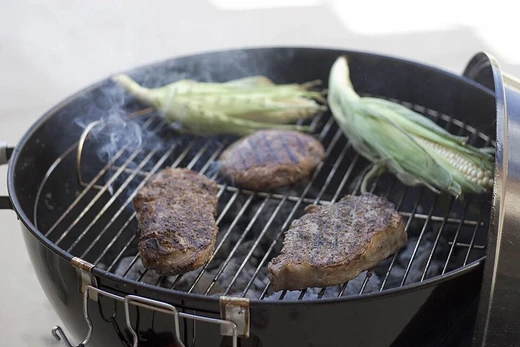
Barbecue, often shortened to BBQ globally and called a barbie or barby in Australia and New Zealand, refers to a range of cooking methods that use live fire and smoke. The word can describe the cooking equipment, the cuisine produced, or the social gatherings where such food is prepared and served. Techniques differ by region, falling into two main categories: direct and indirect heating.
Indirect barbecuing, common in the United States, involves roasting or smoking meat over wood or charcoal at low temperatures for several hours. Elsewhere, barbecuing more often means grilling food directly over hot coals or a gas flame, a quick process using dry heat.
The English word "barbecue" and its relatives come from the Spanish *barbacoa*, which traces back to a Taíno word. Etymologists believe it derives from *barabicu* in the languages of the Arawak people of the Caribbean and the Timucua people of Florida. The Oxford English Dictionary places its origin in Hispaniola, defining it as a "framework of sticks set upon posts." A popular but unsupported folk etymology claims it comes from the French *barbe à queue* ("from beard to tail"), referring to a whole animal roasted on a spit. The word has two English spellings: "barbecue" and "barbeque." While "barbecue" is standard in most countries, "barbeque" appears sometimes in Australia, New Zealand, and the US.
Spanish explorer Gonzalo Fernández de Oviedo y Valdés first printed the word *barbacoa* in Spain in 1526. After Columbus reached the Americas in 1492, Spaniards observed Taíno people roasting meat on a wooden framework set on sticks above a fire. This structure was also used for storing food and sleeping. The flames and smoke enveloped the meat, giving it flavor. The Spaniards called this framework a *barbacoa*. Another method involved digging a hole, burning logs, and placing stones to retain heat. Large cuts of meat, often a whole goat or lamb wrapped in leaves, were set above a pot to catch juices for broth, then covered with maguey leaves and coal and set alight, cooking for hours. Abolitionist Olaudah Equiano described this technique for roasting alligators among the Miskito people on the Mosquito Coast.
Linguists suggest the word passed successively into Spanish, Portuguese, French, and English. The form *barbacado* appeared in English in 1648 in a tract describing the province of New Albion, noting that Indians "barbacado or dry and smoak fish" instead of using salt. The Oxford English Dictionary records the first modern use in 1661, in Edmund Hickeringill's *Jamaica Viewed*, which mentions flesh being "Barbacu'd and eat." It also appears in 1672 in John Lederer's writings. The first noun use came in 1697 from buccaneer William Dampier, who wrote of sleeping on "Borbecu's, or frames of Sticks, raised about 3 foot from the Ground." By 1731, a New London, Connecticut, resident noted attending a "Barbaqued" entertainment. Samuel Johnson's 1755 dictionary defined "To Barbecue" as dressing a whole hog and "Barbecue" as a hog dressed whole. Today, the standard spelling is "barbecue," with "barbeque" as a variant; Oxford Dictionaries consider it a misspelling. In the Southeastern US, "barbecue" mainly refers to roast pork, while in the Southwest, beef cuts are often used.
Because the word came from native groups, Europeans gave it "savage connotations." Hickeringill's *Jamaica Viewed* reinforced this through descriptions of cannibalism, though scholar Andrew Warnes finds little proof of such tales. Another false depiction appears in Theodor de Bry's *Great Voyages*, which, according to Warnes, links smoke cookery to savagery and potential cannibalistic violence. Today, Americans associate barbecue with "classic Americana."
In American English, grilling means fast cooking over high heat, while barbecuing refers to a slow process using indirect heat or hot smoke, similar to some other methods.
- First English use (verb)
- 1661 by Edmund Hickeringill
Lore & Background
The English word barbecue and its cognates come from the Spanish barbacoa, derived from a Taíno word, likely barabicu of the Arawak and Timucua peoples. A folk etymology from French barbe à queue ('from beard to tail') is not supported by academic etymology. Spanish explorer Gonzalo Fernández de Oviedo y Valdés first printed the word barbacoa in 1526. After Columbus landed in the Americas in 1492, Spaniards found Taíno roasting meat over a wooden framework resting on sticks above a fire, which they called a barbacoa. Another form involved digging a hole, burning logs, placing stones, and cooking meat wrapped in leaves.
Reader's Guide
Barbecue's significance lies in its global variation and cultural associations. In the United States, indirect heating with low temperatures and long cooking times is typical, while elsewhere direct grilling over hot coals or gas is common. The word carried 'savage connotations' from European accounts, including Edmund Hickeringill's descriptions of cannibalism in Jamaica Viewed, though such tales are disputed. Today, barbecue is associated with 'classic Americana' in the US. Regional US styles include South Carolina's four sauces, North Carolina's vinegar- or ketchup-based sauces, Memphis dry rubs, Kansas City's thick tomato-based sauce, and St. Louis–style spare ribs. In South Africa, braais are informal gatherings around open fires. The spelling barbeque is a variant in some regions but considered a misspelling in standard English.
Did You Know?
- The Oxford English Dictionary traces the word to Hispaniola, translating it as 'a framework of sticks set upon posts'.
- The first recorded use of the modern form 'barbecu'd' was in 1661 in Edmund Hickeringill's Jamaica Viewed.
- Samuel Johnson's 1755 dictionary defined 'To Barbecue' as 'a term for dressing a whole hog'.
- The four recognized barbecue sauces are typically vinegar-based, tomato-based, mustard-based, and mayonnaise-based; South Carolina is uniquely home to all four.
Frequently Asked Questions
What is barbecue?
Barbecue is a broad term for cooking techniques that rely on live fire and smoke to prepare food, with the specific method shifting from one region to another. It also names the grills and pits used, the cuisines that result, and the social gatherings built around this style of eating.
Where does the word "barbecue" come from?
The term descends from the Taíno word "barabicu," which passed into Spanish as "barbacoa" before entering other languages. Its earliest known printed appearance dates to 1526, in a work by Gonzalo Fernández de Oviedo y Valdés published in Spain.
When did "barbecue" first show up in English?
Beauchamp Plantagenet used it as a verb in 1648, and William Dampier recorded it as a noun in 1697.
What are the accepted spellings of barbecue?
Both "barbecue" and "barbeque" are widely used in everyday writing. In Australia and New Zealand, people commonly shorten the word to "barbie" or "barby."
In which regions is barbecue most strongly associated?
The practice and culture of barbecue are most closely tied to the United States, Australia, New Zealand, South Africa, and South America. Each of these areas has developed its own distinct variations on the fire-and-smoke technique.
More in Barbecue & Grilling 1-15
Spotted an error? Know more?
This is a living reference — every entry is fact-audited, and reader corrections feed straight into our audit queue. Suggest an edit · See this site's audit record