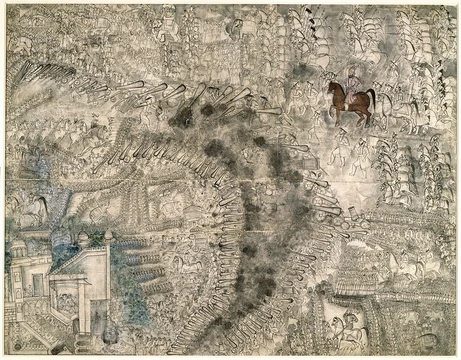
Battle of Kashmir (1814)
Sikh invasion of Kashmir repelled by Afghan defenses and harsh conditions.
The Battle of Kashmir in 1814 followed the battle of Attock and was a Sikh invasion of the Kashmir valley led by Ranjit Singh, Ram Dayal, and Hari Singh Nalwa. The expedition faced severe difficulties from terrain, weather, and local resistance, ultimately forcing a complete withdrawal. Kashmir remained under Afghan control until the battle of Shopian in 1819.
Quick Facts
- Conflict
- Kashmir expedition (1814)
- Location
- Kashmir
- Part of
- the Afghan–Sikh Wars
- Date
- March 1814 – August 1814
- Result
- Durrani victory
Facts from the source article.
Background
Ranjit Singh first considered conquering Kashmir in 1799 after Zaman Shah Durrani withdrew from the Punjab, but his force under Sahib Singh Bhangi advanced no farther than Bhimber. In 1808 he deployed spies on the road to Kashmir and began subjugating Bhimber in 1811 and Rajouri in 1812. The Afghan governor of Kashmir at that time was Ata Muhammad Khan. Fateh Khan Barakzai, the Afghan Wazir, wanted to depose Ata Muhammad Khan for aiding Shah Shuja Durrani and failing to pay tribute, and was also attracted by the region's wealth.
He formed an alliance with the Sikhs, and a treaty was made at Rohtas on 1 December 1812, with Ranjit Singh providing 12,000 men under Dewan Mokham Chand. The combined Afghan-Sikh force captured Kashmir, but Fateh Khan Barakzai kept control and awarded the governorship to his brother Azim Khan. After the battle of Attock, Ranjit Singh continued his ambitions, having forced many hill states south of the Pir Panjal Range into submission. He inspected his troops in December 1813 in preparation for a Kashmir campaign.
Expedition
In March 1814 Ranjit Singh mobilized his armies and advanced on Kashmir, reaching Bhimber in June and then Rajouri. The chief of Rajouri, Raja Aghar Khan, misled the Sikhs into leaving their heavy cannons at Rajouri, taking only light guns. The Sikh army split: a 30,000-man contingent under Ram Dayal, Khushal Singh Jamadar, and Hari Singh Nalwa marched to the Pir Panjal Pass, while Ranjit Singh led his contingent toward the Tosa Maidan. Ranjit Singh's force moved through Poonch and beyond Rajauri on 16 June.
Mazhar Ali sent artillery toward the Tosa Maidan pass but was blocked by Ruhullah Khan, ruler of Poonch; a skirmish left about 500 killed and wounded on both sides. Aghar Khan joined Ruhullah Khan and spread rumors of a Sikh defeat, prompting locals to plunder the Sikh camp, which lost 2,000 guns and 2,000 swords. The two chiefs then harassed the Sikh forces. On 2 July it was reported that Sikh forces were depleting from starvation; Sujan Rae Adalti and his 4,000 men deserted on 5 July.
Ruhullah Khan ordered the destruction of food and encouraged guerilla attacks. On 18 July the Sikhs reached Tosa Maidan, where Ruhullah Khan fought them on 29 and 30 July, compelling Ranjit Singh to retreat to Mandi with heavy losses. Rain continued to hamper both sides. On 5 August, after arriving at Sandha, Ranjit Singh found his guns could not cross a stream and discovered Azim Khan firmly entrenched in the Tosa Maidan pass defenses.
More in Battles Involving the Durrani Empire
Spotted an error? Know more?
Reader corrections go straight into our review queue. Suggest an edit · How this site is sourced