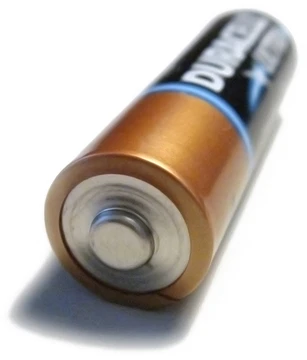
Photoflash battery
Zinc-carbon cell optimized for brief, high-current flashbulb pulses.
Last updated
A photoflash battery is a type of zinc-carbon cell designed to deliver a very strong burst of electric current for a brief moment, enough to trigger a flashbulb. Its lifespan is short when used in devices that need a steady, lower current, like a flashlight with an incandescent bulb. These batteries were made during the time of flashbulbs and were gradually replaced as alkaline cells became common and single-use flashbulbs gave way to electronic flash. They came in 1.5-volt D, C, AA, and AAA sizes.
In a standard zinc-carbon cell, the cathode is usually made from powdered carbon black or acetylene black, manganese dioxide, and electrolyte. The ratio of manganese dioxide to carbon in general-purpose cells ranges from 10:1 to 3:1, but for photoflash batteries, a 1:1 mixture is used. This allows for high current output during intermittent use, as needed for flash photography. However, these cells have lower overall capacity than those with more manganese dioxide.
Another common type of photoflash battery is a series assembly of cells, often providing 22.5 volts, used in battery–capacitor flash units. In this setup, the battery slowly charges a capacitor, which then releases a high-current pulse to ignite the flashbulb. Higher-voltage photoflash batteries were also made to fire reusable xenon electronic flash tubes, which require high voltage without needing extra circuitry to step up the voltage from low-voltage batteries. For example, Eveready manufactured a 240-volt battery (model 491, NEDA 729) and a 497 battery that provided 510 volts and 180 volts.
Quick Facts
- Cathode mix
- 1:1 ratio of MnO2 to carbon black (or acetylene black)
- Higher voltage examples
- Eveready 491 (240 V, NEDA 729); Eveready 497 (510 V and 180 V)
Facts from the source article.
Lore & Background
The photoflash cell was in production during the flashbulb era and was phased out as alkaline cells came into general use and one-use flashbulbs were replaced by electronic flash. The cathode of a zinc-carbon cell is usually made of powdered carbon black (or acetylene black), manganese dioxide and electrolyte. For general purpose cells the MnO2 to carbon ratio varies between 10:1 and 3:1, but a 1:1 mixture is used for photoflash batteries, allowing a high current output with intermittent use. These cells have lower capacity than those with a higher content of MnO2.
Another common type of photoflash battery is a series assembly of cells, often providing 22.5 volts, used in battery–capacitor flash units. The battery slowly charges a capacitor, which is then discharged through a flashbulb to provide a high-current pulse to ignite the bulb. Higher-voltage photoflash batteries were also made to fire reusable xenon electronic flash tubes, which require a high voltage, without the use of circuitry generating this voltage from low-voltage batteries. Eveready battery manufactured the 240-volt Eveready 491 (NEDA 729) battery, and the 497 battery providing 510 volts and 180 volts.
Reader's Guide
The photoflash battery represents a specialized adaptation of zinc-carbon chemistry to meet the transient high-current demands of photographic flash. Its significance lies in the deliberate alteration of the cathode composition—a 1:1 MnO2 to carbon ratio instead of the typical 10:1 to 3:1—which sacrifices overall capacity for the ability to deliver a powerful surge on demand. This design trade-off made it ideal for firing flashbulbs, where a brief, intense pulse was needed, but unsuitable for continuous-drain applications like flashlights, where service life was short.
The legacy of the photoflash battery is tied to the evolution of photography. As alkaline cells became common and electronic flash replaced single-use flashbulbs, the need for these specialized cells diminished. However, the higher-voltage variants, such as the 240-volt Eveready 491 and the 510/180-volt Eveready 497, served a transitional role in powering xenon flash tubes directly, bypassing the need for voltage-boosting circuitry. These batteries illustrate how chemistry and device design co-evolved to solve specific engineering challenges before being superseded by more versatile technologies.
More in Battery Types
Sources
Compiled from Wikipedia and the sources listed below. Text from Wikipedia is available under CC BY-SA 4.0; this entry is adapted from it.
- Wikipedia: Photoflash battery (CC BY-SA 4.0).
- Word definitions: the Codexery glossary, each quoted from its Wikipedia article.
Spotted an error? Know more?
Reader corrections go straight into our review queue. Suggest an edit · How this site is sourced