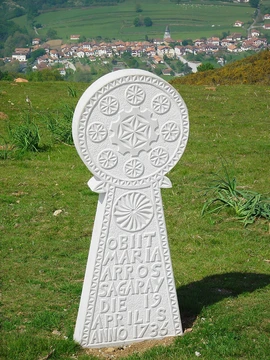
Sorginak
Assistants of Mari, also Basque for witches and priests.
Sorginak are the assistants of the goddess Mari in Basque mythology, and the term also serves as the Basque name for witches, priests, and priestesses. This dual meaning makes it difficult to separate mythological beings from historical religious figures. They are sometimes confused with lamiak, and together with lamiak and Jentilak are said to have built local megaliths.
Quick Facts
- Root form
- sorgin
- Absolutive singular
- sorgina
- Associated goddess
- Mari
- Notable trial
- 1610 process of Logroño
- Trial location
- Zugarramurdi
- Symbolic executions
- 5
Facts from the source article.
Did You Know?
- The common suffix -gin means actor, from egin (to do).
- One theory derives sor from sorte (fortune), meaning fortune-teller.
- Another theory states sor is the radical of sor(tu) (to create), so sorgin literally means creator.
Major persecutions against Basque witches
In the late Middle Ages, references to witchery were limited to fines against accusers. The 16th and 17th centuries brought change with the Spanish Inquisition and the pan-European witch panic. The 1610 Logroño process focused on the akelarre of Zugarramurdi. The previous year, French judge Pierre de Lancre initiated a massive process in Labourd, mainly against Basque women and priests, causing many deaths before being displaced. The witch panic crossed the frontier, and accusations spread until the Inquisition intervened. The Logroño process ended with 12 people burnt at the stake, five symbolically as they had died under torture. This shattered Pyrennean Navarre and led the Inquisition to reconsider its attitude toward witchcraft accusations. The Spanish and Italian Inquisition generally approached sorcery accusations with skepticism, and such processes were rare compared to other European countries.
Places associated with sorginak
Many locations in the Basque Country are linked to sorginak, often also associated with Mari or other mythological figures. In Aramaio, the places of Abadelaueta, Anbotondo, and Amezola, as well as an undetermined field at Gorbea mountain, are said to have been sites of akelarres. Margarita Jauri, a woman from Maeztu, was tried by the Inquisition in the Zugarramurdi coven case; though acquitted, she committed suicide after her detention and torture. The field of Urkiza or Urkizo in Urizaharra appears to have been the local akelarre site. Anboto peak is the principal home of Mari, also called Anbotoko Sorgina and Anbotoko Damie, with her home in an unreachable cave known as Sorginkoba. In Dima, the farmhouse of Petralanda was the main akelarre site of the Arratia Valley in the 16th century according to inquisitional records. Durango was the center of a medieval Beguine heresy ending with 13 people burnt at the stake, and later held other inquisitional trials. The cave of Azkondo in Mañaria was the witches' meeting place; José Miguel Barandiaran noted that cliffs between the field of Akelarre and the cave of Silibranka were the playfield of demons. Murueta has Etxebartxuko-landa as a local legend site. Muxika has several akelarre sites called generically eperlanda. Orozko points to Garaigorta mountain as the local akelarre site, and the cave of Supelegor in Itxina is associated with witches and lamiak, considered one of Mari's mansions. Zalla is called the town of sorcerers. Zeberio's witches went to the Petralanda akelarre but also met at Hereinoza household. An old bridge in Andoain is said to have been built by witches.
More in Basque Mythology
Spotted an error? Know more?
Reader corrections go straight into our review queue. Suggest an edit · How this site is sourced