
BC Kalev
Estonian basketball club with 15 national league titles.

Squad0273 · CC0
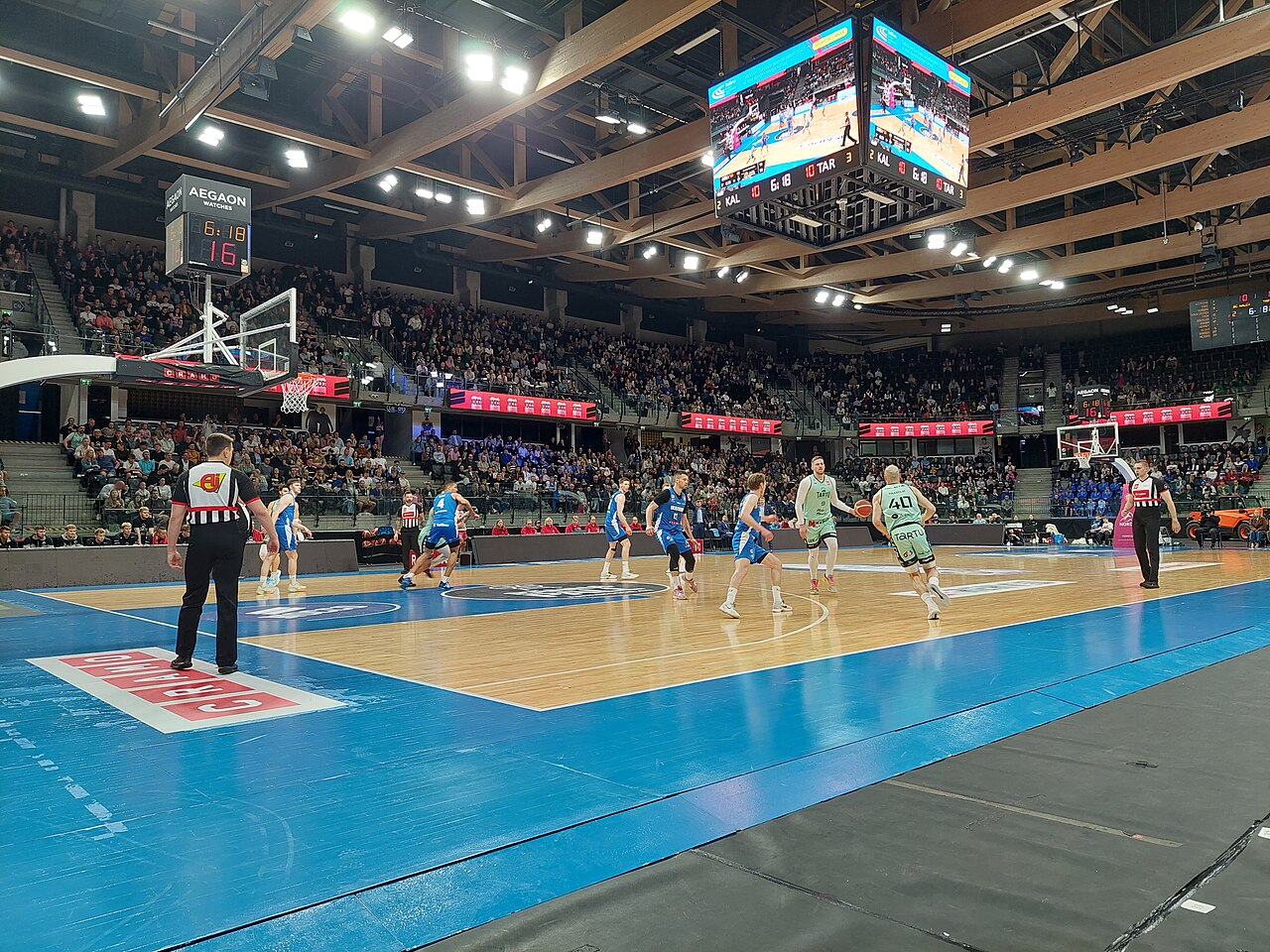
BC Kalev, which competes under the sponsorship name Bigbank/Kalev, is a professional basketball team from Tallinn, Estonia. They participate in the Korvpalli Meistriliiga (KML), the Estonian-Latvian Basketball League, and the FIBA Europe Cup, and play their home games at the Kalev Sports Hall. Over the past twenty years, they have become Estonia’s most successful club, collecting one Estonian-Latvian League title, 14 Estonian League championships, and 9 Estonian Cup victories.
The club was founded in 1998 as the Canon Estonia junior team, coached by Allan Dorbek, and initially played at the Kalev Sports Hall. Their first season ended winless and in last place. In 1999, Ehitustööriist became the team’s name sponsor. A one-season merger with Audentes in 2003, under the name Ehitustööriist/Audentes, was short-lived, and the club continued independently. For the 2004–05 season, they moved to the Saku Suurhall (now Unibet Arena) and entered the Baltic Basketball League (BBL). That year, they claimed their first Estonian championship by defeating Tartu Ülikool/Rock in a seven-game final series, with Howard Frier earning KML MVP honors.
After that title, Ehitustööriist leased the BC Kalev trademark from AS Kalev and became BC Kalev/Cramo. (The trademark had originally belonged to Wiklar bilansis, then passed to BC Rakvere Tarvas after Wiklar’s bankruptcy, and was sold to AS Kalev in 2002.) Allan Dorbek was replaced as head coach by Aivar Kuusmaa. On 2 October 2005, the team won its first Estonian Cup, beating TÜ/Rock 70–64. That season also marked their European debut in the FIBA EuroCup, though they did not advance past the group stage. They defended their KML title in 2006, again edging TÜ/Rock in a seven-game finals, with James Williams named Finals MVP. Despite back-to-back championships, Kuusmaa was replaced by Veselin Matić for the 2006–07 season.
In 2006–07, BC Kalev/Cramo won another Estonian Cup but lost the league finals to rivals TÜ/Rock. They finished in the top six of the BBL, and Travis Reed was named MVP in both the BBL and KML, while Valmo Kriisa was named Estonian Basketball Player of the Year. In Europe, they reached the second round of the FIBA EuroCup and later competed in the 2007–08 ULEB Cup, but failed to advance past the group stage. Another Estonian Cup followed in 2007.
Quick Facts
- Nickname
- Kalev, Kalevlased
- Leagues
- Korvpalli Meistriliiga / Estonian-Latvian Basketball League
- Founded
- 1998
- History
- Canon ENM / (1998–1999) / Ehitustööriist / (1999–2005) / BC Kalev / (2005–present)
- Arena
- Kalev Sports Hall / Nord Sports Hall
- Capacity
- 1,700 / 1,066
- Location
- Tallinn, Estonia
- Sponsor
- Bigbank
- President
- Toomas Linamäe
- Gm
- Ramo Kask
- Coach
- Brett Nõmm
Facts from the source article.
Lore & Background
Founded in 1998 as Canon Eesti noortemeeskond, the club started under coach Allan Dorbek and played at Kalev Sports Hall. Their first season ended winless. In 1999, Ehitustööriist became name sponsor. After a brief merger with Audentes in 2003, the club moved to Saku Suurhall for 2004–05 and debuted in the Baltic Basketball League. They won their first Estonian championship in 2005, defeating Tartu Ülikool/Rock four games to three.
In 2005, the club leased the trademark 'BC Kalev' from AS Kalev and became BC Kalev/Cramo. Under coach Aivar Kuusmaa, they won their first Estonian Cup in October 2005 and debuted in the FIBA EuroCup. They defended their league title in 2006.
Reader's Guide
BC Kalev is the most successful Estonian basketball club of the last two decades, with 15 Estonian League championships and 10 Estonian Cup titles. Their significance lies in consistent domestic dominance and participation in multiple international competitions, including the FIBA Europe Cup, Baltic Basketball League, VTB United League, and the Estonian-Latvian Basketball League, which they won once. The club has been a platform for notable players such as Kristjan Kangur, Tanel Sokk, and Maurice Kemp, and has undergone several name changes reflecting sponsorship and trademark arrangements. Their home arena is the Kalev Sports Hall, though larger games are hosted at Unibet Arena or Tondiraba Sports Center. The club's history includes coaching changes, playoff sweeps, and a withdrawal from the VTB United League in 2022. BC Kalev's legacy is defined by sustained success in Estonia and periodic forays into European competition.
Did You Know?
- The club was founded in 1998 as Canon Eesti noortemeeskond and lost every game in its first season.
- BC Kalev/Cramo won their first Estonian-Latvian League title in 2021, defeating VEF Riga 86–75.
- The team withdrew from the VTB United League on 24 February 2022 due to the Russian invasion of Ukraine.
- BC Kalev/Cramo reached the FIBA Europe Cup semifinals in 2023, losing to Cholet Basket.
Humble Origins and the Road to First Glory
Founded in 1998 as Canon Estonia's junior team under coach Allan Dorbek, the club that would become BC Kalev began its journey at the Kalev Sports Hall in Tallinn. The inaugural campaign was a stark reminder of how far the project still had to grow — the squad finished dead last without claiming a single victory. Sponsorship shifted to Ehitustööriist in 1999, and a brief operational merger with Audentes in 2003 lasted only one season before the club continued independently. The turning point arrived in the 2004–05 season, when the team relocated to the newly opened Saku Suurhall (today's Unibet Arena) and made its debut in the Baltic Basketball League. That same year, the long wait for domestic silverware ended: Ehitustööriist defeated Tartu Ülikool/Rock in a hard-fought seven-game final, taking the series four games to three. Howard Frier's outstanding performance earned him the KML Most Valuable Player honor, capping a season that transformed a struggling newcomer into a genuine championship contender.
A Dynasty Forged in Tallinn
Few Estonian basketball clubs can match the depth of BC Kalev's domestic trophy cabinet. Across roughly two decades, the team has collected fifteen Estonian League championships and ten Estonian Cup titles, making it the most decorated club in the country's top flight. The Estonian Cup alone saw the team lift the trophy in 2005, 2007, 2008, 2009, 2015, and 2016, among other years. The Estonian-Latvian League added another dimension, with BC Kalev claiming its sole championship in that combined competition. The defining narrative of their domestic success is the repeated clash with Tartu Ülikool/Rock in the KML Finals. From the 2005 seven-game thriller to the 2006 decider won by a single point, from the 2009 four-game series to the 2011 and 2012 sweeps, the rivalry produced some of the most memorable finals in Estonian basketball history. Even in the 2015–16 season, when the team went undefeated through the regular season and extended that streak into the playoffs, the finals opponent was once again Tartu Ülikool.
Reaching Beyond the Baltics
While domestic dominance defined BC Kalev's identity, the club has also pursued a meaningful presence on the European stage. Their continental journey began in the 2005–06 FIBA EuroCup, where they fell at the group stage. Subsequent campaigns in the 2006–07 FIBA EuroCup (reaching the second round) and the 2007–08 ULEB Cup (again eliminated in the group phase) showed incremental progress but no breakthrough. The 2013–14 EuroCup, featuring a roster anchored by Frank Elegar, Vlad Moldoveanu, and Rain Veideman, also ended at the group stage. A more significant leap came in July 2009, when the club joined the newly created VTB United League. Though early seasons in that competition were challenging — the 2009–10 KML campaign saw them finish fourth in the regular season and lose to TÜ/Rock in the semifinals — the 2019 VTB season marked a milestone: led by Arnett Moultrie, BC Kalev/Cramo reached the VTB United League playoffs for the first time in club history, only to be swept in three games by UNICS Kazan in the quarterfinals. The 2018 launch of the Estonian-Latvian Basketball League offered another continental platform, where the team finished third in the inaugural season.
Coaches, Legends, and the Human Story
Behind every championship banner stands a rotating cast of coaches and players who shaped the club's character. Allan Dorbek guided the team from its 1998 founding through its first title, before Aivar Kuusmaa took the helm and delivered back-to-back league titles in 2005 and 2006. Kuusmaa's tenure was not linear — he was replaced by Veselin Matić, then Nenad Vučinić, then assistant Alar Varrak, and later Donaldas Kairys, each leaving a distinct imprint. Players like Howard Frier, Travis Reed (who earned both BBL and KML MVP honors in 2006–07), Tanel Sokk (a two-time consecutive Finals MVP in 2012–13 and 2013–14), Vlad Moldoveanu, and Kristjan Kangur (who returned after an eight-year absence to claim Finals MVP in 2018) became living symbols of the franchise. The 2015–16 season, in which the team went undefeated through the regular season and into the playoffs before Rolands Freimanis was named Finals MVP, remains a benchmark of collective excellence. Each era added a new chapter to a story that began with a last-place finish and a single coach's vision in a small Tallinn hall.
Gallery
Frequently Asked Questions
What is BC Kalev?
BC Kalev is a professional basketball club based in Tallinn, Estonia, currently playing under the sponsorship name Bigbank/Kalev. They are widely considered the most successful basketball club in Estonian history.
Where does BC Kalev play its home games?
The team hosts its domestic and European matches at the Kalev Sports Hall in Tallinn.
How many titles has BC Kalev won?
Over the past two decades the club has collected 14 Estonian League championships, 1 Estonian-Latvian League title, and 9 Estonian Cup trophies. That haul makes them the most decorated club in Estonian basketball.
When and how was BC Kalev founded?
The club traces its origins to 1998, when it was set up as the Canon Estonia junior squad under head coach Allan Dorbek. It has since grown into Estonia's leading professional basketball outfit.
Which competitions does BC Kalev take part in?
The team competes in the Korvpalli Meistriliiga, the Estonian-Latvian Basketball League, as well as the FIBA Europe Cup at the continental level.
More in Basketball teams in Estonia 1-19
Spotted an error? Know more?
Reader corrections go straight into our review queue. Suggest an edit · How this site is sourced