
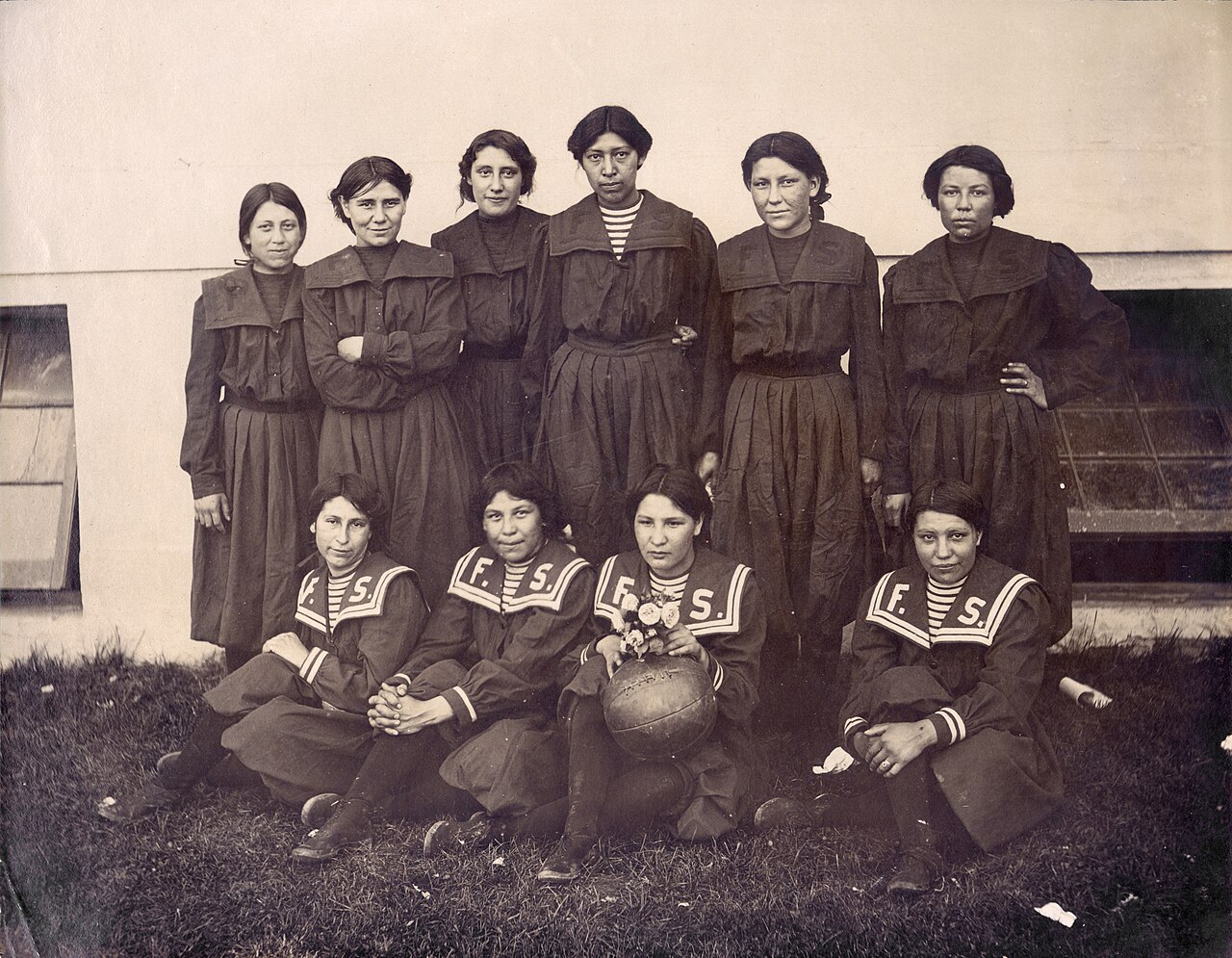
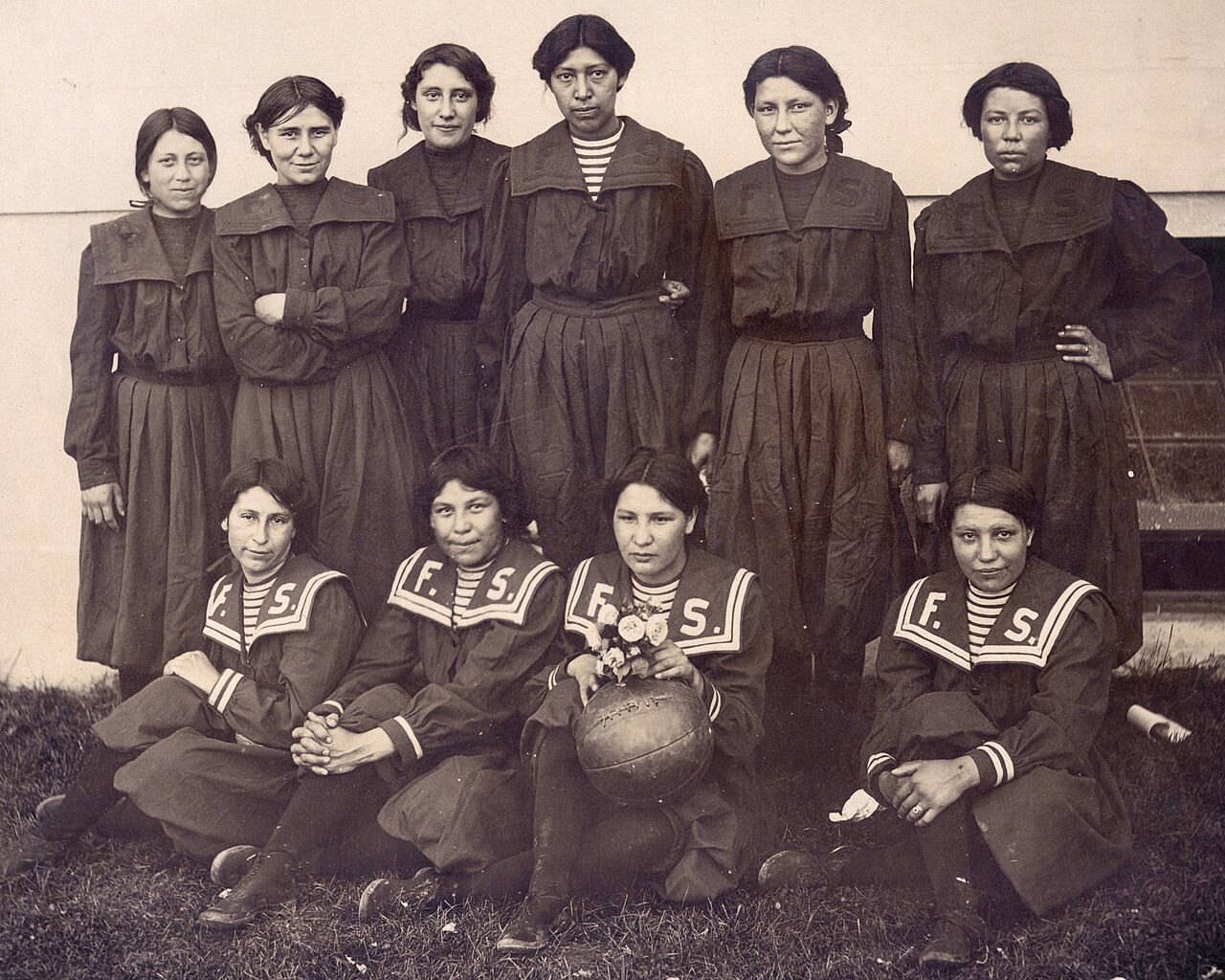
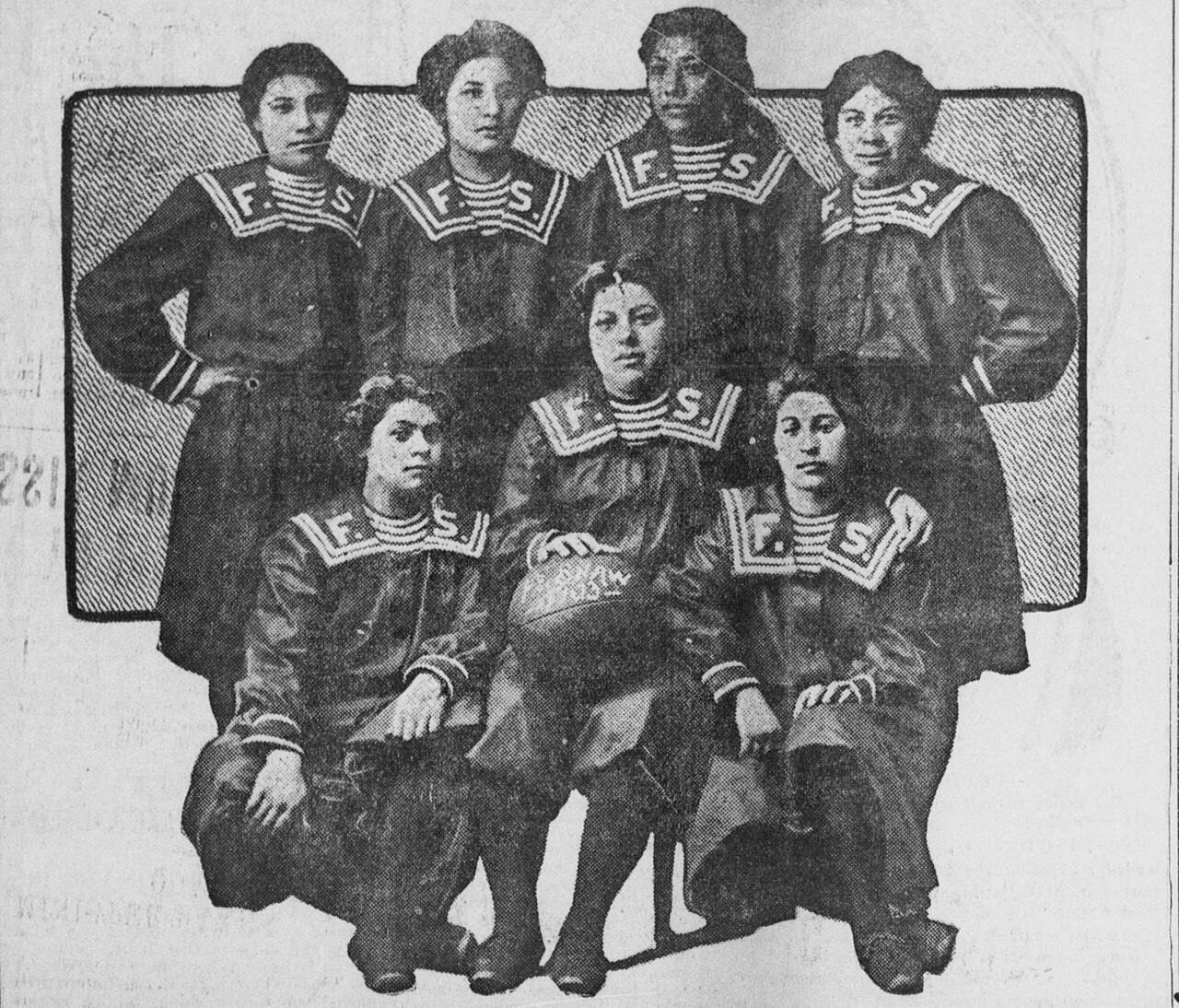
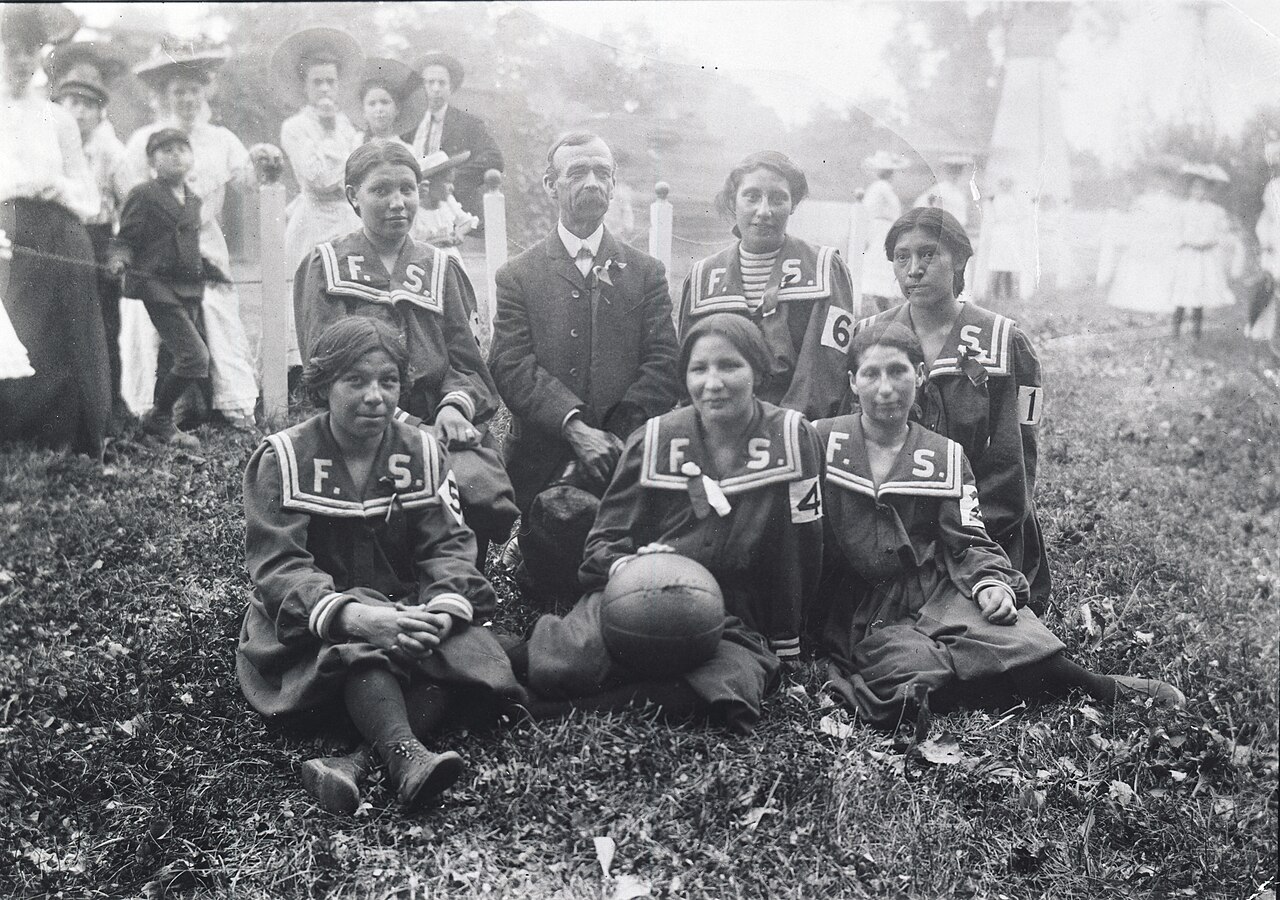
Fort Shaw Indian School Girls Basketball Team
Nine Native American girls earned a silver trophy at the 1904 Louisiana Purchase Exposition.

Wikipedia / Wikimedia Commons
The Fort Shaw Indian School Girls Basketball Team consisted of nine Native American girls from different tribes, all students at the Fort Shaw Indian Boarding School in Fort Shaw, Montana. At the 1904 Louisiana Purchase Exposition, known as the St. Louis World Fair, they defeated basketball teams from across the United States and other countries, earning a silver trophy and being celebrated by promoters as 'world champions,' though this was not an official title.
American Indian boarding schools, also called Indian Residential Schools, were created in the 1800s and 1900s to assimilate Native children into Euro-American culture. The first such school, the Carlisle Indian Industrial School, was founded by Richard Henry Pratt, who based it on his military experience. His motto was "kill the Indian and save the man." Students were forced to abandon tribal clothing and given Christian names, and they were often kept from visiting their families or practicing their languages and customs. The Fort Shaw school followed Carlisle’s model.
Sports were a key part of boarding school life and were used to promote assimilation. Carlisle became famous for its football and other athletic programs. Historians agree that the main reason for athletics was to improve physical health, as disease and high death rates among students were serious concerns—exposed in the 1928 Meriam Report. Outdoor exercise was seen as the best way to fight illness. At the time, sports were also thought to build moral character, especially in boys, by teaching hard work, discipline, and sportsmanship. Pratt believed that Native American athletic teams could show white society that Indians were not "savages" and could compete fairly in white games.
Fort Shaw was originally a U.S. Army post built between Fort Benton and Helena to protect settlers from Indian attacks. The army abandoned it on July 1, 1891. In 1892, after a government school in northeastern Montana burned down, the Department of the Interior turned nearly 5,000 acres of the fort into the Fort Shaw Government Industrial Indian Boarding School. It opened on December 27, 1892, with 52 students. By 1900, enrollment had grown to over 300 students, ages five to eighteen, with 30 staff. Academic classes were held in the mornings, and vocational training like cooking and sewing in the afternoons. The Blackfoot tribe had the most students at t
- team_name
- Fort Shaw Indian School Girls Basketball Team
- year_formed
- 1902
- number_of_players
- 9
- championship
- Silver trophy at the 1904 Louisiana Purchase Exposition (often referred to as 'world champions' by promoters, though not an official title)
- school_location
- Fort Shaw, Montana, United States
- notable_achievement
- First women's basketball team to win a championship at the Louisiana Purchase Exposition
Lore & Background
The original nine players included Genie Butch, Belle Johnson, Nettie Wirth, Minnie Burton, Emma Rose Sansaver, Josephine Langley, Katie Snell, Rose LaRose, and others. Belle Johnson became captain during the second season after Josephine Langley left the team. Josephine Langley learned basketball at Fort Shaw, not Carlisle, and introduced the game to her teammates after learning it from a teacher or other source. The team was coached by superintendent Frederick C. Campbell, who expanded the athletic program and introduced competitive basketball to surrounding schools. Assistant coach Sadie Malley insisted the team not play by 'girls' rules' (half-court). Lizzie Wirth served as chaperone, and Fern Evans and Lillie B. Crawford organized music and recitation performances to fund travel and games.
Reader's Guide
The Fort Shaw Indian School Girls Basketball Team's victory at the 1904 World Fair was a significant achievement, demonstrating the athletic capability of Native American students within the assimilationist boarding school system. The team emerged from an environment where athletics were promoted for physical health and to counter negative stereotypes, as advocated by Richard Henry Pratt. The girls' success challenged prevailing views of Native Americans, yet occurred within a system designed to erase their cultures. Their story highlights the complex role of sports in Indian boarding schools—as a tool for assimilation but also as a space for Native American achievement and pride. The team's world championship remains a landmark in women's basketball history, predating many later developments in the sport.
Did You Know?
- The team consisted of nine players, not seven as previously thought.
- Their victory at the 1904 Louisiana Purchase Exposition earned them a silver trophy, and promoters called them 'world champions,' but it was not an official world championship title.
- Josephine Langley learned basketball at Fort Shaw, not at the Carlisle Indian School.
The 1904 World Championship
The Fort Shaw girls' basketball team achieved what remains one of the most remarkable athletic feats in early American sports history. Comprising seven Native American students from diverse tribal backgrounds, they traveled to the 1904 Louisiana Purchase Exposition in St. Louis — the event more widely recognized as the St. Louis World Fair — and emerged as World Champions. Their victory came against basketball teams representing not only various regions of the United States but also international competitors. For a group of young women from a small government boarding school in north-central Montana, this triumph carried extraordinary weight. It was a public, high-profile demonstration of athletic excellence on a world stage, achieved during a period when Native Americans faced systemic marginalization. The team's success at the fair was also tied to a broader program of performances — including music, recitation, and choreographed exercises — that helped fund their travel and competition. Their championship stands as a singular moment of pride in a history otherwise dominated by forced cultural erasure.
The Boarding School System
The Fort Shaw Indian Boarding School existed within a broader federal apparatus designed to assimilate Native American children into Euro-American culture. The model traced back to Richard Henry Pratt, who established the Carlisle Indian Industrial School with a curriculum shaped by his military experience. His stated objective — to kill the Indian and save the man — encapsulated the philosophy driving these institutions. Students arriving at schools like Fort Shaw were stripped of tribal clothing, assigned Christian names, and separated from families and familiar languages. Fort Shaw itself, located in north-central Montana, had originally been a military fort built to protect settlers. After the Army abandoned the site in 1891, the Department of the Interior repurposed nearly 5,000 acres as a government industrial boarding school, opening in December 1892 with just 52 students. By the turn of the century, enrollment had swelled past 300 children aged five to eighteen. The Blackfoot tribe provided the largest share of students. Athletics were woven into the daily structure, partly to combat the diseases and poor health that plagued boarding school populations — a crisis later exposed by the 1928 Meriam Report.
Building a Team from Scratch
The Fort Shaw girls' basketball program did not emerge from a tradition of competitive play. When the team was first organized in 1902, none of the seven players had ever touched a basketball. Their athletic background came instead from traditional Native field games such as shinney and double ball. The sport had been introduced to the school by Josephine Langley, a student and Indian Assistant who had encountered basketball during a semester at the Carlisle Boarding School. With the backing of superintendent Frederick Campbell, the former military dance hall was converted into a court, and basketball became the girls' winter indoor activity. Campbell, who had served as both superintendent and coach, had expanded the school's athletic program because he believed competition bolstered student self-esteem — a conviction rooted in his own experience playing baseball at the University of Kansas. He also introduced competitive basketball to surrounding schools so Fort Shaw would have opponents. By the team's second season, assistant coach Sadie Malley insisted the girls compete under the full-court, 20-minute-half rules used by boys rather than the half-court girls' rules, a decision that shaped how the team developed its identity and skill.
Life Beyond the Court and the School's End
The Fort Shaw girls' basketball team existed within a school that would not survive long after their championship. On April 17, 1910, the institution lost its government funding amid growing congressional support for abolishing non-reservation schools and increasing integration of public education. The site was ceded back to the U.S. government, ending an era that had spanned barely two decades. For the students, the school had been both a site of cultural suppression and, paradoxically, a space where certain forms of self-expression flourished. In many Native American cultures, girls were encouraged to participate in sports with the same intensity as boys, and the enthusiastic reception to the basketball team at Fort Shaw reflected that tradition. Basketball was also the only sport girls were permitted to play, making the team a unique outlet. Beyond the court, the girls prepared choreographed exercises, musical performances led by teacher Fern Evans, and recitations trained by Lillie B. Crawford — all part of the program they performed at the 1904 fair to fund their travel and competition. The team's story thus intertwines athletic achievement with the broader struggle for cultural survival.
Gallery
More in Basketball at the Summer Olympics 1-24
Spotted an error? Know more?
This is a living reference — every entry is fact-audited, and reader corrections feed straight into our audit queue. Suggest an edit · See this site's audit record