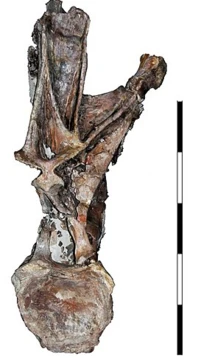
Huaxiagnathus
A coelurosaurian theropod from the Early Cretaceous of China.
Last updated
Huaxiagnathus is a genus of coelurosaurian theropod from China's Early Cretaceous. Its only species, Huaxiagnathus orientalis, is based on two immature skeletons from the Yixian Formation. This dinosaur might be a juvenile form of the later tyrannosauroid Sinotyrannus.
Scientific classification
- KingdomAnimalia
- PhylumChordata
- ClassReptilia
- CladeDinosauria
- CladeSaurischia
- CladeTheropoda
- Family†Compsognathidae
- Genus†Huaxiagnathus
- SpeciesHuaxiagnathus orientalis
Named by Hwang et al., 2004
Sources: Wikipedia taxobox: Huaxiagnathus (CC BY-SA 4.0)
How big is it?
Largest length in the source, 1.8 m, next to a 1.8 m person.
Diagram: drawn by Codexery, schematic shapes to scale (not a likeness). Length: Wikipedia: Huaxiagnathus
Quick Facts
- Species
- orientalis
Facts from the source article.
Description
The best-known Huaxiagnathus fossil is a subadult, almost complete skeleton missing only the tail tip and split across five large slabs. Inside it, researchers found partly digested bones from an unknown vertebrate.
An older, larger Huaxiagnathus specimen had been found earlier in the same rock layer, but preparation errors and damage kept it from being the official type specimen. Huaxiagnathus was bigger than its relative Sinosauropteryx, with the largest individual measuring roughly 1.8 meters long. Its defining features include an unusually long rear extension of the premaxilla that covers the antorbital fossa, a hand as long as the upper arm and forearm combined, first and second claws that are nearly the same size and 167 percent the length of the third claw, a first metacarpal narrower at its base than the second, and a reduced olecranon process on the ulna.
Phylogeny
In 2004, Huaxiagnathus was recovered as the basalmost known compsognathid based on its unspecialized forearm. A 2024 study by Andrea Cau questioned this placement, recovering the taxon along with four other proposed compsognathids in a polytomy within basal Coelurosauria, excluding Compsognathus proper.
Using an updated matrix, Cau and Paterna (2025) determined that Sinotyrannus, a large coeval tyrannosauroid known from an adult, is a mature form of Huaxiagnathus; both share a dorsally convex ilium with a short preacetabular process lacking an anteroventral hook, and other differences are attributed to size and ontogenetic stage. Since Huaxiagnathus was named first, Sinotyrannus is a junior synonym. Qiu et al. (2025) argued against compsognathid monophyly and revised Sinosauropterygidae to include Sinosauropteryx, Huadanosaurus, Huaxiagnathus, Sinocalliopteryx, and Mirischia.
More in Barremian Dinosaurs
Sources
Compiled from Wikipedia and the sources listed below. Text from Wikipedia is available under CC BY-SA 4.0; this entry is adapted from it.
- Wikipedia: Huaxiagnathus (CC BY-SA 4.0).
- Word definitions: the , each quoted from its Wikipedia article.
Spotted an error? Know more?
Reader corrections go straight into our review queue. Suggest an edit · How this site is sourced