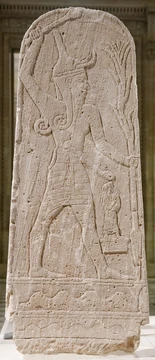
Baal with Thunderbolt
Last updated
The Baal with Thunderbolt, also known as the Baal stele, is a white limestone bas-relief from the ancient kingdom of Ugarit in northwestern Syria. Discovered in 1932 near the Temple of Baal, it is considered the most important of the Ugaritic stelae and is displayed at the Louvre in Paris. Its artistic style blends Egyptian and Syrian elements, reflecting Egyptian influence in Syrian art.
Overview
The stele is carved from white limestone, wider at the base, and measures 142 by 50 cm. It depicts two standing male figures: the larger is Baal, the god of storms, rain, and agriculture, and the smaller most likely represents the king of Ugarit. Baal stands on a large pedestal bearing carved representations of mountains and the sea, symbols of his spheres of power. He faces right, with a raised right hand brandishing a club or battle-mace overhead, while his left hand holds a thunderbolt shaped like a spearhead extending toward the ground, its shaft in the form of a plant.
Baal wears a horned helmet, with braided hair falling over his back and right shoulder, and is clad only in a striped kilt with a wide belt and curved dagger. The smaller figure, bare-headed and in ceremonial dress, stands on a horned altar between the spear and the god, praying. The scene is interpreted as the king humbly submitting to Baal and receiving the god's protection. Baal's lightning is seen as thrusting a spear of vegetation into the ground from the sky, symbolizing the storm's necessity for harvest.
The size difference contrasts divine power with the king's relative weakness, as noted by historian Mark S. Smith. The horned helmet and thunderbolt represent fertility, and historian Alberto Green describes Baal as a vigorous, young, graceful, athletic deity marching forward.
Did You Know?
- Eight more stelae were recovered from the area around the Temple of Baal.
- Another fourteen stelae were unearthed in the Temple of Dagon and throughout the city.
- The stele was probably originally housed inside the Temple of Baal.
More in Baal
Sources
Compiled from Wikipedia and the sources listed below. Text from Wikipedia is available under CC BY-SA 4.0; this entry is adapted from it.
- Wikipedia: Baal with Thunderbolt (CC BY-SA 4.0).
Spotted an error? Know more?
Reader corrections go straight into our review queue. Suggest an edit · How this site is sourced