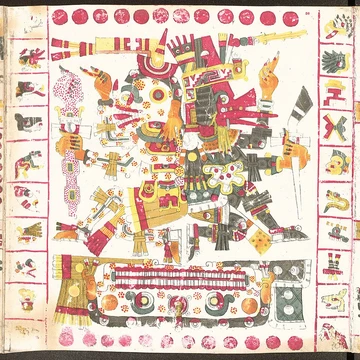
Tonal (mythology)
Mesoamerican belief in a lifelong spiritual bond with an animal.
Last updated
Tonal is a concept in Mesoamerican religion, cosmology, folklore, and anthropology. It refers to the belief that a person, from birth, shares a spiritual bond with an animal that lasts for both their lifetimes. This connection is similar to the idea of a totem, with the person experiencing physical signs corresponding to the animal's condition.
Quick Facts
- Nahuatl term
- tonalli
- Nahuatl meaning
- day or daysign
- Mayan term
- Way
- Mixe term
- Ts'ok
- Jakaltek maya term
- yixomal ispiẍan nax
- Jakaltek maya meaning
- soul bearer
Facts from the source article.
Etymology
The term "tonal" traces back to the Nahuatl word "tonalli," which means "day" or "daysign." In Aztec tradition, a person’s birth date within the tōnalpōhualli calendar shaped their character, since each day was linked to an animal with either a strong or weak aspect. The Nahuatl word "Tonalli" described both the day itself and its associated animal. Among the Maya, the idea of a personal animal companion was known as "Way." The modern Mixe people call this concept "Ts'ok," while the Jakaltek Maya of Concepcion Huista, Guatemala, use the phrase "yixomal ispiẍan nax," which translates to "soul bearer."
Studies
The academic exploration of tonalism began with Daniel Garrison Brinton, a scholar in archaeology, linguistics, and ethnology. In 1894, he authored "Nagualism: A Study in Native-American Folklore and History," detailing historical meanings of the term and its practitioners in Mexico. Brinton documented tonalist beliefs among contemporary groups like the Mixe, Nahuas, Zapotecs, and Mixtecs. These traditions have roots in older civilizations, including the Nahua, Olmec, and Toltec.
More in Aztec Mythology and Religion
Sources
Compiled from Wikipedia and the sources listed below. Text from Wikipedia is available under CC BY-SA 4.0; this entry is adapted from it.
- Wikipedia: Tonal (mythology) (CC BY-SA 4.0).
Spotted an error? Know more?
Reader corrections go straight into our review queue. Suggest an edit · How this site is sourced