Australian Grand Prix
Annual Formula One race in Melbourne since 1996.
Last updated

via Wikipedia: Australian Grand Prix · see source
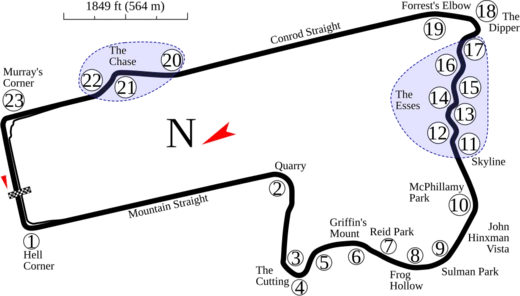
The Australian Grand Prix is an annual Formula One motor racing event held in Melbourne, Victoria, with a contract to remain at least until 2035. It is one of the oldest surviving motorsport competitions in Australia, having moved frequently across 23 different venues since its first running at Phillip Island in 1928. The race became part of the Formula One World Championship in 1985 and has been held at the Albert Park Circuit since 1996, except for cancellations in 2020 and 2021 due to the COVID-19 pandemic. Before that, it was held in Adelaide.
Quick Facts
- First held
- 1928
- Contract until
- 2035
Facts from the source article.
History
The Australian Grand Prix is generally accepted to have begun as the 100 Miles Road Race at the Phillip Island road circuit in 1928, though an event called the Australian Grand Prix was staged in 1927 at Goulburn Racecourse as a series of sprints. The inaugural 1928 race was won by Arthur Waite in a modified Austin 7 supported by the Austin Motor Company. From 1929, races were officially called the Australian Grand Prix, and Bugattis took four consecutive wins from 1929 to 1932.
The last Phillip Island race was in 1935, and the title lapsed for three years. A centennial South Australian Grand Prix was held on Boxing Day 1936 at Victor Harbor before the Australian Grand Prix title was revived in 1938 for the opening of Mount Panorama near Bathurst, won by Englishman Peter Whitehead in an ERA B-Type. One more race was held at Lobethal Circuit in 1939 before World War II. After the war, Mount Panorama held the first post-war Grand Prix in 1947, beginning a rotational system between Australian states fostered by the Australian Automobile Association.
Races used temporary airfield and street circuits until 1952, when Doug Whiteford won at Mount Panorama in a Talbot-Lago Formula One car, pointing to the future. Older Maserati, OSCA and Cooper machinery filtered through, but locally developed cars and the Maybach-based specials driven by Stan Jones remained competitive for several years.
Calendar change
When the Australian Grand Prix relocated to Melbourne, it shifted the timing of Formula 1’s annual trip Down Under. Adelaide had hosted the season finale for eleven years, typically in October or November, whereas Melbourne has opened the championship in 23 of its 28 editions. Albert Park has therefore witnessed the first F1 races of numerous drivers. Jacques Villeneuve, the 1997 world champion, debuted there in 1996 and became one of only three men to claim pole position on his first outing.
Other notable debuts at the circuit include Lewis Hamilton (2007), Max Verstappen (2015), Fernando Alonso and Kimi Räikkönen (both 2001), and Australian Mark Webber (2002). For over three decades, Supercars have run a non-championship support race at the Grand Prix; in 2018, this became a points-paying event called the Melbourne 400. The 2021 race was initially set for March as the season opener but was postponed to November because of COVID-19 restrictions, then cancelled on 6 July.
Economic impact
The economic impact of the Australian Grand Prix for Victoria is frequently debated. Proponents claim the event increases tourism, creates jobs and generates millions of dollars, while opponents dispute the benefits and cite taxpayer costs and disruptions. In 2014, the Victorian government claimed the annual economic impact was between $32 million and $39 million, while opponents claimed it cost taxpayers over $50 million. A 2022 Ernst & Young assessment found the 2022 Grand Prix generated an estimated $92 million in direct spending and boosted Victoria's Gross State Product by an estimated $171 million, also driving up hotel occupancy and hospitality patronage.
This mirrored a 2011 EY report commissioned by Tourism Victoria, which found international exposure and tourism spending generated between $32.04 million and $39.34 million for Victoria's Gross State Product and 351 to 411 full-time equivalent jobs. A 2023 EY assessment estimated the Grand Prix contributed $268 million to the Victorian economy, including $144 million in direct expenditure and 1,149 full-time equivalent jobs, with $128 million from 81,000 international and interstate visitors.
Spectator attendance since 1995
Following the move to Melbourne, spectator attendance peaked at 483,934 in 2026, but has never reached the 520,000 of the last Adelaide race in 1995. In 2009, higher unemployment and a snap public transport strike were cited by Victorian Premier John Brumby for a drop in crowds. Attendance improved in 2010 to an estimated 305,000, the largest since 2005. The Australian Grand Prix Corporation does not release precise crowd figures, citing security concerns; in 2022 it stated that disclosing figures could affect security by assisting threat actors.
After a 2023 freedom-of-information ruling by the Office of the Victorian Information Commissioner that disclosure was important for transparency, the Corporation successfully fought the order in the Victorian Civil and Administrative Tribunal in September 2024. Official attendance numbers, which are inexact and have been challenged by the anti-Grand Prix lobby group Save Albert Park as gross overestimates, include: 1995 (Adelaide) 520,000 (210,000 race day); 1996 (Melbourne) 401,000 (150,000 race day); 2004 360,885 (121,500 race day); 2005 359,000 (103,000 race day); 2010 305,000 (108,500 race day); 2019 324,000 (100,000 race day); 2022 419,114 (128,294 race day); 2023 444,631 (131,124 race day); 2024 452,055 (132,106 race day); 2025 465,498 (131,547 race day); 2026 483,934 (137,869 race day).
Did You Know?
- Jack Brabham's 1955 win at Port Wakefield was the first ever by a rear-engine car (Cooper T40).
- The 1956 race at Albert Park featured Stirling Moss and the factory Maserati team, with Moss winning from teammate Jean Behra.
More in Auto Races in Australia
Sources
Compiled from Wikipedia and the sources listed below. Text from Wikipedia is available under CC BY-SA 4.0; this entry is adapted from it.
- Wikipedia: Australian Grand Prix (CC BY-SA 4.0).
Spotted an error? Know more?
Reader corrections go straight into our review queue. Suggest an edit · How this site is sourced