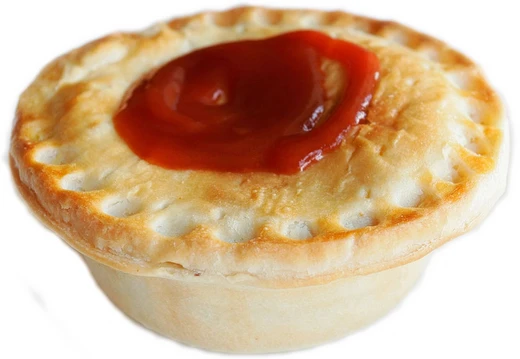
Game pie
A savoury pie of wild birds and animals, ancient in origin.
Game pie is a form of meat pie that features game animals and birds. Its origins trace to Roman times, when wild birds and animals such as partridge, pheasant, deer, and hare were used. The dish reached its most elaborate form in Victorian England, with complex recipes and specialized moulds, while modern versions are simpler savoury combinations of commercially available game.
Quick Facts
- Country
- Roman Empire
- Main ingredients
- Game meat (e.g. rabbit, bear, deer, etc.)
Facts from the source article.
Did You Know?
- In 1653, François Pierre La Varenne published Le Pâtissier françois, whose frontispiece shows a cook making a game pie surrounded by dead game.
- The Oreiller de la Belle Aurore is an elaborate game pie named after Claudine-Aurore Récamier, the mother of Jean Anthelme Brillat-Savarin.
- In Evelyn Waugh's novel Vile Bodies, the game pie at Shepheard's is described as 'quite black inside and full of beaks and shot and inexplicable vertebrae'.
Early history
Game pie has a long history, starting with the wealthy of the Roman Empire. According to Wilhelm Adolf Becker, Emperor Augustus enjoyed pies filled with chicken, pheasants, pigeon, and duck. During the Middle Ages, the term "bake mete" referred to a pie where meat or fish was cooked with fruit, spices, and other ingredients. These fillings and sauces were placed inside a tough, inedible pastry shell called a "coffin," which had a sealed lid and was baked without a separate pan—the pastry itself served as the container.
Often, the pastry was considered unnecessary and thrown away. Old cookery books describe the technique of building up the pie's sides to create a strong crust as "raising the coffin." Interestingly, "mete" meant the pie itself, not the meat: a 15th-century cookbook includes a bake mete recipe for a pear custard pie. In Geoffrey Chaucer's 14th-century work The Canterbury Tales, the franklin is described as having a house never without bake mete, both fish and flesh, in great abundance.
The best meat often went to the wealthy, while their servants ate pies made from leftover "umbles"—liver, heart, tripes, and other offal—giving rise to the phrase "eating humble pie." Medieval game pies could contain a surprising variety of birds, including heron, crane, crow, swan, stork, cormorant, and bittern, as well as smaller birds like thrushes, starlings, and blackbirds caught in nets. The 15th-century cookbook Un Vyaunde furnez sanz nom de chare describes a croustade of veal, herbs, dates, and eggs baked in a coffin, though other sources mention croustades of chicken and pigeon.
It was common to decorate the tops of game pies with whole birds as ornaments, or "subtelties," a practice that lasted into the Victorian era. An 1890s edition of Mrs Beeton's Book of Household Management, for instance, shows a game pie topped with a stuffed pheasant.
Tudor and Stuart periods
Between the reigns of the Tudors and Stuarts, from around 1500 to 1685, royal feasts were as much about spectacle as sustenance, with musicians, comedians, jugglers, and acrobats sharing the stage with the food. Sometimes the two merged. In about 1630, at a dinner for Charles I, a massive game pie was brought out. When its crust was lifted, a dwarf armed with a sword and buckler jumped out from the pie’s interior.
Another time, the king received a pie that, when opened, released live birds—a possible source for the nursery rhyme “Sing a Song of Sixpence.” These pies were sweeter than later versions, often mixing fruit with meat, game, and spices. The Tudor Christmas Pie was a lavish dish of partridge, chicken, and goose, plus the newly introduced turkey, which arrived from the New World in 1523. Game pie wasn’t just for the wealthy.
Until the 1816 Gaming Act, country folk could legally catch small game like rabbits and pigeons to add to their meals. More prized game was supposed to be reserved for the rich, but that rule wasn’t always followed. Shakespeare’s The Merry Wives of Windsor mentions a venison pasty made from an “ill-killed” deer, hinting at poaching.
Golden age of game pies in England
Game pies for the wealthy in the 1700s could be incredibly complex. Hannah Glasse’s popular 1747 cookbook included a Christmas pie recipe that called for a pigeon, partridge, chicken, and goose, all deboned and stacked inside each other, then placed inside a huge turkey. In an 1816 memoir, William Hutton described his grandmother’s pie, which was shaped like a goose ready for roasting. She deboned a goose, then a duck, then a fowl, then a partridge, and finally a pigeon, placing each one inside the previous bird.
After seasoning everything, she filled the gaps with rich gravy. Benjamin Disraeli’s novel Venetia mentions an English dinner around 1770 featuring a “great battalia pie,” a culinary masterpiece where chickens, pigeons, and rabbits were preserved in spices, cocks’ combs, and savory balls, all drenched in a sauce of claret, anchovy, and sweet herbs. The pie’s pastry lid was decorated by the cook with images of the animals buried inside.
Eventually, it became common to serve game pies cold. In the early 1800s, a massive game pie was made for the Earl of Sefton to give to the Liverpool corporation. It held many types of game, stuffed one bird inside another, plus truffles, veal, bacon, and other items. The meats were cooked first, then chilled with ice and placed in a large pastry shell with a crust, which was baked for another three hours.
Hot aspic sauce was poured in through a funnel, and the pie was left to cool for two days before being served cold. The 1845 cookbook The Practical Cook, English and Foreign describes similar pies using chickens, pigeons, partridges, hares, rabbits, pheasants, gray plovers, grouse, wild fowl, or small birds, sometimes with slices of ham. To make the aspic, calf’s foot jelly or veal knuckle bones were boiled down to a jelly and added while the pie cooled. Once cold, the pie was sliced and served just like its relative, the modern pork pie.
Moulds and dishes
In the late 1700s, potters like Josiah Wedgwood began using new industrial methods to mass-produce affordable, oven-safe glazed pottery. Acting on a suggestion from Richard Lovell Edgeworth in 1786, Wedgwood created game pie dishes that had an inner liner for the filling and a decorative lid. These offered a practical substitute for the traditional pastry crust, as wheat shortages were widespread due to the early Industrial Revolution and trade disruptions from the Napoleonic Wars. Wedgwood’s dishes often featured raised bas-relief decorations of dead game and vine leaves, with lid handles shaped like a hare or root vegetable. Some designs were made to look like a pastry crust and lid. According to William Jesse’s 1844 biography of Beau Brummel, this style was introduced in 1800 after the royal household banned flour for pastry, using rice instead.
The development of the sprung metal pie form allowed for a finer, more delicate pastry than the old hot water crust, and made it possible to add much more intricate decorative details to the pastry’s surface. These moulds came in a wide variety of designs. In 1851, potter Herbert Minton introduced Majolica wares—earthenware ceramics with raised figures and bright glazes. Not long before, only the aristocracy and gentry had the legal right to eat game, and many restrictions remained. Expensive Majolica game pie dishes, covered with images of lavish game animals, became a way for aspiring middle-class families to show off that they had the wealth or connections to serve game legally to their guests, rather than obtaining it on the black market.
More in Australian Pies
Spotted an error? Know more?
Reader corrections go straight into our review queue. Suggest an edit · How this site is sourced