Atmospheric optics
How Earth's atmosphere shapes light into visible phenomena.
Last updated
Atmospheric optics is the study of the optical characteristics of the atmosphere or products of atmospheric processes, including patterns beyond naked-eye discernibility. Meteorological optics, a subset often used interchangeably, focuses on patterns observable with the naked eye. The field explains how Earth's atmosphere produces a wide range of visual phenomena, from the blue sky to rainbows and mirages.
Quick Facts
- Primary rainbow angular radius
- 42°
- Secondary rainbow angular size
- 50.5° to 54°
- Common halo angular distance
- 22° and 46°
Facts from the source article.
Cloud coloration
The color of a cloud seen from Earth reveals conditions inside it. Dense deep tropospheric clouds reflect 70% to 95% of visible light because tightly packed water droplets scatter sunlight efficiently, giving the cloud a white appearance from above. As light penetrates deeper, its intensity decreases, so the cloud base can appear light to dark grey depending on thickness and how much light is reflected or transmitted. Thin clouds may look white or take on the color of their background.
High tropospheric and non-tropospheric clouds appear mostly white if composed of ice crystals or supercooled water droplets. As a cloud matures, droplets combine into larger ones, increasing the space between them and allowing light to penetrate farther. If the cloud is large and droplets are spaced far apart, some light is absorbed rather than reflected, producing a range of colors from white to black.
Halo
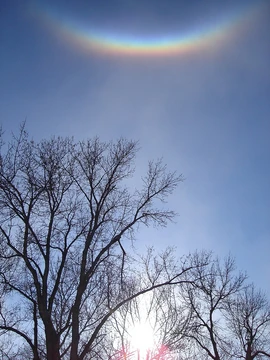
A halo is an optical phenomenon from sunlight or moonlight interacting with ice crystals in the atmosphere, producing colored or white arcs, rings, or spots. Many halos appear near the Sun or Moon, but some occur elsewhere, even in the opposite part of the sky. They can also form around artificial lights in very cold weather when diamond dust ice crystals float in the air. Halos are produced by ice crystals in cirrus or cirrostratus clouds at altitudes of 5 km to 10 km, or by low-level diamond dust.
The crystals' shape and orientation determine the halo type; they act like prisms and mirrors, refracting and reflecting light and splitting it into colors through dispersion. Circular halos typically appear at angular distances of 22° and 46° from the crystals. Halos have been used in weather lore to indicate an approaching warm front and associated rain. Sun dogs are a common halo type: two subtly colored bright spots about 22° to the left and right of the Sun at the same elevation.
They are caused by plate-shaped hexagonal ice crystals that align horizontally as they sink, refracting sunlight sideways. As the Sun rises, the rays become skewed, moving the sun dogs farther from the Sun but keeping them at the same elevation. Sun dogs are red nearest the Sun, grading to blue or violet farther out, with colors overlapping and muted, eventually merging into the white parhelic circle.
Rainbow
A rainbow is a narrow, multicolored semicircular arc caused by dispersion of white light by numerous water drops, usually rain, illuminated by sunlight. It always appears in the sky directly opposite the Sun. For a ground observer, the visible arc depends on the Sun's height: a full semicircle of 42° angular radius appears when the Sun is at the horizon, shrinking as the Sun rises and disappearing above 42°. A single reflection inside raindrops produces the primary bow, with red on the outside and blue/violet on the inside, spanning 40° to 42°.
A fainter secondary bow, about 10° outside the primary, results from two internal reflections, giving an angular size of 50.5° to 54° with reversed colors (blue/violet outside). The darker region between the two bows is called Alexander's Dark Band, caused by no reflected light reaching the observer from that area.
Larger droplets produce brighter bows. The rainbow's continuous spectrum appears as distinct bands only due to human color vision; a black-and-white photograph shows a smooth intensity gradation. The commonly cited sequence is Newton's seven colors: red, orange, yellow, green, blue, indigo, violet.
Mirage
A mirage is a naturally occurring optical phenomenon where light rays bend to produce a displaced image of distant objects or the sky. The word comes from French mirage, from Latin mirare, meaning 'to look at, to wonder at,' sharing roots with 'mirror' and 'to admire.' Unlike a hallucination, a mirage is real and can be captured on camera, as light rays are actually refracted to form the false image. What the image represents is interpreted by the human mind; for example, inferior images on land are often mistaken for reflections from water.
Mirages are categorized as inferior (lower), superior (higher), and Fata Morgana, a superior mirage with elaborate, vertically stacked images that change rapidly. Green flashes and green rays are optical phenomena occurring shortly after sunset or before sunrise, when a green spot appears above the Sun for a second or two, or a green ray shoots up from the sunset point. They can be observed from any altitude, usually over an unobstructed horizon like the ocean, and also from the Moon and bright planets such as Venus and Jupiter.
This occurs because light rays are strongly bent when passing through air layers of different temperatures in a steep thermal inversion, forming an atmospheric duct that acts like a refracting lens, producing both inverted and erect images.
Did You Know?
- A book on meteorological optics was published in the sixteenth century, with numerous books appearing since about 1950.
- Rayleigh scattering gives the sky a blue gradient, darkest at the zenith and brightest near the horizon.
More in Atmospheric Optical Phenomena
Sources
Compiled from Wikipedia and the sources listed below. Text from Wikipedia is available under CC BY-SA 4.0; this entry is adapted from it.
- Wikipedia: Atmospheric optics (CC BY-SA 4.0).
Spotted an error? Know more?
Reader corrections go straight into our review queue. Suggest an edit · How this site is sourced