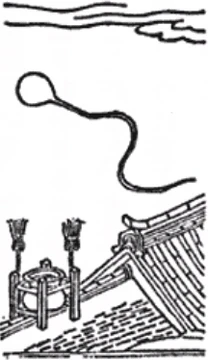
Onibi
Japanese ghost lights born from corpses and resentment.
Onibi is a type of atmospheric ghost light found in Japanese folklore. They are believed to be spirits arising from the corpses of humans and animals, or the fiery forms of resentful people. The term is sometimes used as a Japanese translation for "will-o'-the-wisp" or "jack-o'-lantern."
Quick Facts
- Common colors
- Blue
- bluish white
- red
- yellow
- Typical size range
- 2–3 cm (0.066–0.098 ft) to 20–30 cm (0.656–0.984 ft) in diameter
- Typical floating height
- 1–2 m above ground
- Frequent season
- Spring to summer
- Common locations
- Wetlands, forests, prairies, graveyards
Facts from the source article.
Outline
The Wakan Sansai Zue from the Edo period describes onibi as a blue light similar to a pine torch, with several gathering together; humans who approach risk having their spirit sucked out. Illustrations in that work suggest a diameter ranging from about 2 or 3 cm to 20 or 30 cm, and a floating height of roughly 1 to 2 m above the ground. In the Edo-period essay Mimibukuro, Yasumori Negishi recounts an anecdote of an onibi above Hakone mountain that split into two, flew around, reunited, and split several more times.
Modern theories address their appearance and features. While generally blue, some onibi appear bluish white, red, or yellow. Sizes vary from a candle flame to human-sized or even several meters across. They may appear singly, in pairs, in groups of 20 to 30, or in countless numbers that burn and vanish throughout the night.
Onibi are most common from spring to summer, especially on rainy days. They favor watery areas such as wetlands, as well as forests, prairies, and graveyards, and often appear in places surrounded by natural features; town sightings are rare. Some onibi feel cool to the touch, while others burn with heat like real fire.
Types
Asobibi appears below the castle and above the sea in Kōchi, Kōchi Prefecture, and on Mitani Mountain. It seems very close then flies far away, splits apart several times, and later reunites; it is said to be harmless to humans. Igebo is the local name for onibi in Watarai District, Mie Prefecture. Inka appears together with a ghost or yōkai.
Kazedama, from Ibigawa in Ibi District, Gifu Prefecture, manifests during storms as a spherical ball of fire about the size of a personal tray, giving off bright light; during the typhoon of Meiji 30 (1897), it appeared from the mountain and floated in the air several times. Sarakazoe appears in Sekien Toriyama's Konjaku Gazu Zoku Hyakki; it is linked to Okiku's spirit from the Banchō Sarayashiki ghost story, which rose from a well as an inka counting plates.
Sōgenbi appears in Sekien Toriyama's Gazu Hyakki Yagyō and is described as a monk who stole from the Jizōdō in Mibu-dera, received Buddhist punishment, and became an onibi with the anguishing face of the priest visible inside the fire; the name also appears in the Edo-period ghost story collection Shinotogibōko. Hidama, from Okinawa Prefecture, ordinarily lives in the kitchen behind the charcoal extinguisher, takes a bird-like shape when flying, and can cause fires.
Wataribisyaku appears in mountain villages of Chii village, Kitakuwada District, Kyoto Prefecture, as a bluish white ball of fire that floats lightly; it is said to have an appearance like a hishaku (ladle) due to a long, thin tail. Kitsunebi is sometimes considered a kind of onibi, though some hold that they are strictly different.
Considerations
Eyewitness accounts of onibi vary widely, suggesting that the term covers several distinct luminous phenomena. Despite the character for fire in its name, onibi frequently appear on rainy days, indicating they are not ordinary combustion flames but a different type of luminescent body. In ancient China, it was said that phosphorus and oni fire come from the blood of humans and animals; the character 燐 at that time could also refer to firefly luminescence or triboelectricity, not the chemical element phosphorus.
In Japan, the Wakan Sansai Zue explains that when humans, horses, and cattle die in battle and stain the ground with blood, their spirits turn into onibi after years or months. About a century later, in the 19th century, Shūkichi Arai's Fushigi Benmō stated that the phosphorus of buried corpses turns into onibi; this interpretation was widely accepted until the 1920s and appeared in dictionaries into the Shōwa period. Biologist Sankyō Kanda, who studied luminescent animals, identified phosphorus in 1696 and knew human bodies contained it; in Japan the character 燐 was applied to phosphorus, likely mixing with the Chinese hint linking onibi and phosphorus.
This led to the surmise that decaying corpses release phosphorus from phosphoric acid, producing light. While this explains many onibi, numerous testimonies remain inconsistent with the phosphorus illumination theory.
Other
In Europe, legends tell of onibi floating about when ghosts appear. In Germany on November 2, All Souls' Night, a great number of onibi can be seen behind the temple in the graveyard, taken as proof that a long line of ghosts had come to the temple; the ghosts of children wore a white undergarment and participated in the line by Frau Holle. Because these appearances occurred in a graveyard, an explanation involving gases from decomposition has been offered.
More in Atmospheric Ghost Lights
Spotted an error? Know more?
Reader corrections go straight into our review queue. Suggest an edit · How this site is sourced