Cold trap (astronomy)
Cold regions that freeze and retain volatiles for eons.
A cold trap is a region cold enough to freeze and retain volatile compounds. In astronomy, cold traps on airless bodies can preserve ices for geologic time periods, offering a record of the primordial solar system.
Quick Facts
- Earth cold trap altitude
- about 12 km (7.46 mi) above sea level
- Earth water loss rate
- about 1 millimeter of ocean every 1 million years
- Earth water loss timescale
- trillions of years for all water to disappear
Facts from the source article.
Cold traps on airless planetary bodies
Airless bodies such as Mercury, the Moon, and Ceres have obliquities near zero. Harold Urey noted that polar depressions or craters on these bodies cast persistent shadows lasting millions to billions of years. Without an atmosphere, convection cannot mix heat, so these shadows become extremely cold. Volatiles like water ice that drift into these permanent shadows become trapped for geologic time.
The shadows receive no sunlight; most heat comes from scattered and emitted radiation from surrounding topography. Horizontal heat conduction is negligible due to the high porosity and low thermal conductivity of the uppermost layers. Temperatures can be modeled using ray-casting or ray-tracing algorithms with 1D vertical heat conduction models. For bowl-shaped craters, an equilibrium temperature expression is possible.
Remote sensing by orbiters measures cold trap temperatures. The Lunar Reconnaissance Orbiter's Diviner radiometer extensively studied lunar cold traps. On Mercury, radar, reflectance, and visible imagery have indicated ice deposits inside cold traps. The Dawn spacecraft detected cold traps on Ceres.
Atmospheric cold traps
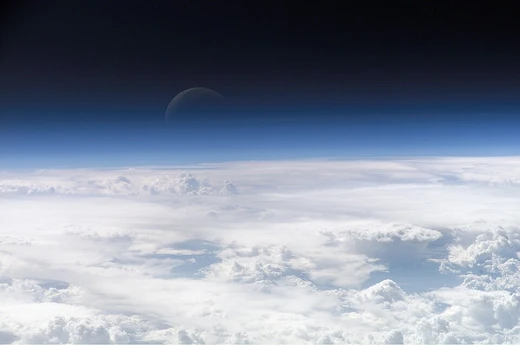
In atmospheric science, a cold trap is a region substantially colder than the layers below it. On Earth, the tropical tropopause layer exhibits a minimum cold point where temperature drops with height. This cold trap dehydrates ascending air masses: water vapor rising from the troposphere freezes into ice crystals, which gravitationally settle back into the lower atmosphere before reaching the stratosphere. The atmospheric cold trap preserves Earth's water supply over geological timescales.
At the tropopause temperature minimum, ascending moist air is freeze-dried to its equilibrium water vapor concentration, limiting water abundance at stratospheric altitudes where photolysis occurs. Without this mechanism, water vapor would ascend into the upper atmosphere, undergo photolysis by solar ultraviolet radiation, and allow hydrogen to escape into space. The extreme dryness of Venus is attributed to the historical absence of an atmospheric cold trap.
In a warm primitive Venusian atmosphere, high surface water vapor concentration bypassed condensation, elevating the mixing ratio at the cold trap and allowing moisture to ascend into the upper atmosphere where hydrogen escaped. Earth's cold trap lies about 12 km above sea level, well below the height where water vapor would be split by solar UV rays. Because of this cold trap, Earth loses water at a rate of about 1 millimeter of ocean every 1 million years, a rate that would take trillions of years to deplete all water.
A warmer atmosphere can hold more moisture per the Clausius–Clapeyron relation, but even with localized warming, the modern cold trap remains robust enough to prevent significant water vapor loss to space.
More in Atmosphere
Spotted an error? Know more?
Reader corrections go straight into our review queue. Suggest an edit · How this site is sourced