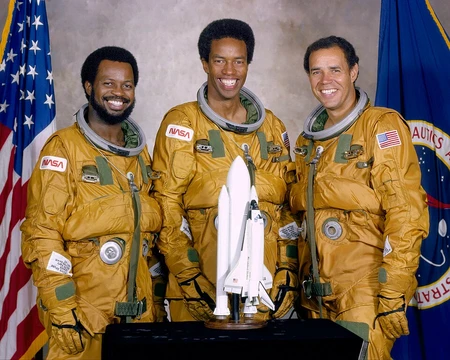
Guion Bluford
First African American astronaut to fly in space.

via Wikipedia: Guion Bluford · see source
Guion Stewart Bluford Jr. was born on November 22, 1942, and is an American aerospace engineer, a retired U.S. Air Force officer and fighter pilot, and a former NASA astronaut. He made history as the first African American to travel to space, serving as a mission specialist aboard the Space Shuttle Challenger on the STS-8 mission in 1983. Over his career, he flew on four Space Shuttle missions between 1983 and 1992, and he holds the distinction of being the first African American to make a second, third, and fourth trip to space. He was the first African American to receive NASA's Gold Astronaut Pin and the U.S. Air Force Command Pilot Astronaut Wings. Bluford was inducted into the International Space Hall of Fame in 1997, the U.S. Astronaut Hall of Fame in 2010, and the National Aviation Hall of Fame in 2019.
Bluford was born in Philadelphia and graduated from Overbrook High School in 1960. He earned a Bachelor of Science in Aerospace Engineering from Penn State in 1964, a Master of Science with distinction in Aerospace Engineering from the Air Force Institute of Technology (AFIT) in 1974, a Ph.D. in Aerospace Engineering with a minor in laser physics from AFIT in 1978, and an MBA from the University of Houston–Clear Lake in 1987. He also studied at the Wharton School of Business. His hobbies include reading, swimming, jogging, racquetball, handball, scuba diving, and golf. He married Linda Tull in 1964 and has two sons.
In his Air Force career, Bluford completed pilot training at Williams Air Force Base, earning his wings in January 1966. After F-4C combat crew training in Arizona and Florida, he was assigned to the 557th Tactical Fighter Squadron at Cam Ranh Bay, Vietnam, where he flew 144 combat missions, 65 of them over North Vietnam. In July 1967, he became a T-38A instructor pilot at Sheppard Air Force Base, Texas, training U.S. and West German pilots for the Euro-NATO Joint Pilot Training Program. After graduating from AFIT in 1974, he worked at the Air Force Flight Dynamics Laboratory at Wright-Patterson Air Force Base as Deputy for Advanced Concepts for the Aeromechanics Division and later as Branch Chief of the Aerodynamics and Airframe Branch. He has authored and presented scientific papers on computational fluid dynamics. He logged 688 hours in space and over 5,200 hours of jet flight time in aircraft including the T-33, T-37, T-38, F-4C, F-15, U-2/TR-1, and F-5A/B, with 1,300 hours as a T-38 instructor pilot. He also holds an FAA commercial pilot license and is a certified scuba diver with more than 50 open water dives.
Bluford was selected as a NASA astronaut in January 1978 as part of NASA astronaut group 8, recruited through efforts by Nichelle Nichols to increase minority and female astronaut representation. After a year of training, he was officially designated an astronaut in August 1979. His technical assignments included work on Space Station operations, the Remote Manipulator System, Spacelab systems and experiments, Space Shuttle systems, payload safety, and verifying flight software in the Shuttle Avionics Integration Laboratory and Flight Systems Laboratory. He served as a mission specialist on STS-8, STS-61-A, STS-39, and STS-53.
On his first mission, STS-8, launched August 30, 1983, aboard Challenger, Bluford helped develop procedures for night operations during the first night launch and night landing of the Shuttle. The crew deployed the Indian National Satellite (INSAT-1B), tested the Canadarm with the Payload Flight Test Article, operated the Continuous Flow Electrophoresis System with live cells, conducted medical measurements, and activated four "Getaway Special" canisters. The mission completed 98 orbits in 145 hours, landing at Edwards Air Force Base on September 5, 1983.
For STS-61-A, the German D-1 Spacelab mission launched October 30, 1985, Bluford led the international payload team during on-orbit operations. This mission set a record with eight crew members, including three European payload specialists, and was the first U.S. mission to transfer payload control to a foreign country (Germany). The crew deployed the Global Low Orbiting Message Relay Satellite from a Getaway Special container and performed 76 experiments in Spacelab covering fluid physics, materials processing, life sciences, and navigation. After 111 orbits in 169 hours, Challenger landed at Edwards on November 6, 1985.
On STS-39, launched April 28, 1991, aboard Discovery, Bluford managed payloads in support of the Department of Defense Strategic Defense Initiative Office. The crew gathered data on aurora, Earth-limb, celestial, and other phenomena.
- born
- November 22, 1942
- field
- Aerospace engineering, astronautics
- nationality
- American
- known_for
- First African American in space; four Space Shuttle flights (STS-8, STS-61-A, ST
Verified Timeline
Quick Facts
- Birth Name
- Guion Stewart Bluford Jr.
- Birth Date
- 1942-11-22
- Birth Place
- Philadelphia, Pennsylvania, U.S.
- Education
- Pennsylvania State University (BS) / Air University (MS, PhD) / University of Houston (MBA)
- Rank
- Colonel, USAF
- Time
- 28d 16h 33m
- Selection
- NASA Group 8 (1978)
- Mission
- STS-8 / STS-61-A / STS-39 / STS-53
Facts from the source article.
Lore & Background
Bluford was born in Philadelphia and graduated from Overbrook High School in 1960. He earned a Bachelor of Science in Aerospace Engineering from Pennsylvania State University in 1964, a Master of Science with distinction in Aerospace Engineering from the Air Force Institute of Technology (AFIT) in 1974, a Ph.D. in Aerospace Engineering with a minor in laser physics from AFIT in 1978, and an MBA from the University of Houston–Clear Lake in 1987. He married Linda Tull in 1964 and has two sons. In the Air Force, Bluford attended pilot training at Williams Air Force Base, receiving his pilot wings in January 1966. He flew 144 combat missions in Vietnam, 65 over North Vietnam, as an F-4C pilot assigned to the 557th Tactical Fighter Squadron, Cam Ranh Bay. He later served as a T-38A instructor pilot at Sheppard Air Force Base, Texas, and held roles at the Air Force Flight Dynamics Laboratory, Wright-Patterson Air Force Base, as Deputy for Advanced Concepts and then Branch Chief. He logged over 5,200 hours of jet flight time and 688 hours in space. Selected as a NASA astronaut in January 1978 as part of NASA astronaut group 8, Bluford flew on four Space Shuttle missions: STS-8 (1983), STS-61-A (1985), STS-39 (1991), and STS-53 (1992). On STS-8, the third flight of Challenger, he helped develop procedures for the first night launch and night landing. On STS-61-A, he led the international payload team for the German D-1 Spacelab mission, the first to carry eight crew members. On STS-39, he managed payloads for the DOD Strategic Defense Initiative Office. On STS-53, his last mission, he deployed the classified DOD-1 payload. After leaving NASA and retiring from the USAF in July 1993, he held executive positions at NYMA, Federal Data Corporation, and Northrup Grumman, and later founded the Aerospace Technology Group in Cleveland, Ohio.
Reader's Guide
Guion Bluford's significance lies in his role as a pioneer who broke racial barriers in human spaceflight. As the first African American in space, his participation on STS-8 in 1983 demonstrated that the U.S. space program could reflect the diversity of the nation. His subsequent three missions further established a legacy of inclusion and excellence. Beyond his astronaut career, Bluford's technical contributions as an aerospace engineer and his leadership in post-NASA roles—including managing a team of over 400 scientists and engineers providing technical support to NASA Lewis, and leading a team that designed, developed, built, and integrated two human spaceflight research facilities into the International Space Station—underscore his lasting impact on space exploration. His induction into the International Space Hall of Fame (1997), the U.S. Astronaut Hall of Fame (2010), and the National Aviation Hall of Fame (2019) mark his enduring legacy as both a trailblazer and a skilled practitioner in aerospace.
Did You Know?
- Bluford flew 144 combat missions in Vietnam, 65 of which were over North Vietnam.
- He earned a Ph.D. in Aerospace Engineering with a minor in laser physics from the Air Force Institute of Technology in 1978.
- Bluford was an Eagle Scout and, in December 1986, returned the Challenger flag to Boy Scout Troop 514 of Monument, Colorado.
- He logged over 5,200 hours of jet flight time in aircraft including the T-33, T-37, T-38, F-4C, F-15, U-2/TR-1, and F-5A/B.
- In 2020, Ohio Governor Mike DeWine awarded him the Ohio Distinguished Service Medal, Ohio's highest non-combat decoration for service.
Frequently Asked Questions
Who is Guion Bluford?
Guion Stewart Bluford Jr. is an American aerospace engineer, retired U.S. Air Force fighter pilot, and former NASA astronaut. He is best known for becoming the first African American to travel into space in 1983.
Why is Guion Bluford important in space history?
Bluford shattered a racial barrier in American spaceflight by becoming the first person of African descent to orbit the Earth. His 1983 mission on the Space Shuttle Challenger opened the door for a new generation of diverse astronauts.
How many Space Shuttle missions did Guion Bluford fly?
He completed four Shuttle flights during his NASA career: STS-8, STS-61-A, STS-39, and STS-53. Across those missions he served as a mission specialist.
When and how did Guion Bluford first go to space?
Bluford launched aboard the Space Shuttle Challenger on mission STS-8 in August 1983. He served as a mission specialist, deploying a communications satellite during the flight.
What was Guion Bluford's background before joining NASA?
Before his astronaut career, Bluford worked as an aerospace engineer and served as a fighter pilot in the United States Air Force. His engineering and flight experience helped qualify him for the 1978 NASA astronaut class.
More in Astronauts And Space Pioneers 1-20
Spotted an error? Know more?
This is a living reference — every entry is fact-audited, and reader corrections feed straight into our audit queue. Suggest an edit · See this site's audit record