Cancho Roano
Best preserved Tartessian site, possibly a temple or palace-shrine.
Last updated
Where it is
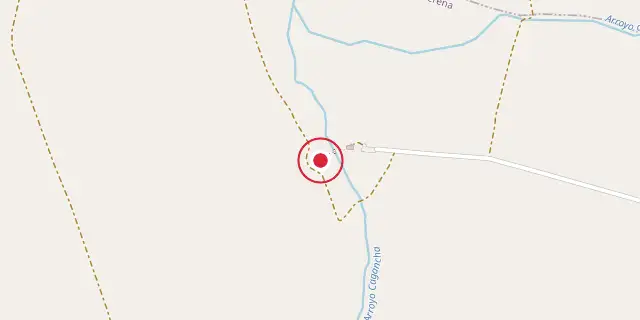
Coordinates: 38°42′04″N 5°41′10″W (38.7010, -5.6860) · Open in OpenStreetMap
Coordinates and connected clubs: the infobox of Wikipedia: Cancho Roano (CC BY-SA 4.0). Map: drawn by Codexery from OpenStreetMap tiles.
Cancho Roano is an archaeological site in the municipality of Zalamea de la Serena, in the province of Badajoz, Spain. It lies three miles from Zalamea de la Serena in a small valley along the stream Cagancha. The site is notable as the best preserved Tartessian site.
History
The building dates to at least the sixth century BCE, with later expansions and modifications. Objects found at the site place its construction around 550 BCE.
It was destroyed by fire no later than 370 BCE, apparently ritually burned and sealed in rammed earth, a practice similar to Etruscan customs. The main body is square and oriented east, surrounded by a deep moat permanently filled with water. Its exact function is unknown, but the presence of altars indicates a religious character, though the defensive system suggests it may have been a palace-shrine.
Interpretations
The sacred character and multiple cells have led to the idea of a temple for sacred prostitution, possibly dedicated to the Phoenician deity Astarte. This hypothesis is supported by looms found in two chambers, evoking the weavers of the goddess Asherah who worked as prostitutes in the ancient Temple of Jerusalem. Similar rites appear in iconography from other Phoenician sites in Hispania, such as Gadir, Castulo, and La Quéjola (Albacete).
Another possibility is a palace housing a harem whose members would participate in sacred rites. Richard Freund proposed that Cancho Roano was a memorial city representing Tartessos, which he equated with Atlantis, citing a stele with concentric circles matching Plato's description. However, his theories are widely dismissed, and the symbol is a typical warrior shield from Southwestern Stelae of the Iberian Peninsula.
Did You Know?
- Excavations were directed by John Maluquer de Motes.
- The site, along with an interpretation center, is open to the public.
- It was declared a National Monument in 1986.
Frequently Asked Questions
Where is Cancho Roano?
Cancho Roano is located in Zalamea de la Serena, Badajoz, Extremadura, Spain.
Who owns Cancho Roano?
Cancho Roano is owned by Extremadura Identity Museums Network, es and Museos de Identidad de Extremadura.
More in Astarte
Sources
Compiled from Wikipedia and the sources listed below. Text from Wikipedia is available under CC BY-SA 4.0; this entry is adapted from it.
- Wikipedia: Cancho Roano (CC BY-SA 4.0).
Spotted an error? Know more?
Reader corrections go straight into our review queue. Suggest an edit · How this site is sourced