Frequently Asked Questions
The most-asked questions about assault rifles.
What exactly is an assault rifle?
An assault rifle is a selective-fire, shoulder-fired rifle that chambers an intermediate cartridge, letting the user switch between semi-automatic and fully automatic fire. In strict military taxonomy the term is specific, though in everyday civilian usage it is often applied loosely to any military-styled rifle.
How does an assault rifle differ from a battle rifle or a carbine?
A battle rifle fires a full-power round such as 7.62×51 mm and is generally heavier, while a carbine is a shortened rifle that may still use that full-power cartridge. The assault rifle occupies the middle ground, using a lighter intermediate round to keep full-auto recoil manageable for a single soldier.
Which models are the most widely recognized?
The Kalashnikov AK-47 / AKM and the American M16 / M4 family are the two names most people associate with the category. Other frequently cited designs include the German G3, the French Famas, and the Chinese Type 56, each reflecting a distinct national engineering philosophy.
When and where did the concept originate?
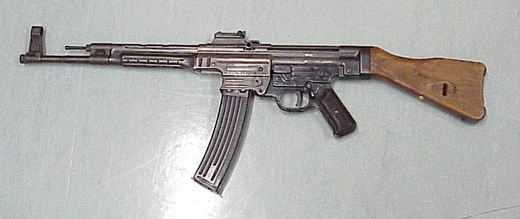
The idea crystallized in the late 1930s and first saw combat with the German StG 44 during World War II, which paired an intermediate cartridge with selective fire in a compact package. After the war the concept was refined and propagated worldwide through the AK and M16 lines.
Who are the key figures most linked to assault-rifle development?
Mikhail Kalashnikov is the designer behind the AK series, and the M16 lineage traces to the Armalite AR-15 developed for the U.S. military. The StG 44's creation involved German ordnance engineers, and the intermediate-cartridge idea itself drew on earlier work by designers such as Vasily Degtyaryov.
What is the single most important technical trait of an assault rifle?
Chambering an intermediate cartridge is the defining feature, because it produces less recoil than a full-power round while still delivering adequate effectiveness at typical infantry engagement distances. That balance is what makes sustained automatic fire practical in the hands of one operator.
What is a common misconception about the term 'assault rifle'?
Many people assume it is a legally defined category in most countries, but in the United States, for example, the phrase carries no formal statutory meaning and is used colloquially for a broad range of firearms. In small-arms taxonomy it has a precise technical definition tied to cartridge type and fire mode.
What notable historical events are closely tied to assault rifles?
The AK-47 became a defining symbol of numerous 20th-century liberation and civil conflicts across Africa, Asia, and the Middle East, while the M16 was central to U.S. operations in Vietnam and later wars. The 1944 fielding of the StG 44 marked a doctrinal turning point in how armies equipped their infantry.
Where should a newcomer start if they want historical context?
A general military-history survey covering World War II and the early Cold War is a solid entry point, since that is when the concept was born and spread. From there, dedicated small-arms history books or public museum collections such as the Imperial War Museum or the Smithsonian National Museum of American History provide rich context without requiring technical expertise.
Are assault rifles still relevant in modern militaries?
Yes; every major armed force fields some variant as the standard infantry weapon, though modern versions often add modular accessories, alternative calibers, or hybrid configurations. The core principle—intermediate cartridge, selective fire, shoulder-fired—remains the backbone of infantry small-arms doctrine worldwide.