Frequently Asked Questions
The most-asked questions about assault rifles, part 2.
What exactly is an assault rifle in the strict military sense?
It is a selective-fire rifle chambered for an intermediate-power cartridge, letting the operator switch between semi-automatic and fully automatic modes. It occupies the middle ground between a full-power service rifle and a compact submachine gun in both range and recoil.
Who are the key figures most associated with developing the assault rifle concept?
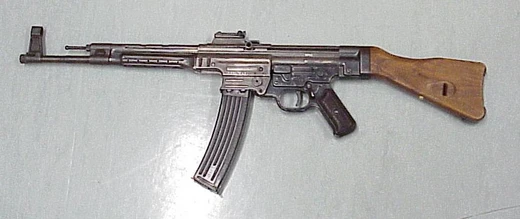
German engineers behind the StG 44 are usually credited with the first practical design, while Mikhail Kalashnikov and Finnish designer Aimo Janne each contributed influential mechanical and ergonomic ideas. The modern category really emerged from the convergence of their work in the late 1940s and 1950s.
Where should a newcomer start if they want to understand assault rifles?
Begin with the core operating principles—gas operation, bolt cycling, and why intermediate cartridges were chosen—before comparing individual models. A brief look at the StG 44 and AK-47 histories provides the context needed to appreciate later designs.
How does an assault rifle differ from a battle rifle?
An assault rifle fires a shorter, lighter intermediate round and typically offers full-auto fire, whereas a battle rifle chambers a full-power cartridge and is generally restricted to semi-automatic use in service. The difference shows up in weight, recoil, and effective range.
Which models are the most recognizable in the assault rifle family?
The AK-47/AKM, the M16/M4 family, and the G36 are the names most people recognize immediately. Enthusiast discussions also frequently center on the HK416, FN SCAR, and the older FN FAL, though the FAL is technically a battle rifle.
Why do assault rifles use intermediate cartridges rather than full-power rounds?
An intermediate round cuts recoil enough to keep full-auto bursts on target while still delivering useful energy at typical infantry ranges of roughly 300 to 600 meters. This trade-off was the central insight behind the StG 44 and has defined the category ever since.
What is the most common misconception about the term 'assault rifle'?
In many legal codes the label is applied to any semi-automatic rifle with military-styled features, even though it cannot fire in full-auto. The strict military definition requires selective-fire capability, which most civilian-legal firearms do not possess.
In which conflicts did the assault rifle concept first prove decisive on the battlefield?
The StG 44 saw limited action on the Eastern Front in 1944, but the category truly proved itself during the Korean and Vietnam Wars, where the M16 and AK-47 became iconic. Those engagements demonstrated the tactical edge of a lighter, controllable full-auto platform over older full-power rifles.
How do direct-impingement and short-stroke-piston gas systems compare?
A direct-impingement layout, as in the M16, routes hot gas straight into the receiver to cycle the bolt, while a short-stroke piston, as in the AK or HK416, uses a separate cylinder to drive a piston that pushes the bolt carrier. The piston design generally tolerates fouling better and runs cooler under sustained fire.
What has kept the AK-47 in service for over seven decades?
Its generous tolerances, minimal parts count, and ability to function after exposure to sand, mud, and rough handling made it exceptionally field-maintainable with basic tools. That logistical simplicity gave it a lasting advantage across dozens of militaries and insurgent groups worldwide.