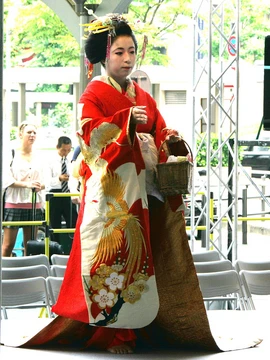
Sei Shōnagon
Heian court lady and author of The Pillow Book, as translated by Arthur Waley.

Sei Shōnagon was a Japanese author, poet, and court lady who served Empress Teishi around the year 1000, during the middle Heian period. Her actual given name is unknown; aristocratic custom at the time assigned court ladies nicknames derived from a father’s or husband’s office. “Sei” comes from her father’s family name Kiyohara, while “Shōnagon” refers to a government post, though neither her father nor her two known husbands held it, leading some scholars to suggest it may have belonged to a possible third husband. She was the daughter of Kiyohara no Motosuke, a scholar and noted poet who served as a provincial official, and granddaughter of the poet Kiyohara no Fukayabu. The family were middle-ranking courtiers facing financial difficulties, likely due to lacking a revenue-producing office. At sixteen she married government official Tachibana no Norimitsu and bore a son, Norinaga; by the time she began serving Empress Teishi at age twenty-seven, she may have been divorced. After her court service ended, she possibly married Fujiwara no Muneyo and had a daughter, though some evidence suggests she became a Buddhist nun. Shōnagon is also known for her rivalry with contemporary writer Murasaki Shikibu, author of *The Tale of Genji*, who served Empress Shoshi. Murasaki wrote scathingly of Shōnagon in her diary while conceding her literary gifts. Shōnagon’s fame rests on *The Pillow Book*, a collection of lists, gossip, poetry, observations, and complaints from her court years. The work circulated in handwritten manuscripts for centuries before being printed in the seventeenth century, existing in four main variants; the most complete are the Sankanbon and Nōinbon texts. Her writing depicts Empress Teishi’s elegant court with wit and detailed reminiscences, often omitting harsh realities such as Teishi’s death in childbirth, as passionate writing was considered unstylish. Shōnagon was regarded as having an excellent memory, particularly for recalling classic poems, and her entries offer advice on conversation, preaching, and letter writing, including prescriptions for “morning-after letters” in a court where illicit sexual encounters required a poetic response on beautiful paper.
- known_for
- Author of The Pillow Book
Lore & Background
Sei Shōnagon was a Japanese author, poet, and court lady who served Empress Teishi around the year 1000 during the middle Heian period. Her actual given name is unknown; it was customary to call a court lady by a nickname taken from a court office belonging to her father or husband. "Sei" derives from her father's family name "Kiyohara," while "Shōnagon" refers to a government post, though her relationship to this post is unknown—neither her father nor either of her two husbands held such a post. She was the daughter of Kiyohara no Motosuke, a scholar and well-known poet who worked as a provincial official, and her grandfather was also a poet. The family were middle-ranking courtiers with financial difficulties. She married Tachibana no Norimitsu at 16 and had a son, Norinaga. At 27, she began serving Empress Teishi, consort of Emperor Ichijō, and may have been divorced by then. She later may have married Fujiwara no Muneyo and had a daughter. Shōnagon is known for her rivalry with contemporary writer Murasaki Shikibu, who wrote scathingly of her in her diary while conceding her literary gifts. Shōnagon became popular through *The Pillow Book*, a collection of lists, gossip, poetry, observations, and complaints written during her years at court. Her essays describe daily experiences, customs, and affairs of the Imperial Court in Kyoto from a unique viewpoint. The work was circulated at court and existed in handwritten manuscripts for centuries before being printed in the 17th century. Her writing is considered witty, depicting Empress Teishi's elegant court from a detailed, gossipy perspective, de-emphasizing harsh realities such as Teishi's death from childbirth. She was regarded by contemporaries as having an excellent memory, often recalling precise details and quoting classic poems to suit occasions. Her entries include advice on conversation, preaching, and letter writing, advocating pure language and rigorous formalities.
Reader's Guide
Sei Shōnagon served Empress Teishi (Sadako) around the year 1000 during the middle Heian period. Her actual given name is unknown; "Sei" derives from her father's family name Kiyohara, and "Shōnagon" refers to a government post, though neither her father nor her two known husbands held such a post. She was the daughter of the poet and scholar Kiyohara no Motosuke, and her grandfather Kiyohara no Fukayabu was also a poet. Her family were middle-ranking courtiers with financial difficulties. She married Tachibana no Norimitsu at sixteen and had a son, Norinaga. At twenty-seven, around 993, she began serving Empress Teishi, possibly after divorce. She may later have married Fujiwara no Muneyo and had a daughter, or perhaps became a Buddhist nun. Shōnagon is known for a rivalry with contemporary writer Murasaki Shikibu, author of *The Tale of Genji*, who wrote scathingly of her in her diary while conceding her literary gifts. Shōnagon’s fame rests on *The Pillow Book*, a collection of lists, gossip, poetry, observations, and complaints from her court years. The work describes daily experiences, customs, and imperial court affairs from a unique, witty perspective. It circulated in handwritten manuscripts for centuries before being printed in the 17th century. Four main text variants exist, with the Sankanbon and Nōinbon considered most complete. Shōnagon writes about Empress Teishi’s declining fortunes after Fujiwara no Michinaga made his daughter Shōshi empress alongside her. She de-emphasizes harsh realities like Teishi’s death in childbirth, following the fashionable style of lightheartedness. Her writing includes precise recollections of events and clothing, and she was noted for her excellent memory and ability to quote classic poems. The work offers advice on conversation, preaching, and letter writing, including detailed prescriptions for paper, calligraphy, and morning-after letters in court society.
Did You Know?
- Arthur Waley translated Sei Shōnagon's The Pillow Book in 1928.
- Waley's translation of The Pillow Book was part of his broader work bringing Japanese classical literature to English readers.
- The Pillow Book was one of several major Japanese works Waley translated, including The Tale of Genji and Japanese Poetry: The Uta.
- Waley never visited Japan or China, yet translated major works of both countries' classical literature.
Frequently Asked Questions
Who is Sei Shōnagon?
She was a Japanese court lady, poet, and writer from the middle Heian period, best remembered for composing The Pillow Book. She is widely regarded as one of the most celebrated female voices in Japanese literary history.
What is The Pillow Book?
It is a loosely structured collection of short observations, lists, gossip, poetry, and personal complaints she gathered while living at the imperial court. The work is considered a foundational text of the zuihitsu (essay) genre in Japanese literature.
When did Sei Shōnagon live?
She was born around 966 and died sometime between 1017 and 1025, placing her life squarely in the middle Heian period of Japan.
What was her role at the imperial court?
She served as a lady-in-waiting to Empress Teishi (also known as Sadako) around the year 1000. That position gave her a front-row seat to the rituals, politics, and daily textures of Heian court life, which became the raw material for her writing.
Why is Sei Shōnagon important to Asian literature?
Her sharp, witty, and candid voice broke from the more formal conventions of her era and offered readers an unfiltered look inside Heian court culture. The Pillow Book remains a touchstone for anyone studying early Japanese prose and the broader zuihitsu tradition.
More in Asian Literary Voices 1-22
Spotted an error? Know more?
This is a living reference — every entry is fact-audited, and reader corrections feed straight into our audit queue. Suggest an edit · See this site's audit record