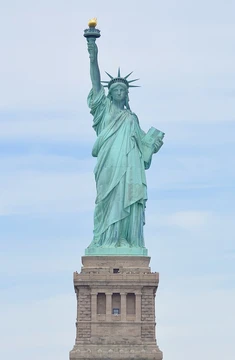
Statue of Liberty
A colossal neoclassical sculpture gifted by France to the United States.
The statue was dedicated in 1886 as a gift from France celebrating republican ideals and the abolition of slavery.[1] The statue depicts a woman in classical robes, modeled after the Roman goddess Libertas, who raises a torch with her right hand and carries a tablet in her left hand that reads "JULY IV MDCCLXXVI" (July 4, 1776) in Roman numerals.[2]
Quick Facts
- Location
- Liberty Island; New York City, U.S.
- Beginning date
- October 28, 1886
- Restored
- 1938, 1984–1986, 2011–2012
- Sculptor
- Frédéric Auguste Bartholdi
- Visitors year
- 2019
- Governing body
- National Park Service
Facts from the source article.
Geography and history
The statue stands on Liberty Island, formerly Bedloe's Island, in New York Harbor.[3] French historian and abolitionist Édouard de Laboulaye first proposed the monument in 1865 to honor the centennial of U.S. independence and the liberation of the nation's slaves.[4] The statue was built in France, disassembled, and shipped to New York aboard the French steamer Isère in June 1885.[5][6] The pedestal, designed by Richard Morris Hunt, was completed in April 1886, and reassembly of the statue began immediately.[7][8]
What the cited sources add
A National Park Service report from 2000 concluded that the dinner-party legend of the statue's conception in 1865 is traceable to an 1885 fundraising pamphlet by Bartholdi, and that the statue was most likely conceived in 1870 or 1871.[9] The same report found no evidence that the statue was intended to memorialize black Civil War combatants, and that the design evolved from Bartholdi's earlier Egyptian monument concept.[9] The National Park Service states that the statue's broken shackle and chain at its right foot symbolize the end of all types of servitude and oppression.[10] A Christian Science Monitor article notes that the statue's symbolism has shifted over time, and that its meaning as a beacon for poor immigrants is a contested idea.[1]
The same article reports that the statue was conceived as a symbol of Enlightenment liberalism and the abolition of slavery.[1] The National Park Service also notes that after the statue's dedication, African Americans were reluctant to embrace it as a symbol due to continued racism and discrimination.[10]
References
- Bruinius, "What Does Lady Liberty Stand for? A Look at Changing Attitudes.", The Christian Science Monitor, May 16, 2019. facts only, no text reused. csmonitor.com
- Wikipedia, "Statue of Liberty" (CC BY-SA 4.0), which cites: Hayden Despont 1986, p. 45; Sutherland 2003, p. 19 (original not read by us) en.wikipedia.org
- Wikipedia, "Statue of Liberty" (CC BY-SA 4.0), which cites: Harris 1985, p. 7–9; Khan 2010, p. 60–61; Moreno 2000, p. 39–40; Harris 1985, p. 7–9 (original not read by us) en.wikipedia.org
- Wikipedia, "Statue of Liberty" (CC BY-SA 4.0), which cites: "The French Connection", National Park Service, May 19, 2019 (original not read by us) en.wikipedia.org
- Wikipedia, "Statue of Liberty" (CC BY-SA 4.0), which cites: Khan 2010, p. 60–61 (original not read by us) en.wikipedia.org
- Wikipedia, "Statue of Liberty" (CC BY-SA 4.0), which cites: Harris 1985, p. 7–9; "The Isere-Bartholdi Gift Reaches the Horseshoe Safely", The Evening Post, June 17, 1885; Harris 1985, p. 7–9 (original not read by us) en.wikipedia.org
- Wikipedia, "Statue of Liberty" (CC BY-SA 4.0), which cites: "Statistics", Statue of Liberty, August 16, 2006 (original not read by us) en.wikipedia.org
- Wikipedia, "Statue of Liberty" (CC BY-SA 4.0), which cites: Moreno 2000, p. 39–40; Bell Abrams 1984, p. 25; Moreno 2000, p. 39–40 (original not read by us) en.wikipedia.org
- Joseph, "The Black Statue of Liberty Rumor", National Park Service, September 2000. facts only, no text reused. home.nps.gov
- "Abolition", National Park Service. facts only, no text reused. nps.gov
Each numbered sentence above was checked against the source it cites before publication. Sentences citing Wikipedia adapt text from the English Wikipedia article Statue of Liberty (contributors), used under CC BY-SA 4.0; this entry is available under the same licence. Other sources were used for facts only; no text or images are copied from them.
More in Artworks in the Collection of the National Park Service
Spotted an error? Know more?
Reader corrections go straight into our review queue. Suggest an edit · How this site is sourced