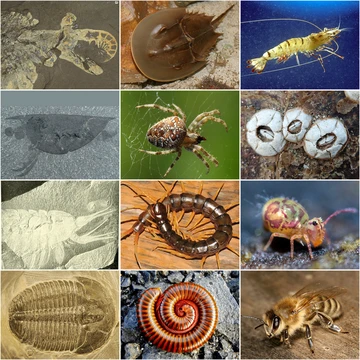
Orb-weaver spider
Common builders of spiral wheel-shaped webs found worldwide.
Last updated
Araneidae is found worldwide and contains numerous familiar, large, or vividly colored garden spider species.[1]
Scientific classification
- KingdomAnimalia
- PhylumArthropoda
- SubphylumChelicerata
- ClassArachnida
- OrderAraneae
- InfraorderAraneomorphae
- FamilyAraneidae
Named by Clerck, 1757
Sources: Wikipedia taxobox: Orb-weaver spider (CC BY-SA 4.0)
Quick Facts
- Diversity
- 197 genera, 4,710 species
Facts from the source article.
Key facts and history
The English name "orb-weaver" comes from the word "orb" meaning "circular"[2] Orb-weaver webs are built in a stereotypical fashion, with a nonsticky silk framework followed by a sticky spiral.[1] Sexual cannibalism is common in the family, with male Argiope bruennichi cannibalized in up to 80% of cases.[3][4] An insect that becomes entangled in the sticky capture threads receives a rapid bite that immobilizes it, after which the spider envelops it in silk.[5]
When the captured prey is venomous, the spider may wrap it in silk before biting.[5] A crisscross silk structure called a stabilimentum is placed through the web's center by certain orb-weavers, especially those in the genus Argiope.[6]
What the cited sources add
Deinopoidea have a cribellum and calamistrum, structures absent in Araneoidea.[7][8]
References
- Wikipedia, "Orb-weaver spider" (CC BY-SA 4.0), which cites: "Families", World Spider Catalog (original not read by us) en.wikipedia.org
- Wikipedia, "Orb-weaver spider" (CC BY-SA 4.0), which cites: "orb", Merriam-Webster Dictionary (original not read by us) en.wikipedia.org
- Wikipedia, "Orb-weaver spider" (CC BY-SA 4.0), which cites: Schneider, "Sexual conflict over copulation duration in a cannibalistic spider", Animal Behaviour, 2006, p. 781–788 (original not read by us) en.wikipedia.org
- Wikipedia, "Orb-weaver spider" (CC BY-SA 4.0), which cites: Elgar, "Sexual Cannibalism, Size Dimorphism, and Courtship Behavior in Orb-Weaving Spiders (Araneidae)", Evolution, 1991, p. 444–448; Legrand, "Factors driving extreme sexual size dimorphism of a sit-and-wait predator under low density", Biological Journal of the Linnean Society, 2000, p. 643–664; Elgar, "Sexual Cannibalism, Size Dimorphism, and Courtship Behavior in Orb-Weaving Spiders (Araneidae)", Evolution, 1991, p. 444–448 (original not read by us) en.wikipedia.org
- Wikipedia, "Orb-weaver spider" (CC BY-SA 4.0), which cites: Craig, "Insect Perception of Spider Orb Webs in Three Light Habitats", Functional Ecology, 1988, p. 277–282 (original not read by us) en.wikipedia.org
- Wikipedia, "Orb-weaver spider" (CC BY-SA 4.0), which cites: Gálvez, "Age variation in the body coloration of the orb-weaver spider Alpaida tuonabo and its implications on foraging", Scientific Reports, 26 February 2018, p. 3599 (original not read by us) en.wikipedia.org
- Coddington, "Spiders: webs, behavior, and evolution", Stanford University Press, 1986, p. 319–363. facts only, no text reused. archive.org
- Wikipedia, "Orb-weaver spider" (CC BY-SA 4.0), which cites: Coddington, "Spiders: webs, behavior, and evolution", Stanford University Press, 1986, p. 319–363 (we also read that source) en.wikipedia.org
Each numbered sentence above was checked against the source it cites before publication. Sentences citing Wikipedia adapt text from the English Wikipedia article Orb-weaver spider (contributors), used under CC BY-SA 4.0; this entry is available under the same licence. Other sources were used for facts only; no text or images are copied from them.
More in Arthropods
Sources
Compiled from Wikipedia and the sources listed below. Text from Wikipedia is available under CC BY-SA 4.0; this entry is adapted from it.
- Wikipedia: Orb-weaver spider (CC BY-SA 4.0).
- Word definitions: the Codexery glossary, each quoted from its Wikipedia article.
Spotted an error? Know more?
Reader corrections go straight into our review queue. Suggest an edit · How this site is sourced