Green Arrow (Arrow episode)
Oliver Queen adopts the Green Arrow alias as a new threat emerges.

The fourth season of *Arrow* kicks off with its seventieth episode, titled "Green Arrow." This installment marks a turning point for the series: Oliver Queen's vigilante identity is finally called by his comic-book name, and it introduces a flash-forward scene alongside the usual flashbacks. The episode was written by showrunners Marc Guggenheim and Wendy Mericle, based on a story by Greg Berlanti and Beth Schwartz, with direction from Thor Freudenthal.
Months after the season three finale, Oliver and Felicity Smoak are living a quiet suburban life in Ivy Town. Their peace is interrupted when Laurel Lance and Thea Queen arrive, seeking help against a new threat in the newly renamed Star City. A terrorist group called the Ghosts, led by Damien Darhk, is murdering city officials. Darhk possesses apparent magical powers, and Oliver learns from Ra's al Ghul that he leads an organization called H.I.V.E. Diggle recognizes the name as the group that hired Floyd Lawton to kill his brother, Andy, but keeps this to himself. Meanwhile, Darhk performs a blood ritual in his hideout and is visited by an employee—Quentin Lance. After deciding to stay in Star City, Oliver broadcasts a message to the city, calling himself the "Green Arrow." In the episode's flashbacks, Oliver is drugged by A.R.G.U.S. head Amanda Waller and recruited to work for the organization on a mission in Hong Kong. The episode ends with a flash-forward six months later, where Oliver stands grieving at a grave. Barry Allen arrives, and Oliver insists the death isn't his fault, but revenge for it is.
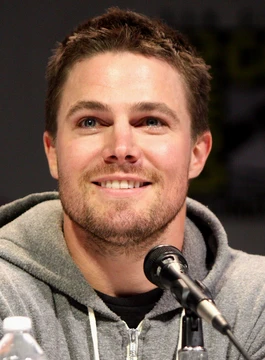
The episode introduces Neal McDonough as Damien Darhk. The main cast includes Stephen Amell as Oliver, Katie Cassidy as Laurel, David Ramsey as John Diggle, Willa Holland as Thea, Emily Bett Rickards as Felicity, and Paul Blackthorne as Quentin, with Grant Gustin guest-starring as Barry Allen.
Ahead of the premiere, co-showrunner Marc Guggenheim said season four would aim for a lighter tone, with Oliver having "a new outlook on life," and that Darhk would be introduced early. The season three finale had ended on an optimistic note for Oliver and Felicity, but the season's darker tone drew mixed reviews. The episode was watched live by 2.67 million viewers, a slight drop from the previous season's premiere.
- Series
- Arrow
- Season
- 4
- Episode
- 1 (overall 70)
- Original air date
- October 7, 2015
- Network
- The CW
- Written by
- Marc Guggenheim and Wendy Mericle (from a story by Greg Berlanti and Beth Schwartz)
- Directed by
- Thor Freudenthal
Lore & Background
The episode takes place several months after the season three finale. Oliver and Felicity Smoak have been living a suburban life in Ivy Town, but return to the newly renamed Star City when a terrorist group called the Ghosts, led by Damien Darhk, begins murdering city leadership. Oliver decides to stay and broadcasts an announcement calling himself the "Green Arrow." In flashback sequences, he is recruited against his will by Amanda Waller to work for A.R.G.U.S. on a mission in Hong Kong. The episode ends with a flash forward six months into the future, showing Oliver grieving at a newly laid grave.
Reader's Guide
The episode was watched live by 2.67 million viewers, a slight fall from the previous season premiere. Critics had a generally positive response, with many considering it a potential return to form for the series. McDonough's introduction as Damien Darhk met with favorable reception, as did the perceived change of tone. However, many critics expressed caution about the series' ability to maintain that tone throughout the season, particularly in light of the graveside flash forward. The episode holds a critics' approval rating of 94% on Rotten Tomatoes. It marks the first appearance by Neal McDonough as Darhk and features Grant Gustin guest starring as Barry Allen.
Did You Know?
- This is the first episode of Arrow to refer to Oliver Queen's vigilante persona as 'Green Arrow'.
- The episode is the first in the series to include a flash forward sequence in addition to flashbacks.
- Damien Darhk, played by Neal McDonough, is introduced as the season antagonist in this episode.
- The episode was filmed in Vancouver, British Columbia, Canada between July 13 and July 23, 2015.
The Arrow's Moral Crucible
In the second season, Oliver Queen commits to a new philosophy: he will fight crime without taking a life, adopting the name "The Arrow" to embody that restraint. This vow is immediately put under siege when Slade Wilson, a survivor from Oliver's five years shipwrecked on Lian Yu, resurfaces with a personal vendetta. The season's flashbacks to Oliver's second year on the island reveal the origins of their bitter feud, as he navigates a new threat from Dr. Anthony Ivo while trying to survive alongside Slade, Sara, and the archer Shado. Back in Star City, Oliver takes in Roy Harper as his protégé, an aspiring vigilante who needs guidance. He also gains the unexpected support of Quentin Lance and, most significantly, Sara Lance, who survived her own ordeal at sea six years earlier. Together with John Diggle and Felicity Smoak, Oliver builds a growing network of allies while wrestling with the line between justice and vengeance.
Evolving the Hero's Identity
The production team made deliberate choices to visually signal Oliver's transformation from a shadowy vigilante into a more public symbol of heroism. In the season's second half, he replaces his earlier "paint" mask with a domino mask reminiscent of the comic book character. Showrunner Andrew Kreisberg explained that the change was woven into the plot: Oliver receives the mask from Barry Allen in the episode "Three Ghosts," and the decision reflects his evolution from "Arrow to Green Arrow." Costume designer Maya Mani developed roughly fifty mask options before settling on a design that felt simple and timeless. On the broader production side, the season also served as a testing ground for a potential spin-off. A backdoor pilot for The Flash was originally planned as the twentieth episode, but after Grant Gustin's positive reception in earlier installments, The CW executives opted for a traditional pilot format to allow more development time and a larger budget.
Critical and Audience Reception
The second season earned widespread praise from critics and strong viewership numbers. Jeff Jensen of Entertainment Weekly awarded the first half a B+, praising the show's intelligence, adult and witty writing, exciting action sequences, and Stephen Amell's commanding central performance. Carrie Raisler of The A.V. Club gave the first half an A−, reflecting the season's broad critical appeal. The season averaged 3.28 million viewers per week and accumulated fifteen nominations across various categories. This strong reception helped secure the series' renewal for a third season on February 12, 2014, just weeks after the season finale aired. The positive critical and audience response also validated The CW's investment in the Arrowverse, reinforcing the network's commitment to shared-continuity superhero storytelling. The season's success demonstrated that a TV-budget production could deliver sophisticated, character-driven narratives that resonated with both casual viewers and dedicated fans of the DC Comics source material.
Building the Arrowverse and Expanding the Franchise
Arrow's second season played a pivotal role in seeding the broader Arrowverse. The season introduced characters from The Flash, which was in development as a potential spin-off at the time, establishing shared continuity across the network's superhero lineup. The series itself, based on the DC Comics character created by Mort Weisinger and George Papp, was set within this interconnected universe. The season was prefaced by a recap special called "Year One," which aired on October 2, 2013, offering highlights of the first season alongside a preview of what was to come. After concluding its 23-episode run on May 14, 2014, the season was released on home media on September 16, 2014, as a five-disc DVD set and a nine-disc Blu-ray and DVD combo pack. These box sets included bonus material such as making-of featurettes, deleted scenes, a gag reel, and highlights from the Paley Fest, giving fans extended access to the production behind the show.
Frequently Asked Questions
What is Green Arrow (Arrow episode)?
It is the premiere of Season 4 of Arrow, serving as the seventieth episode of the overall series. The episode aired on The CW on October 7, 2015, and was directed by Thor Freudenthal.
What happens in Green Arrow (Arrow episode)?
Set months after the Season 3 finale, the episode follows Oliver and Felicity trying to enjoy a quiet life in Ivy Town until a new threat forces Oliver to step back into the vigilante role. In a first for the show, his identity is explicitly referred to as Green Arrow, and the episode also introduces a flash-forward sequence in addition to the standard flashback structure.
Why is Green Arrow (Arrow episode) important to the Arrow series?
It marks a major tonal and narrative reset for the show, officially giving Oliver his comic-book name on screen for the first time. The introduction of the flash-forward device alongside the existing flashbacks also signals a new storytelling approach for the remainder of the series.
Where does Green Arrow (Arrow episode) fit in the Arrow timeline?
It takes place several months after the events of the Season 3 finale, during which Oliver and Felicity have settled into a suburban routine in Ivy Town. The disruption of that peace by a new antagonist is what propels Oliver back into action under the Green Arrow identity.
More in Arrow episodes 1-24
Spotted an error? Know more?
Reader corrections go straight into our review queue. Suggest an edit · How this site is sourced