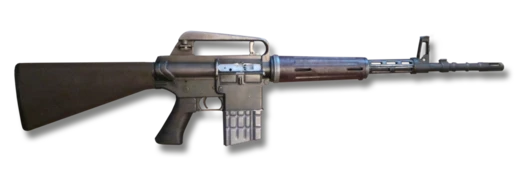
M27 Infantry Automatic Rifle
USMC select-fire rifle replacing M16A4 and M4A1.
Last updated
The M27 Infantry Automatic Rifle (IAR) is a 5.56mm, select-fire assault rifle and squad automatic weapon developed from the HK416 by Heckler & Koch. It was originally intended for automatic riflemen in the United States Marine Corps but later replaced the M16A4 and M4A1 for all infantry riflemen. A subvariant, the M38 DMR, serves as a designated marksman rifle.
Background
The Marine Corps first identified the need for an Infantry Automatic Rifle with a Universal Need Statement in 1999. Limited trials around 2000 by the 2nd Battalion, 7th Marines confirmed the value of a lightweight automatic rifle. The main distinction between a standard infantry rifle and an automatic rifle is the latter's ability to fire continuously without jamming, overheating, or losing accuracy. Combat experience in Iraq and Afghanistan generated formal requests for recommendations.
The need statement spent six years moving through procurement before an official program launched and a list of required capabilities was created in early 2005. The program formally began on 14 July 2005, when the Marine Corps sent Requests For Information to manufacturers. Desired traits included portability, maneuverability, visual similarity to other squad rifles to avoid singling out the gunner, effectiveness in counterinsurgency, and a high volume of fire.
An initial requirement for a 100-round magazine was dropped in favor of the standard 30-round STANAG magazine because available 100-round designs proved unreliable. The caliber was set at 5.56x45mm with non-linked ammunition for commonality with existing rifles. In 2006, contracts went to several manufacturers.
Fabrique Nationale offered an FN SCAR variant, Heckler & Koch submitted an HK416 variant, and Colt Defense provided two designs. Other companies, including Land Warfare Resources Corporation, Patriot Ordnance Factory, and General Dynamics with the CIS Ultimax 100 MK5, attempted to compete but were not selected as finalists. In December 2009, the H&K weapon won the competition and entered a five-month final testing phase. It was formally designated the M27 Infantry Automatic Rifle in the summer of 2010.
Combat reviews
The M27 Infantry Automatic Rifle first entered service in December 2010. In April 2011, 84 of these weapons were issued to 1st Battalion, 3rd Marines before their deployment to Afghanistan. Soldiers who had previously carried the M249 SAW were initially unimpressed with the M27, but their opinion improved with experience. Loaded, the M27 weighs 9 pounds versus the M249’s 22 pounds, a major advantage during five-hour patrols.
Gunners called it a “two weapons in one” system, capable of precise single shots out to 800 meters and fully automatic fire. Its resemblance to standard M16-style rifles made it hard for enemies to spot the machine gunner. Battalion leaders found the M27 better at preventing collateral damage because it is easier to control during automatic fire than the M249. Concerns about losing suppressive volume were addressed by training courses created in December 2010.
With the M27, suppression shifted from sheer volume and noise to precision fire: rifle-grade accuracy at long range and automatic fire at close range. Shooters would engage targets at 700 meters with aimed shots, then switch to suppressive fire at 200 meters, all from the prone position. Some gunners in combat even acted as designated marksmen. A single well-aimed shot from the M27 was considered as effective as three or four automatic rounds from the SAW, while still offering the option of accurate automatic bursts.
Marines liked that the M27 handled like other M4-style rifles. Its gas-operated short-stroke piston system runs cooler, stays cleaner, needs less maintenance, wears internal parts less, and is more reliable than direct impingement designs. Despite losing the ability to sustain fire, gunners valued the rifle-grade accuracy. Due to budget constraints, the Marine Corps explored using the M27 as a multipurpose weapon, including as a designated marksman rifle to replace the Squad Advanced Marksman Rifle.
Design
The M27 Infantry Automatic Rifle is a modified version of the HK416, fitted with specific accessories for the Marine Corps. It uses a gas-operated short-stroke piston system with a rotating bolt and a 16.5-inch cold hammer forged free-floating barrel. The handguard includes four Picatinny rails for attaching optics and other gear, and the rifle has ambidextrous controls and a charging handle.
Other calibers besides 5.56 mm were looked at but dropped when the Marine Corps chose not to adopt 6.8 SPC systems. The M27 takes standard 30-round STANAG magazines. The improved tan-follower STANAG magazine is preferred over the older green-follower version because it inserts more easily and feeds reliably during sustained automatic fire.
Some STANAG magazines, especially painted or damaged ones, have caused jams in the magwell. A gunner typically carries up to 16 magazines, sometimes as many as 21, while a rifleman carries seven. The flared magazine well helps with quick reloads. PMAG 30 GEN M2 magazines do not fit the M27 because their front plastic bevel blocks seating, so the Marines banned those polymer magazines to avoid compatibility problems with M4 and M16 units.
Magpul then made the PMAG 30 GEN M3, which works with both the M27 and M16-series rifles. After testing the M855A1 Enhanced Performance Round, the M27 had feeding issues with standard magazines, leading to the PMAG 30 GEN M3 Window, approved in December 2016, which handles the EPR more reliably. Extended magazines holding 50 to 100 rounds were also being developed to increase capacity.
Variants
The M38 Squad Designated Marksman Rifle is a variant of the M27 IAR, sharing its ability to fire in semi-automatic or fully automatic modes. Its key distinction is a Leupold TS-30A2 Mark 4 MR/T 2.5-8x36mm scope, the same model used on the Mk 12 Special Purpose Rifle. The M38 designation comes from the 3rd Battalion, 8th Marines unit that evaluated the weapon, following the naming pattern of the M27.
By April 2018, all three Marine expeditionary forces had received the rifle. Each infantry squad gets one M38, equipped with the scope and a QDSS suppressor, for engaging targets up to 600 meters. The M27 Reconnaissance Weapons Kit features an 11-inch barrel for close-quarters use by Recon Marines.
More in AR-15 Style Rifles and DMRs
Sources
Compiled from Wikipedia and the sources listed below. Text from Wikipedia is available under CC BY-SA 4.0; this entry is adapted from it.
- Wikipedia: M27 Infantry Automatic Rifle (CC BY-SA 4.0).
- Word definitions: the Codexery glossary, each quoted from its Wikipedia article.
Spotted an error? Know more?
Reader corrections go straight into our review queue. Suggest an edit · How this site is sourced