Saturn V instrument unit
Ring-shaped guidance unit atop Saturn V and Saturn IB rockets.
Last updated
The Saturn V instrument unit (IU) is a ring-shaped structure mounted atop the Saturn V's third stage and the Saturn IB's second stage, housing the rocket's guidance system. It contained a digital computer, analog flight control computer, emergency detection system, inertial guidance platform, control accelerometers, and control rate gyros. Designed by NASA at Marshall Space Flight Center and manufactured by International Business Machines, the IU was critical for navigating the Saturn V during Apollo missions.
Quick Facts
- Diameter
- 260 in / 6.6 m
- Height
- 36 in / 91.4 cm
- Material
- Aluminum alloy honeycomb sandwich, 0.95 in thick
- Manufacturer
- International Business Machines (IBM)
- Designer
- NASA Marshall Space Flight Center (MSFC)
- Structure manufacturer
- North American Rockwell in Tulsa, Oklahoma
Facts from the source article.
Mission history
The instrument unit debuted on SA-5, the first Saturn I Block II launch. The first version, 154 in in diameter and 58 in high, was designed and built by MSFC, with components in four pressurized cylindrical containers attached to a central hub. Version 2, flown on SA-8, 9, and 10, was the same diameter but 34 in high, with components hung on the inner wall to reduce weight. Version 3, 260 in in diameter and 36 in tall, was designed by MSFC and manufactured by IBM in Huntsville, flying on all Saturn IB and Saturn V launches.
Mission profile
After clearing the launch tower, a stored program in the launch vehicle digital computer commanded a roll to orient the vehicle, followed by a pitch maneuver toward the desired azimuth; these commands were not affected by navigation measurements. First-stage cutoff and separation occurred when the IU received a fuel-level signal. Guidance during second and third stage burns used both time and navigation measurements to achieve the target orbit with minimum fuel.
Second-stage cutoff was commanded at a predetermined fuel level, and the third stage burned just long enough to reach a circular parking orbit. During crewed missions, the vehicle coasted in Earth orbit for 2-4 passes while the crew performed system checks and ground stations refined the state vector. When the Moon, Earth, and vehicle were optimally aligned, the third stage was reignited for translunar injection; for Apollo 15 this burn lasted 5 minutes 55 seconds.
After translunar injection, the Command/Service Module separated, rotated 180 degrees, docked with the Lunar Module, and the combined spacecraft separated from the S-IVB/IU.
Subsystems
The IU comprises six subsystems: structure, guidance and control, environmental control, emergency detection, radio communications (for telemetry, tracking, and command), and power. The structure is a short cylinder 36 inches high and 260 in in diameter, made of aluminum alloy honeycomb sandwich 0.95 in thick, fabricated in three 120-degree segments joined by splice plates. Top and bottom edges are extruded aluminum channels bonded to the honeycomb, chosen for strength-to-weight ratio, acoustical insulation, and thermal conductivity.
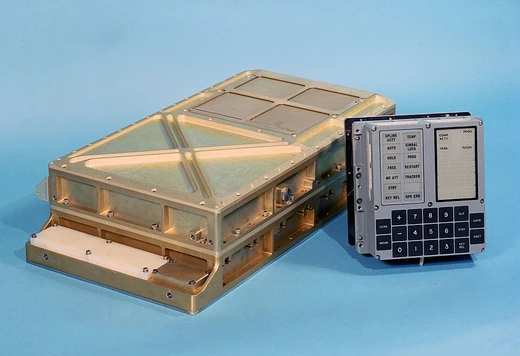
The IU supported components on its inner wall and the weight of the Apollo spacecraft above. Fore and aft protective rings, 6 inches tall and painted blue, were bolted to the channels for handling and removed during stacking. The interior is divided into 24 locations marked by numbers 1–24. Guidance, Navigation, and Control equipment included a space stabilized platform (ST-124-M3 inertial platform at location 21), a launch vehicle digital computer (LVDC at location 19), and an analog flight control computer (location 16).
Vehicle attitude is defined by roll axis (X, tail to nose), pitch axis (Y, marked +Y outside location 21), and yaw axis (Z, marked +Z outside location 3).
More in Apollo Program Hardware
Sources
Compiled from Wikipedia and the sources listed below. Text from Wikipedia is available under CC BY-SA 4.0; this entry is adapted from it.
- Wikipedia: Saturn V instrument unit (CC BY-SA 4.0).
Spotted an error? Know more?
Reader corrections go straight into our review queue. Suggest an edit · How this site is sourced