Charged Particle Lunar Environment Experiment
Apollo 14 instrument measuring low-energy charged particles on the Moon.
Last updated
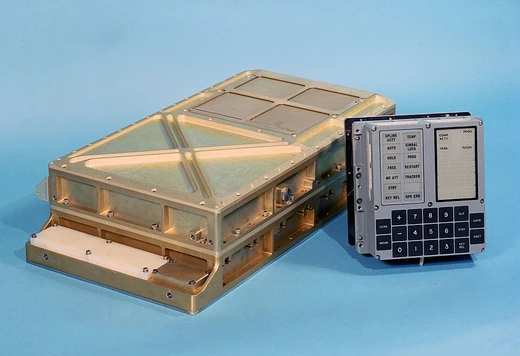
The Charged Particle Lunar Environment Experiment (CPLEE) was a lunar surface instrument deployed by the Apollo 14 mission as part of the Apollo Lunar Surface Experiments Package. It measured the energy spectra of low-energy charged particles, specifically electrons and ions with energies from 40 eV to 20 keV, striking the Moon. Its primary purpose was to study plasma particles from the Sun and the low-energy particle flux in the Earth's magnetic tail.
Quick Facts
- Mass
- 2.7 kg / 5.95 lb
- Stowed volume
- 2540 cubic cm
- Power consumption
- 3.0 W normally, 6.0 W at night
- Deployment date
- 5 February 1971
- Deployment time
- approximately 18:00 UT
- Principal investigator
- David L. Reasoner
- Original designer
- Brian J. O'Brien
Facts from the source article.
Design
The instrument had a mass of 2.7 kg, a stowed volume of 2540 cubic cm, and consumed 3.0 W of power normally, increasing to 6.0 W at night when the survival heater operated. Its core consisted of two electrostatic analyzers: analyzer A pointed toward local lunar vertical, while analyzer B pointed 60 degrees from vertical toward lunar west. Each detector had a field of view of 4 by 20 degrees; the long axis of analyzer A's field was oriented north-south, and that of analyzer B east-west.
Both detectors approximately pointed in the ecliptic plane. Each analyzer contained direction-defining slits, deflection plates, five small-aperture (1 mm nominal) C-shaped channel electron multipliers, one large-aperture (8 mm nominal) helical channel electron multiplier, and six accumulators. For a given deflection voltage, the five small-aperture multipliers counted particles of one polarity at different energies, while the large-aperture multiplier made a wide-band measurement of the opposite polarity.
In automatic mode, deflection voltages of zero (twice for background and calibration) and plus and minus 35, 350, and 3500 volts were applied for 2.4 seconds each during each 19.2-second interval. Each analyzer measured for 1.2 seconds and transmitted while the other operated. A manual mode allowed continuous application of a single deflection voltage for improved temporal resolution. Useful data provided accumulated counts of electrons and ions in 18 energy windows between 40 eV and 20 keV per 19.2-second interval.
The windows at 35 V were centered roughly at 40, 50, 65, 70, 95, and 200 eV; those at 350 V were ten times these values, and at 3500 V one hundred times. A dust cover with a 63Ni radioactive source on its underside over each aperture protected the instrument and provided calibration.
The instrument was designed by Australian Professor Brian J. O'Brien of Rice University's Department of Space Science. After O'Brien left Rice in 1968, his postdoctoral student David L. Reasoner became principal investigator. Two Rice students earned PhDs analyzing CPLEE data: Frederick J. Rich (1973) and Patricia H. Reiff (1975).
Timelines
The Charged Particle Lunar Environment Experiment (CPLEE) was set up about 3 meters northeast of the ALSEP central station. It was leveled to a 1.7-degree eastward tilt using a bubble level, and its east-west alignment was adjusted to within 1 degree using a Sun compass. The instrument was deployed around 18:00 UT on February 5, 1971, and turned on at 19:00 UT for a five-minute functional test. A checkout procedure took place the next day from 4:00 to 6:10 UT.
After the lunar module ascended on February 6 at 18:49 UT, the dust cover was removed at 19:30 UT. The experiment ran normally until April 8, 1971, when the power supply for analyzer B, which pointed away from lunar vertical, failed. Analyzer A continued operating until June 6, 1971, when its power supply partially failed, leading to intermittent operation for the rest of 1971. In 1972, it ran continuously during lunar nights but intermittently during lunar days due to high temperatures causing low voltage.
From December 1972 to February 1973, operation was continuous, after which voltage issues returned. The Apollo 14 central station lost its signal on March 1, 1975, and regained it on March 5. Further losses and reacquisitions occurred sporadically until the ALSEP program ended, including gaps in 1976 and 1977. The CPLEE was in standby mode when the ALSEP stations were shut down on September 30, 1977.
More in Apollo Program Hardware
Sources
Compiled from Wikipedia and the sources listed below. Text from Wikipedia is available under CC BY-SA 4.0; this entry is adapted from it.
- Wikipedia: Charged Particle Lunar Environment Experiment (CC BY-SA 4.0).
Spotted an error? Know more?
Reader corrections go straight into our review queue. Suggest an edit · How this site is sourced