Frequently Asked Questions
The most-asked questions about apollo 11.
What is Apollo 11 in a nutshell?
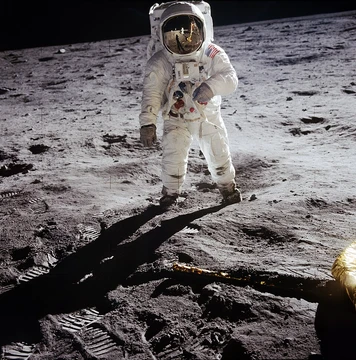
Apollo 11 was NASA's 1969 crewed spaceflight that became the first mission to land humans on the Moon. It fulfilled the goal President Kennedy set in 1961 of putting a person on the lunar surface before the decade's end.
Who were the three astronauts on the crew?
The crew was Commander Neil Armstrong, Lunar Module Pilot Buzz Aldrin, and Command Module Pilot Michael Collins. Armstrong and Aldrin walked on the Moon while Collins orbited above alone in the command module Columbia.
When exactly did the Moon landing take place?
The lunar module Eagle touched down in the Sea of Tranquility on July 20, 1969, at 20:17 UTC. Armstrong stepped onto the surface roughly six and a half hours after touchdown.
What were Armstrong's famous first words on the Moon?
His exact phrasing was "That's one small step for [a] man, one giant leap for mankind." Whether he intended the word "a" is still debated, as he later said he meant to include it but the transmission was unclear.
How long did the full mission last?
From launch on July 16 to Pacific splashdown on July 24, the flight spanned about eight days. The astronauts spent roughly 21.5 hours on the lunar surface itself.
What went wrong during the powered descent?
With about 30 seconds of fuel left, the guidance computer was overloading and the landing site had to be shifted to avoid a boulder field. Armstrong took manual control for the final stretch, and they settled with only seconds of propellant remaining.
Where can I see Apollo 11 hardware in person?
The command module Columbia is on display at the Smithsonian's National Air and Space Museum in Washington, D.C. The lunar module Eagle is housed at the National Museum of the U.S. Air Force in Dayton, Ohio.
Who was the key figure calling the shots in Mission Control?
Gene Kranz served as Flight Director, making the go/no-go calls from the Houston control room throughout the flight. His team of console controllers monitored every subsystem from launch through splashdown.
Why is it numbered 11 rather than 1?
The number simply reflects its sequential position in the overall Apollo program. Earlier flights—Apollo 1 (a 1967 pad fire), plus Apollo 4 through 10—were uncrewed or Earth-orbit test flights that built toward the first lunar landing.
Where should a newcomer start digging into Apollo 11?
NASA's official Apollo 11 archive (apollo11.aeronautics.org) gathers the original mission audio, transcripts, and photographs in one searchable location. The 2009 documentary by Todd Douglas Miller is also widely recommended for a tight, chronological retelling of the eight days.