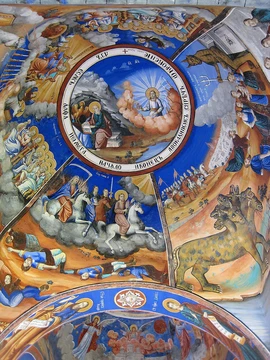
Assumption of Moses
A Jewish apocryphal testament of Moses with apocalyptic prophecies.
The Assumption of Moses, also called the Testament of Moses, is a 1st-century Jewish apocryphal work that records secret prophecies Moses revealed to Joshua before his death. It survives only in a single incomplete 6th-century Latin manuscript, and its missing portions may have described a dispute between the archangel Michael and Satan over Moses' body. The text is notable for its apocalyptic determinism and its scathing view of the priesthood.
Quick Facts
- Also known as
- Testament of Moses
- Original language
- Hebrew or other Semitic language (then Koine Greek)
- Surviving manuscript
- 6th-century Latin translation
- Manuscript discovered by
- Antonio Ceriani
- Manuscript location
- Biblioteca Ambrosiana, Milan
- Number of chapters
- 12
Facts from the source article.
Did You Know?
- The manuscript was discovered by Antonio Ceriani in the Biblioteca Ambrosiana in Milan in the mid-19th century and published in 1861.
- The text is also referred to as the Ascension of Moses.
Identification
The work is known under two titles because ancient lists such as the Stichometry of Nicephorus refer to both a Testament of Moses and an Assumption of Moses as separate texts. Ceriani and later Tromp identified the manuscript with the Assumption of Moses, citing a match between verse 1:14 and a quotation in the Historia Ecclesiastica of Gelasius of Cyzicus. Charles, however, argued for identification with the Testament of Moses, since the extant text contains only Moses' final exhortations and no assumption. He proposed that the two texts were later combined into a single work.
Relation to the Epistle of Jude
Ancient writers including Gelasius of Cyzicus and Origen cite the Assumption of Moses for a dispute over Moses' body between the archangel Michael and the devil, a scene referenced in the Epistle of Jude. This dispute does not appear in the surviving manuscript, which may support identification with the Testament of Moses or simply reflect the text's incompleteness (roughly a third is lost). An alternative explanation holds that Jude drew from three sources: general Jewish traditions about Michael as gravedigger for the just, the accusation by Michael of Azazel in the Book of Enoch, and the angel of the Lord rebuking Satan over the body of Joshua the High Priest in Zechariah 3.
Arguments for this view include Jude's quotations from 1 Enoch 1:9 and Zechariah 3, the fact that Joshua in Zechariah 3 is dead, and the example of Zechariah 3 providing an argument against slandering heavenly beings.
Content
The text comprises twelve chapters. In Chapter 1, Moses chooses Joshua as successor and entrusts him with books to preserve until the end of days. Chapters 2–5 outline Jewish history up to Hellenization under Antiochus IV in the form of foretelling. Chapter 6 predicts figures including the Hasmoneans and Herod the Great with his sons, continuing to the partial destruction of the Temple.
Chapter 7, concerning the end of days, is too fragmented to understand fully. Chapter 8 describes a great persecution by hypocrites, which some scholars read as eschatological prophecy and others, like Charles, as events before the Maccabean rebellion. Chapter 9 tells of a Levite named Taxo and his seven sons who seal themselves in a cave rather than yield to Hellenizing influences. Chapter 10 contains an eschatological hymn in which God arises, punishes the Gentiles, and exalts Israel, preceded by a messenger with sacerdotal tasks. Chapters 11 and 12 conclude with Moses exhorting Joshua not to fear, as history fulfills God's covenant.
Date, original language and themes
Most scholars date the work to the early 1st century AD, based on vaticinia ex eventu that appear familiar with the death of Herod the Great, suggesting a date between 4 BCE and 30 CE for those sections. Other scholars place it in the previous century, viewing the 1st-century references as later insertions. The extant Latin version is a translation from Koine Greek, which itself likely came from Hebrew or a text with strong Semitic influence. No theological peculiarities link the text to a specific Jewish group. Its main themes are apocalyptic determinism—history unfolding solely according to God's plan—and the figure of Moses as mediator and intercessor. The work is also noted for its scathing condemnation of the priesthood and deprecation of Temple services.
More in Apocalyptic Literature
Spotted an error? Know more?
Reader corrections go straight into our review queue. Suggest an edit · How this site is sourced