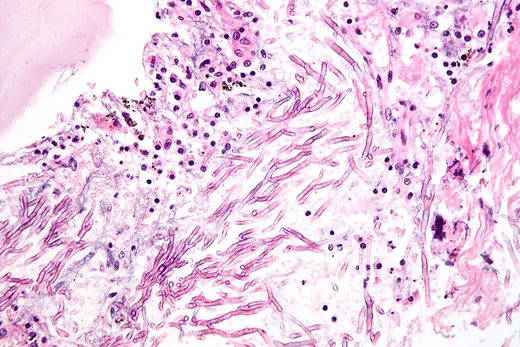
Fusarium solani species complex
A species complex of fungi causing plant and human disease.
The Fusarium solani species complex (FSSC) is a group of filamentous fungi in the division Ascomycota, family Nectriaceae, comprising at least 50 closely related species that were once considered a single morphological species. Members are common soil-inhabiting molds implicated in plant diseases as well as serious human infections such as fungal keratitis.
Quick Facts
- Genome size
- about 40 Mb
- Gc-content
- 50%
- Chromosome number
- 5-13
Facts from the source article.
Did You Know?
- FSSC has been found in larvae and adults of the picnic beetle and is a symbiote of the ambrosia beetle.
- The pathogen can persist in soil for a decade and can cause complete crop loss if unchecked.
- In the 2023 Matamoros outbreak, CDC recommended liposomal amphotericin B and voriconazole, but patients were trialed on fosmanogepix through compassionate use.
History and taxonomy
The genus Fusarium was first described in 1809. During the 1930s, Wollenweber and Reinking divided it into sections, including Martiella and Ventricosum. In the 1940s, Snyder and Hansen merged these sections into a single species, Fusarium solani, based on physical traits. This species is actually a complex of many closely related, genetically distinct but visually similar cryptic species.
It includes the sexual form Nectria haematococca, part of the Nectriaceae family. A taxonomic debate exists between lumpers and splitters. Lumpers favor a broad Fusarium genus for the entire complex, a view common among disease specialists. Splitters argue for finer distinctions based on sexual-stage features, proposing the genus Neocosmospora be expanded to cover the whole complex.
Both sides use molecular phylogeny, and their trees largely agree; the dispute is over where to set genus boundaries. As of early 2026, MycoBank mostly follows the splitter view, accepting Neocosmospora names. Species Fungorum tends to prefer Fusarium names or accepts both. Neocosmospora was originally established by Smith in 1899.
Growth and morphology
FSSC produces white, cottony colonies that become blue-green or bluish brown rather than pink or violet. The underside may be pale, tea-with-milk-brown, or red-brown, though some clinical isolates are blue-green or ink-blue. Colonies are low-floccose, loose, slimy, and sporadic. On potato dextrose agar, FSSC grows rapidly, reaching 64–70 mm in diameter in 7 days. Aerial hyphae give rise to conidiophores laterally, branching into thin, elongated monophialides that produce conidia. Macroconidia are slightly curved, hyaline, and broad, often aggregating in fascicles, typically with 3 septa but occasionally 4–5. Microconidia are oval or cylindrical, hyaline, smooth, and typically lack septa. Chlamydospores are produced under suboptimal conditions, are brown and round, 6–11 μm, with rough walls.
Physiology and biochemistry
FSSC has 5–13 chromosomes and a genome size of about 40 Mb with 50% GC-content. Mycelium is rich in alanine and fatty acids including δ-aminobutyric, palmitic, oleic, and linolenic acids. It requires potassium for growth and develops a feathery pattern when potassium is below 3 mM. It utilizes mannose, rhamnose, and sorbose preferentially. It decomposes cellulose at optimal pH 6.5 and 30 °C, and can metabolize steroids and lignin and reduce Fe3+ to Fe2+. FSSC produces mycotoxins including fusaric acid, naphthoquinones, fusarubin, javanicin, marticin, isomarticin, solaniol, neosolaniol, T-2 toxin, HT-2 toxin, and diacetoxyscirpenol. Bioassay-guided fractionation of a Neocosmospora sp. yielded three new resorcylic acid lactones (neocosmosin A, B, C) and three known ones (monocillin IV, monocillin II, radicicol), with compounds 4–6 showing good binding affinity for human opioid receptors.
Pathology
The Fusarium solani species complex, or FSSC, is generally not susceptible to common antifungal drugs. Amphotericin B and natamycin are the most effective options, though they still show limited success against severe systemic infections. Since 2006, evidence has mounted that FSSC can cause fungal infections in humans. It is linked to conditions such as disseminated disease, osteomyelitis, skin infections, fungemia, and endophthalmitis.
FSSC accounts for half of all human Fusarium infections and is responsible for most cases of systemic fusariosis and corneal infections. In immunocompromised individuals, it is a frequent cause of both disseminated and skin infections. In the southern United States, FSSC, along with the Fusarium oxysporum species complex, is the most common cause of fungal keratitis, especially during harvest season when corneal injury from dust or plant material occurs.
Fungal spores then invade the damaged cornea and can grow into the eye’s anterior chamber if untreated. FSSC is also a major cause of fungal keratitis in HIV-positive patients in Africa. By 2011, FSSC was linked to cases involving Bausch and Lomb ReNu contact lens solution; some FSSC members can form biofilms on soft lenses, but proper cleaning and overnight soaking in polyhexanide biguanide solution prevent this. In October 2022, an investigation into a meningitis outbreak of 79 cases in Durango, which killed 35 people including 34 women after cesarean sections, found four batches of bupivacaine contaminated with Fusarium solani.
As of June 1, 2023, a separate multistate meningitis outbreak linked to FSSC was ongoing among patients who received epidural anesthesia at two clinics in Matamoros, Tamaulipas, with 212 US residents at risk and two deaths.
More in Animal Fungal Diseases
Spotted an error? Know more?
Reader corrections go straight into our review queue. Suggest an edit · How this site is sourced