Angels in art
Angels in art span Christian, Islamic, and Jewish traditions.
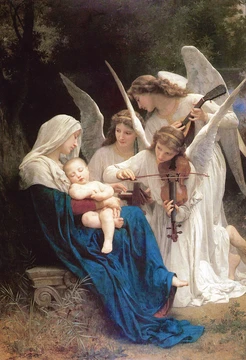
Angels in art are normally given wings and intended to be beautiful, though some depictions aim for awe-inspiring or frightening attributes, notably for cherubim and ophanim.[1] Until the 19th century, even feminine-looking angels lacked breasts and were considered genderless, a convention sometimes abandoned in later funerary art.[2]
Quick Facts
- Key islamic angelology text
- Ajā'ib al-makhlūqāt wa gharā'ib al-mawjūdāt by Zakariya al-Qazwini, 13th century
- Number of zabāniya
- 19
- Angels protecting newborns
- Senoy, Sansenoy and Semangelof
Facts from the source article.
Key facts and history
Specific ideas for portraying angels began to develop in the early Church.[3] The earliest known Christian image of an angel, from the mid-third century, shows Gabriel without wings in the Catacomb of Priscilla.[4] Representations on sarcophagi and lamps of that period also show angels without wings.[4] Flying winged angels in pairs derive from classical winged Victories.[5]
From the 5th century onward, Christian art generally represented angels with wings, as in the mosaics of Santa Maria Maggiore (432–440).[6] Amelia R. Brown suggests that Byzantine artists drew on the iconography of court eunuchs, who had light skin, lacked beards, and wore white tunics decorated with gold.[7] In the 19th century, Pre-Raphaelite painters used model Jane Burden Morris to create a prototype Victorian angel with long dark hair and androgynous features.[8] The Prince's Sarcophagus, a marble coffin unearthed near Sarigüzel close to Istanbul during the 1930s and dated to the reign of Theodosius I (379–395), contains the earliest known winged angel carvings.[5]
Byzantine artists looked to winged Greek figures like Victory and to imperial court imagery for their angel depictions.[7] In medieval art, higher-ranking angels were dressed in vivid colors, whereas lower-ranking ones wore white.[9]
What the cited sources add
Richman-Abdou notes that the first known work of art showing angels with wings dates to the 4th century, adorning the Prince's Sarcophagus found near Turkey.[10] The same source states that Northern Renaissance artists like Jan Van Eyck replaced angels' ivory or golden feathers with striking rainbow gradients.[10] Richman-Abdou explains that Neoclassical artists painted naturalistic angels as Cupid-esque cherubs and beautiful female figures, evoking earlier Renaissance models.[10] The My Modern Met account adds that Jewish modernist Marc Chagall regularly incorporated angels into his work, citing his lifelong interest in the Old Testament.[10]
The "Eros: More Than Just Cupid" source describes Eros as often depicted with a bow and arrow to make people fall in or be indifferent to love.[11]
References
- Wikipedia, "Angels in art" (CC BY-SA 4.0), which cites: Wood, Alice. Of Wing and Wheels: A Synthetic Study of the Biblical Cherubim. pp. 2–4. . (original not read by us) en.wikipedia.org
- Wikipedia, "Angels in art" (CC BY-SA 4.0), which cites: "Catholic Questions, Wise Answers", Franciscan Media, 2001, p. 10; "Can Angels Be Male or Female?", Catholic Answers (original not read by us) en.wikipedia.org
- Wikipedia, "Angels in art" (CC BY-SA 4.0), which cites: Gorgievski, Sandra. Face to Face with Angels: Images in Medieval Art and in Film, McFarland (2010); , Volume IX, No. 2, September/October 2012 (pp. 32–36); "'Angels Exist But Have No Wings, Says Church', Skye News, 20 December 2013"; Everson, David. "Gabriel Blow Your Horn! – A Short History of Gabriel within Jewish Literature", Xavier University, December 2009; Marshall, Peter and Walsham, Alexandra (editors). Angels in the Early Modern World, p. 5, Cambridge University Press (2006), (original not read by us) en.wikipedia.org
- Wikipedia, "Angels in art" (CC BY-SA 4.0), which cites: Proverbio(2007), pp. 81–89; cf. review in La Civiltà Cattolica, 3795–3796 (2–16 August 2008), pp. 327–328. (original not read by us) en.wikipedia.org
- Wikipedia, "Angels in art" (CC BY-SA 4.0), which cites: Proverbio(2007) p. 66; Marshall, Peter and Walsham, Alexandra (editors). Angels in the Early Modern World, p. 5, Cambridge University Press (2006), (original not read by us) en.wikipedia.org
- Wikipedia, "Angels in art" (CC BY-SA 4.0), which cites: Proverbio (2007), pp. 90–95; cf. review in La Civiltà Cattolica, 3795–3796 (2–16 August 2008), pp. 327–328. (original not read by us) en.wikipedia.org
- Wikipedia, "Angels in art" (CC BY-SA 4.0), which cites: "Brown, Amelia R., 'Painting the Bodiless: Angels and Eunuchs in Byzantine Art and Culture', University of Queensland (2007)" (original not read by us) en.wikipedia.org
- Wikipedia, "Angels in art" (CC BY-SA 4.0), which cites: "Homan, Roger. "Jane Burden: How a Pre-Raphaelite model changed our image of angels", The Social Affairs Unit, 14 October 2005" (original not read by us) en.wikipedia.org
- Wikipedia, "Angels in art" (CC BY-SA 4.0), which cites: "Vinycomb, John. Fictitious and Symbolic Creatures in Art, p. 30, Chapman and Hall, London(1909)" (original not read by us) en.wikipedia.org
- Richman-Abdou, "Exploring the Heavenly History of Angels in Art", My Modern Met, 2021-05-03. facts only, no text reused. mymodernmet.com
- "Eros: More Than Just Cupid – My Class: Gods and Heroes of Classical Mythology – HSA020C132H 2017-18", eportfolios.roehampton.ac.uk. facts only, no text reused. eportfolios.roehampton.ac.uk
Each numbered sentence above was checked against the source it cites before publication. Sentences citing Wikipedia adapt text from the English Wikipedia article Angels in art (contributors), used under CC BY-SA 4.0; this entry is available under the same licence. Other sources were used for facts only; no text or images are copied from them.
More in Angels in Art
Spotted an error? Know more?
Reader corrections go straight into our review queue. Suggest an edit · How this site is sourced