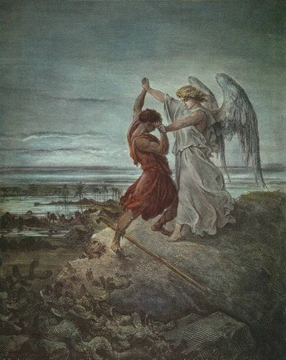
Liberation of Peter
An angel frees Peter from Herod's prison.
The liberation of the apostle Peter is an event described in chapter 12 of the Acts of the Apostles, in which Peter is rescued from prison by an angel. Although the account is brief, it has prompted theological discussions and inspired numerous artworks.
Quick Facts
- Biblical book
- Acts of the Apostles
- Chapter
- 12
- Key figures
- Peter
- King Herod
- Rhoda
- Mary (mother of John Mark)
- Festival date (roman rite)
- 1 August
- Festival date (orthodox)
- 16 January
Facts from the source article.
Did You Know?
- Loveday Alexander describes this episode as one of the most sensational in Acts, noting greater dramatic tension than in the earlier prison escape in Acts 5:18–19.
- Peter was sleeping peacefully despite his perilous situation.
Biblical narrative
Herod had Peter thrown into prison. The evening before he was to be tried, an angel came and ordered him to leave. Peter’s chains dropped off, and he followed the angel out, believing he was seeing a vision. The prison gates swung open on their own, and the angel guided him into the city. Then the angel vanished. Realizing it was real, Peter went to the home of Mary, John Mark’s mother. A servant girl named Rhoda heard him at the door but was so thrilled that she ran inside to tell everyone, forgetting to let him in. Finally they opened the door, and Peter explained how the Lord had freed him. When Herod learned of the escape, he had the guards executed.
Theological significance
F. F. Bruce argues that direct divine intervention is strongly indicated in this narrative. He contrasts Peter's escape with the earlier execution of James the Great by Herod, noting that why James should die while Peter should escape is a mystery of divine providence. James B. Jordan suggests the incident is portrayed as a type of resurrection for Peter, recapitulating the resurrection of Jesus. Amy-Jill Levine and Marianne Blickenstaff relate the disbelief of Rhoda's message to Luke 24:1–12, where disciples refused to believe the resurrection news brought by women.
Veneration
Churches dedicated to Saint Peter in Chains exist in Rome, Pisa, London, Birżebbuġa in southern Malta, Tollard Royal in the UK, Cincinnati, and Wheelersburg, Ohio. The Roman church claims to hold the chains that fell from Peter. The relic of his chains was originally kept in Jerusalem, where pilgrims venerated it. In the fourth century, Patriarch Juvenal gave the chains to Empress Eudocia, who took them to Constantinople. She later sent a portion to Rome with her daughter Licinia Eudoxia, who built the church of S. Petrus ad Vincula on the Esquiline Hill to house it. Chains from Peter’s imprisonment under Nero were also placed there.
Festivals
The traditional festival of Saint Peter in Chains was on 1 August, with a collect asking God to deliver the faithful from the bonds of their sins as he delivered Peter. It was included in the pre-1962 General Calendar of the Roman Rite. Traditional Roman Catholics continue to celebrate it as a Greater-Double or Double Major feast. In the Orthodox Church, the feast is observed on 16 January.
More in Angelic Apparitions in the Bible
Spotted an error? Know more?
Reader corrections go straight into our review queue. Suggest an edit · How this site is sourced