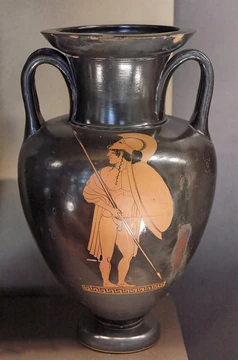
Alabastron
A small ancient vessel for perfumes and oils.
An alabastron is a small, tapering or pear-shaped vessel without feet, used for holding perfumes or massage oils. Its name may derive from the alabaster stone from which early examples were made, though the direction of the naming is uncertain.
Quick Facts
- Earliest known mention
- Herodotus
- Spread to greece
- Around the 7th century BC
- Common materials
- alabaster
- stone
- terra-cotta
- glass
- gold
- Height of silver alabastra
- 12–16 cm / 0.394–0.525 ft
Facts from the source article.
Did You Know?
- The quadrilingual 'Caylus Vase of Xerxes' alabastron with Egyptian hieroglyphs was used in the 19th century for deciphering ancient cuneiform scripts.
- Similar vases include the Jar of Xerxes I and the Yale Babylonian Collection Alabastron Vessel.
History
The earliest known written record of these perfume containers comes from Herodotus, who noted a myrrh alabastron among the gifts the Persian ruler Cambyses II sent to the Ethiopian king. The stone alabastrites, according to Pliny the Elder, took its name from a town called Alabastrum near Thebes in Upper Egypt. Some researchers identify this town with the modern Stone Village close to Tell el-Amarna, while the nearby settlement of Hebenu is also called Alabastron.
The container’s distinctive shape, featuring two lug handles, first emerged in Egypt near the end of the Middle Kingdom and persisted through the New Kingdom. After the Late Bronze Age, alabastron-shaped vessels reappeared in Egypt during the latter half of the eighth century and grew widespread by the 26th Dynasty. They also appeared in Assyrian lands and along the Levantine coast. A glass alabastron from the reign of Sargon II is the earliest known example. From the seventh century onward, alabastra spread throughout the Mediterranean and into ancient Greece.
Description
These containers were originally crafted from alabaster, particularly the onyx-alabaster variety, though it is uncertain whether the vessels were named after the material or the material after the vessels. They can also be made from stone, terra-cotta, glass, and even gold. Most types have a narrow body with a rounded end, a narrow neck, and a broad, splayed mouth. Many lack handles, but some have ear-shaped projections or lugs with holes for strings to aid mobility.
Later glass designs were decorated with scallops, festoons, or abstract patterns of rings or zigzags. Around the 7th century BC, alabastra spread to Greece as part of the orientalizing phenomenon, with Lydia and Anatolia also playing a role in production. Three distinct Greek types exist: a basic Corinthian bulbous shape about 3–4 inches tall; a long, pointed version common in eastern Greek, Etruscan, and Italo-Corinthian pottery; and an Attic type about 4–8 inches long with a rounded base and lugs.
Alabastra also appeared in Assyria, Syria, and Palestine, and were traded by Greek and Phoenician merchants as far as Italy and the western Mediterranean. Glass varieties were produced on Cyprus and Rhodes, where Phoenician activities are attested. In Lydia, precious metal alabastra are known from the sixth century BC. Greek artisans produced elaborately decorated silver alabastra, long and narrow, 12–16 cm in height, with bodies divided into four horizontal zones by ornamental bands.
An alabastrotheca was a box or holder used to store alabastra or keep them upright, as their rounded bottoms prevented them from standing alone.
More in Ancient Greek Pot Shapes
Spotted an error? Know more?
Reader corrections go straight into our review queue. Suggest an edit · How this site is sourced