Frequently Asked Questions
The most-asked questions about ancient greek military equipment.
What does 'ancient Greek military equipment' actually encompass?
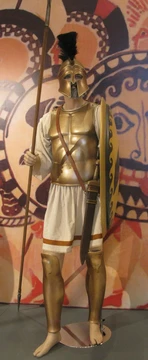
It refers to the weapons, armor, shields, and tactical gear used by Greek city-states and their armies roughly from the 8th century BCE through the Hellenistic period. The term covers everything from the iconic bronze hoplon shield and Corinthian helmet to lighter peltast kit, cavalry barding, and naval boarding tools.
Who are the most famous figures associated with Greek military gear?
The hoplite citizen-soldiers of Sparta and Athens are the most recognizable, but Alexander the Great's Macedonian phalanx and his personal panoply are equally iconic. Figures like Leonidas at Thermopylae and the generals of the Peloponnesian War also anchor most discussions.
What is the single most recognizable piece of Greek military equipment?
The round bronze-rimmed hoplon shield, often paired with the crested Corinthian helmet, is the visual shorthand for Greek warfare. Together they form the standard hoplite silhouette seen on countless vases and in modern popular culture.
Where should a beginner start if they want to learn about this topic?
A good entry point is understanding the hoplite as the central infantry type, then branching out into lighter infantry, cavalry, and naval forces. From there, studying the major battles of the 5th and 4th centuries BCE gives concrete context for how the gear was actually used.
What materials were Greek soldiers primarily working with?
Bronze dominated the early and middle periods for helmets, greaves, spear tips, and shield rims, while iron gradually replaced it for swords and some armor components. Leather, linen, and wood made up the structural base of most equipment.
How did equipment differ between Greek city-states?
While the core hoplite kit was broadly shared, Sparta favored a more uniform, state-issued look with the distinctive red cloak and simpler helmet, whereas Athenian gear often carried civic insignia and richer decoration. Regional variations also appeared in shield shapes, helmet styles, and the use of lighter peltast-type equipment.
What is a peltast and how did their gear differ from a hoplite's?
A peltast was a light infantryman who carried a smaller, lighter shield called the pelte, a short spear or javelin, and minimal body armor. This made them faster and more versatile than the heavily armored hoplite, and they became increasingly important from the 4th century BCE onward.
What role did the Greek navy play in military equipment?
The trireme was the dominant warship, and its equipment included boarding axes, rams, and the gear needed to operate the oars and sails. Naval warfare was a distinct branch with its own specialized tools, separate from the land-based hoplite and cavalry arsenals.
Which battles are most associated with Greek military equipment?
Marathon (490 BCE) and Thermopylae (480 BCE) are the most frequently cited, as they showcase hoplite phalanx tactics at their peak. Later, Chaeronea (338 BCE) demonstrated the shift toward the Macedonian sarissa phalanx, marking a major evolution in Greek-adjacent military technology.
How did Greek military equipment evolve over time?
Early Archaic gear was relatively simple and individually owned, but by the Classical period city-states could outfit standardized hoplite units. The Hellenistic era saw the rise of the longer sarissa, heavier cavalry armor, and siege technology, reflecting the shift from citizen militias to professional standing armies.