Luxor Obelisks
Pair of Ramesses II obelisks, one in Paris, one in Luxor.
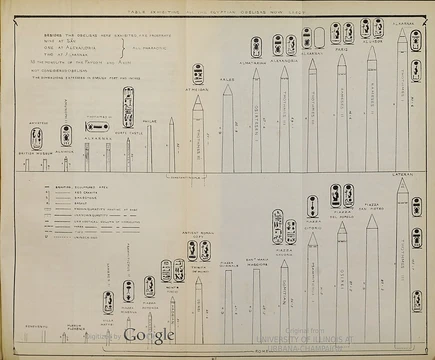
The Luxor Obelisks are a pair of ancient Egyptian obelisks, over 3,000 years old, originally carved to stand at either side of the portal of the Luxor Temple during the reign of Ramesses II around 1250 BC. The western stone, 23 meters high, was gifted to France in the 1830s and now stands in the Place de la Concorde in Paris, while the eastern obelisk remains at its original location in Egypt. The Paris obelisk was classified as a monument historique in 1936.
Quick Facts
- Height of paris obelisk
- 23 m / 75 ft 6 in
- Date of carving
- c. 1250 BC
- Original location
- Luxor Temple portal
- Year gifted to france
- 1830s
Facts from the source article.
Together in Egypt
The Luxor Temple existed for about 150 years before Ramesses II added the two obelisks during his renovations. Each obelisk was carved from a single red granite block quarried roughly 100 miles south of Luxor in Aswan, transported on a specially built barge, and lowered into position using ropes and sand. The two stones differed slightly in height, with the one still in Luxor being taller; the shorter obelisk was placed on a taller pedestal and set farther from the pylon, possibly to make them appear equal height to an approaching viewer. The remaining Luxor obelisk leans, while the Paris obelisk has an ancient fissure that was repaired in antiquity. Both obelisks have slightly convex eastern and western faces, a feature found on no other ancient obelisks and whose purpose is unknown. Hieroglyphic text in sunken relief covers all four sides of each obelisk.
Luxor Obelisk in Paris
The idea of moving the Luxor Obelisks to Paris first emerged during Napoleon's Egyptian campaign. In March 1799 General Louis-Charles-Antoine Desaix wrote to Napoleon about two obelisks in Thebes that would be extraordinary in Paris. Vivant Denon's 1802 travelogue also raised the possibility of bringing them as a trophy. In October 1800 Jean-Marie-Joseph Coutelle presented technical plans for transporting and erecting one obelisk at the Place de la Concorde, but these plans lapsed with the campaign's end.
In the 1820s Charles X, who opened an Egyptian Museum, sought an obelisk; Jean-François Champollion, after seeing the Luxor obelisks, urged the government to acquire them. In November 1830 Muhammad Ali Pasha of Ottoman Egypt gave the Luxor obelisks to France, reversing an earlier gift to the British, who instead received the obelisk of Hatshepsut from Karnak Temple—a stone Champollion knew was impractical to remove. French diplomat Baron Isidore Justin Séverin Taylor finalized the gift despite Charles X having been overthrown.
France later gave the Ottomans a mechanical clock, the Cairo Citadel Clock, which has rarely worked; in 2021 Egypt announced efforts to repair it. In 1981 President François Mitterrand renounced French possession of the second obelisk, restoring its ownership to Egypt.
Modern events
On 1 December 1993 AIDS activists covered the Paris obelisk with a giant pink condom for World AIDS Day. That same year the monument was covered by a replica trophy for the 1998 World Cup. In 2015 Milène Guermont's interactive sculpture PHARES stood beside the obelisk, designed to illuminate it.
More in Ancient Egyptian Obelisks
Spotted an error? Know more?
Reader corrections go straight into our review queue. Suggest an edit · How this site is sourced