
Kernavė
Medieval capital of the Grand Duchy of Lithuania.
Last updated
Where it is
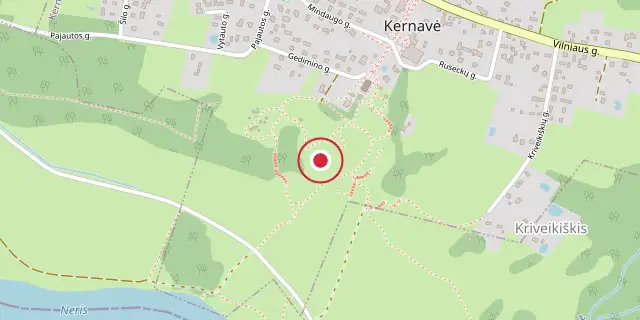
Coordinates: 54°52′59″N 24°51′00″E (54.8830, 24.8500) · Open in OpenStreetMap
Coordinates and connected clubs: the infobox of Wikipedia: Kernavė (CC BY-SA 4.0). Map: drawn by Codexery from OpenStreetMap tiles.
Kernavė, a small town in southeastern Lithuania’s Širvintos district, sits on the right bank of the Neris River. Once the medieval capital of the Grand Duchy of Lithuania, it now draws tourists and archaeologists alike. As of 2021, its population was 238. The site became a Lithuanian state cultural reserve in 1989 and was added to the UNESCO World Heritage list in 2004.
The town lies on the upper terrace of the Neris, about 21 kilometers from Širvintos and 35 kilometers from Vilnius. It is near the Vilnius–Kaunas and Vilnius–Panevėžys highways, and can also be reached from Vilnius by boat along the Neris. Over time, it has been known by various names: Kernavos, Kernovo, Kiernowo, Kiernów (in Polish), and Kernuvke (in Yiddish).
History
People first settled the area sparsely at the end of the Paleolithic era, with more settlements appearing during the Mesolithic and Neolithic periods. Kernavė served as the first capital of Lithuania, a symbol of statehood and pagan independence. It was first mentioned in written records in 1279, when the Teutonic Knights besieged it while it was the seat of Grand Duke Traidenis. This event appears in the Livonian Rhymed Chronicle and later in Hermann von Wartberge’s Cronicon Livoniale.
In 1390, during the Lithuanian Civil War, the knights burned the town and its buildings in the Pajauta valley, including the castle. After that, the town was not rebuilt; residents moved to the hilltop instead of staying in the valley. Over time, an alluvial layer covered the remains, forming wet peat that preserved many relics. This has made the site a treasure for archaeologists, who sometimes call Kernavė the “Troy of Lithuania.”
Among its finds is the oldest known medgrinda—a secret underwater road paved with wood, used for defense and dating from the 4th to 7th centuries. In 1613, the town appeared on a famous map of the Grand Duchy of Lithuania, Magni Ducatus Lithuaniae, et Regionum Adiacentium exacta Descriptio, printed in Amsterdam and funded by magnate Mikołaj Krzysztof Radziwiłł. Interest revived in the mid-19th century after romantic writer Feliks Bernatowicz set his novel Pojata, córka Lizdejki there.
The hillforts were soon excavated by the Tyszkiewicz brothers and later by Władysław Syrokomla in 1859. After World War II, Vilnius University resumed excavations in 1979, followed by the Lithuanian Institute of History from 1980 to 1983. The State Cultural Reserve of Kernavė was formally created in 2003.
The church
Near the present-day church lies the churchyard of older churches. The foundations of a church built in 1739 have been excavated; that wooden structure was moved to Krivonys in 1935. A concrete monument with a cross, erected in 1930 for the 500th anniversary of Vytautas’s death, marks the site of the Vytautas Church built in 1420. From the 15th to the 19th century, the people of Kernavė were buried in this churchyard.
Two chapels stand nearby. The wooden chapel, an example of folk architecture, is thought to have been built at the end of the 13th century on the Kernavelė estate and later moved to the Kernavė church. By the end of the 19th century, it was used as a storehouse. After a new church was built in 1920, the chapel fell into decay.
It was repaired in 1959 and restored in 1993–1994. Now belonging to the Kernavė parish, it displays wooden church sculptures. The brick chapel, built between 1851 and 1856 by landowner Stanisław Romer, serves as a mausoleum for the Romer (Riomeriai) family. It is an example of late classicism, with an unusual octagonal plan.
Inside, an opening in the floor leads to a crypt where coffins were bricked into niches. The stone altar mensa survives, along with black benches along the walls and memorial plaques bearing the family’s coat of arms and names. After World War I, the chapel was neglected; it was repaired in 1959 and again in 1987. It now belongs to the Kernavė parish.
Both chapels sit within the Kernavė archaeological and historical reservation. The current church, built between 1910 and 1920, features Neo-Gothic elements. In the 1980s, Monsignor Česlovas Krivaitis oversaw repairs to the churchyard, new gates, and restoration of the altar and interior. The churchyard is decorated with Stations of the Cross by artist Jadvyga Grisiūtė.
Two monuments commemorate the 600th anniversary of Christianisation and the 700th anniversary of Kernavė’s first written mention. One shows a hearth and a sword, symbolizing the shift from Paganism to Christianity; the other depicts a knight with a sword standing between city gates, a key part of the town’s coat of arms.
Millstones are built into both monuments. Near the 700th-anniversary monument lies the grave of Nikodemas Švogžlys-Milžinas, a priest, writer, and promoter of Kernavė’s history. The church also houses several valuable artworks.
More in Ancient Cities
Sources
Compiled from Wikipedia and the sources listed below. Text from Wikipedia is available under CC BY-SA 4.0; this entry is adapted from it.
- Wikipedia: Kernavė (CC BY-SA 4.0).
Spotted an error? Know more?
Reader corrections go straight into our review queue. Suggest an edit · How this site is sourced