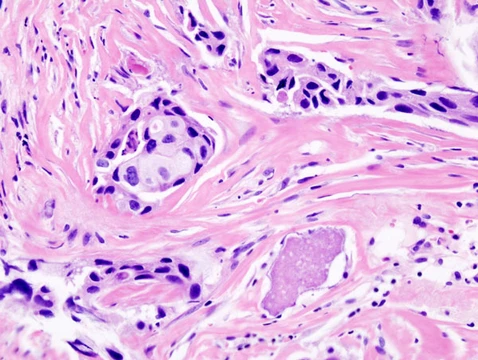
Adenoma
Benign glandular tumor with potential for malignant transformation.
Last updated
An adenoma is a benign tumor of epithelial tissue with glandular origin or glandular characteristics. Although benign, adenomas are considered pre-cancerous and may transform into adenocarcinomas over time. They can cause serious health complications through mass effect or unregulated hormone production.
Quick Facts
- Field
- Oncology
Facts from the source article.
Histopathology
Adenoma is a benign tumor of glandular tissue, such as the mucosa of stomach, small intestine, and colon, where tumor cells form glands or gland-like structures. In hollow organs, the adenoma grows into the lumen as an adenomatous polyp, which may be pedunculated or sessile. The proliferation shows cell dysplasia, irregular cells with hyperchromatic nuclei, stratified or pseudostratified nuclei, nucleolus, decreased mucosecretion, and mitosis; architecture may be tubular, villous, or tubulo-villous, while basement membrane and muscularis mucosae remain intact.
Locations
Adenomas of the colon, also called adenomatous polyps, are prevalent and commonly found at colonoscopy; they are removed due to tendency toward malignancy. Ashkenazi Jews have a 6% higher risk of adenomas and colon cancer, warranting regular colonoscopies. Renal adenomas are small, asymptomatic, and derived from renal tubules, possibly precursor to renal carcinoma. Adrenal adenomas are common incidental findings; about one in 10,000 is malignant, so biopsy is rarely needed for homogeneous lesions under 3 cm.
Some adrenal adenomas secrete cortisol (Cushing's syndrome), aldosterone (Conn's syndrome), or androgens (hyperandrogenism). Solitary thyroid nodules occur in about one in 10 people; biopsy often confirms adenoma, but follicular type may require excision. Pituitary adenomas occur in 10% of neurological patients; prolactinoma, the most common subtype, is more frequent in women and often diagnosed during pregnancy; medical therapy with cabergoline or bromocriptine suppresses prolactinomas.
Parathyroid adenomas may cause primary hyperparathyroidism. Hepatic adenomas are rare and may present with hepatomegaly. Breast adenomas are called fibroadenomas, often very small and asymptomatic; treatments include needle biopsy or removal.
Treatment
Response to detecting an adenoma varies by type and location; physicians can typically anticipate growth rates. Common responses include surgical removal and monitoring according to established guidelines. For example, after removing one or two adenomatous polyps from the colon in a patient with no particular risk factors, best practice is to resume surveillance colonoscopy after 5–10 years rather than more frequently.
More in Anatomical Pathology
Sources
Compiled from Wikipedia and the sources listed below. Text from Wikipedia is available under CC BY-SA 4.0; this entry is adapted from it.
- Wikipedia: Adenoma (CC BY-SA 4.0).
- Word definitions: the , each quoted from its Wikipedia article.
Spotted an error? Know more?
Reader corrections go straight into our review queue. Suggest an edit · How this site is sourced